Thursday, February 11, 2016

Gems from the Black Press: Arkansas Weekly Mansion


This article is part of a series  of articles whose purpose is to share each week an interesting article from early black publications of the late 19th and early 20th centuries. As previously noted,the articles found inside of these long forgotten publications contain rich history that reflect  the early years of African America life in the first decades of freedom. Some are publications of fraternal or benevolent societies, and some were more community based. All  pieces shared in this series provide a close up to history and culture of times long past.


Today's Focus:

Arkansas Weekly Mansion
Editor's Notes

The Arkansas Weekly Mansion was a weekly publication based in Little Rock Arkansas. Like many African American publications, news from around the country pertaining to "the race" was often presented in the weekly editions. Ancestry has , one edition of this publication digitized. The issue is from 1883, and it presents an interesting glimpse of life around the country.


I looked at the column entitled "Editor's notes" and found a fascinating list of simple news bullets from around the nation. Image from the edition is here below, followed by a transcription of the notes.


Mrs. Mary A. Shadd Cary has graduated in law from Howard University. (Afro-American)


The board of bishops A.M.E. Church meets in Chicago June 27.

Cadet Whitaker’s father died recently in Kershaw County, South Carolina.

Mr. Theodore Sterrett, father of the wife of historian George W. Williams, died recently in Minneapolis Minn. He was formerly barber at the Galt House, Louisville Kentucky.

James T. Rapier, formerly a member of Congress, died in Montgomery Alabama, May 31.

Mr. McCabe, the colored state auditor of Kansas, is conducting his office with great credit to himself and profit to the state.

Dr. Jenifer writes to the Christian Recorder, that he has cancelled the $10,000 on the Charles Street and the $666 mortgage on the old Anderson street churches.

A large mass meeting of the citizens of Louisville has endorsed the meeting of the convention in that city, and pledged a “generous Kentucky welcome” to all comers.

Chicago has two colored medical graduates this year—Messrs. D.  H. Williams, and J. W. Henderson. There is a colored section boss names Washington Turner, in the employ of the Illinois Central railroad, who has a working gang of sixty-five colored men.

Thomas F. Cassells, colored has entered on his duty as collector on the port of Memphis.

John H. Alexander, the colored youth recently appointed cadet at West Point, from Ohio, is son of an old man “Jim” Alexander formerly of Helena Ark., and well known to the citizens of the state. James M. Alexander Sr. was a member of the legislature in Clayton times.

The state teacher’s association meets at the operahouseat (sic)the capitol June 27, 28, & 29. A fine programme (sic) will be presented.  

The colored men of the Cherokee nation have protested against the recent action of the Cherokee nation in declaring that the large amount of money received from the government shall be distributed only to Cherokees by blood.

Judge Gedders, democratic candidate for governor of Ohio, held a competitive examination at Elyrea (sic) for appointment to a cadetship at West Point, which resulted (see remaining text below)


in a tie. The Judge requested that the two candidates shall be re-examined at West Point with the understanding that the winner will get the appointment. The winner, a colored student from Oberlin, named Alexander was appointed. “The world do move.”

J. S. Harris city editor of the Kansas City Enterprise is compiling a book to be entitled, “The Prominent Colored Men of the West.”

Rev. J.W. Asbury, a colored minister is nominated for registrar of state lands in Kentucky.
George Bentley, (col.), porter of the Fourth National Bank of Grand Rapids Mich., recently robbed the bank of $1500.

The richest colored man in America is Mr. Aristide Marie of New Orleans who owns several large stores opposite the custom house, and has a yearly income of $50,000. He spends (illegible text)
(partially illegible paragraph…)

…We have received a copy of (illegible)…called “Poetic Gems” by R (? Text not visible) Attorney at law, Charlotte, (illegible). It contains a number of poems, (Illegible) etc. by the author, some of decided merit.

The Grand Lodge of Colored Freemasons of Georgia, has purchased a site on Gwinnett Street, Savannah, and proposes to erect a “fine three-story temple”. The cornerstone will be laid June 25th.

J. H. H. Longstark, of the Savannah Echo, translates the annexed from the Georgia Familiar Journal:  The present negro population of the United States is between 6,500.000 and 7,000,000. They have increased during the last decade thirty-five percent. If the white population is not increased by emigration, and the colored people keep on at this rate, the negro will have at the end of one hundred years from now a majority of 12,000,000.

Messrs. Palesser, Paleser, & Co., of Bridgeport Conn., have lately issued a sheet containing plans and specifications for a handsome modern six or eight room cottage, which is worth examining by anyone intending to build. The same firm furnishes specifications in blank for any class of residence which are of great practical value and convenience.

Hon. Wm. T. Brown formerly Superintendent of Education in Louisiana died at New Orleans May 15.

Mr. Tully Con, a great under-ground R.R. man in the olden times died in St. Francis Co., recently.

In the New York Globe, Col. Williams, the historian moves that “an American Negro Historical Society” be created. We second the motion.


As can be noticed, the editor often made his own remarks about observations that he shared from other publications. His remarks made after the small piece about the young Alexander being appointed to West Point speaks to the sentiment of the editor and the readership: "The world, do move." Following the suggestion of historian Col. Williams who suggested that a national historical society be formed, a "Negro Historical Society" again the editor voiced his own sentiment: "We second the motion."

As a researcher who also studies Oklahoma and Indian Territory history I was pleased to see an article reflecting the voices of protest expressed by Cherokee Freedmen, regarding their treatment by the Cherokee Nation by a move to exclude them from national funds, based on color. And the information about the young man who earned the appointment at West Point encourages me to pursue more details about the young man, and to see if more can be learned of his career.

Items such as these tiny snippets from the early Black press, provide a closer glimpse into the lives of our forefathers and mothers and the readers can glean a sense of pride seldom reflected in other pieces from the press in the same era.

Wednesday, January 27, 2016

Gems from the Black Press: The 1920 Negro State Fair, of Oklahoma

This article is part of a series  of articles whose purpose is to share each week an interesting article from early black publications of the late 19th and early 20th centuries. As previously noted,the articles found inside of these long forgotten publications contain rich history that reflect  the early years of African America life in the first decades of freedom. Some are publications of fraternal or benevolent societies, and some were more community based. All  pieces shared in this series provide a close up to history and culture of times long past.
************************************


The Tulsa Star. (Tulsa, Okla.) October 9, 1920, Weekly Mail Edition, Page 1
Accessed from: Chronicling America, Historic American Newspapers, Library of Congress

In the early first half of the 20th century, life in the new state of Oklahoma was a fascinating place to be. Although segregation had worked its way into what was once Indian Territory, there was still an amazing and thriving, self-supporting Black community. A fascinating article from the Tulsa Star from October 1920 reflects much of the spirit of the Oklahoma African American population.

During that time, North Tulsa and the Greenwood District was thriving, black towns numbered more than two dozen, and the future looked bright for this state once a part of the western frontier. The article of October 9, 1920 provides and amazing glimpse into early Oklahoma Black life, especially before the 1921 racial disturbance when the Greenwood District was attacked.

The event was the Negro State Fair, scheduled to unfold in Wewoka, Oklahoma. The fair was a four day event taking place on the ranch of J. Coody Johnson, a leader in the Freedmen Community in Wewoka. and was expected to draw people from throughout the state.  The Negro Fair was widely celebrated and accepted by officials of the state. The fair was directed primarily to the African American population, as was clearly spelled out in the article.


The fair was endorsed by the larger community, and a presence from the entire state of Oklahoma was anticipated! Schools were closed for two days with permission of the State Superintendent. Also for entertainment there were exhibits and for the daring, flights in an airplane were also available. This was amazing during an era when air traffic was not frequent.


The fair was organized by attorney, and rancher J. Coody Johnson, known to have been a strong advocate for Seminole Freedmen. He was a wealthy man by the early 1900s and his land was used for the state event. He was assisted by Mrs. Julia Davidson of Wewoka who served as secretary for the event.

 
The Tulsa Star. (Tulsa, Okla.) October 9, 1920, Weekly Mail Edition, Page 4
Accessed from: Chronicling America, Historic American Newspapers, Library of Congress

Organizers of the Negro State Fair, Wewoka, Oklahoma


It is not known how often the fair was held after the event of 1920. But it is quite clear that this is an event that should be noted as one in which the members of the Oklahoma Black community  sought to honor their own accomplishments, and to celebrate their successes during those four memorable days in 1920. 
****************************

Monday, January 18, 2016

Gems From the Black Press: La Quasima Club of Columbus & the Social Event of the Season

Gems from The Black Press: This article is part of a series  of articles whose purpose is to share each week an interesting article from early black publications of the late 19th and early 20th centuries. As previously noted,the articles found inside of these long forgotten publications contain rich history that reflect  the early years of African America life in the first decades of freedom. Some are publications of fraternal or benevolent societies, and some were more community based. All  pieces shared in this series provide a close up to history and culture of times long past.
********


Today's focus:
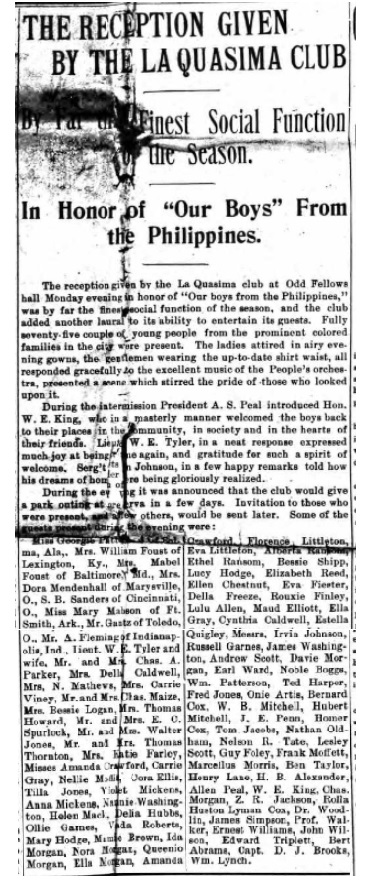
The Reception Given by the LaQuasima Club
from: The Columbus Standard


In 1901 the Columbus Standard was said to be the leading newspaper for Afro-Americans in the state of Ohio. An online article from July 1901 describes an interesting social event that was said to the the social event of the season for the Black community, in Columbus Ohio.

Source:Ancestry.com. U.S., African American Newspapers, 1829-1947 [database on-line]. Provo, UT, USA: Ancestry.com Operations, Inc., 2013. This
collection was indexed by Ancestry World Archives Project contributors.

Original data: Negro Newspapers for the American Council of Learned Studies. Washington, D.C.: The Library of Congress.

Apparently the event was honoring men who had been serving in the US military and had been involved actively in the conflict in the Philippines. The reference to "Our Boys" is reflecting the men returning from conflict.  Little is seen in the press of how returning service men of color were received upon return from service, especially after the Spanish American conflict. These returning soldiers were returning from time served in the Spanish American War and specifically from the Philippine Islands.

The event unfolded at the Odd Fellows Hall in Columbus, and a list of attendees was included in the article. It was clearly described as a major society event, for the article pointed out that seventy-five couples of young people from "the prominent colored families in the city were present." (1) I was quite surprised to note that among the guests whose names were published was a resident of my own hometown, of Ft. Smith Arkansas as well.

The article described the event where the ladies were "attired in airy evening gowns, the gentlemen wearing the up-to-date shirt waist, all responded gracefully to the music of the people's orchestra, presented a scene which stirred the pride of those who looked upon it."

Beyond this being a simple description of a social event, such an article is quite useful in terms of providing today's reader with an interesting glimpse into the social life of an African American community at the turn of the 20th century. Clearly there was an "elite" portion of the population with the reference to the "prominent" families in attendance. At the same time there was an orchestra more than likely a black orchestra in Columbus at that time as well.  The article is also full of names of many who were in attendance, and this can be an interesting way of looking at a portion of the population almost as a Who's Who list of the Black Columbus at that time, and it provided a wonderful glimpse about he ways in which the Columbus Black community socialized. 

The very existence of the La Quasima club is something for those with ancestral ties to Columbus to explore.
What was the origin of this club?
How long did it last?
Did it evolve into something that still exists today?

And there is also the Odd Fellows Hall. Was this a G.U.O. O. F. building? (Grand United Order of Odd Fellows?) Does the building still stand today?

Articles such as this one from the Columbus Standard provide that opportunity to give readers even 100 years later a flavor of life in the community at that time.

Tuesday, January 12, 2016

Gems from the Black Press: Race News from The Colorado Statesman

Welcome back to Gems from the Press!

The purpose is to share each week an interesting article from early black publications of the late 19th and early 20th centuries. As previously noted,the articles found inside of these long forgotten publications contain rich history that reflect  the early years of African America life in the first decades of freedom. Some are publications of fraternal or benevolent societies, and some were more community based. All provide close ups to history and culture of times long past.


Today's Focus:
"Race News"
From: The Colorado Statesman, June 1900

Source:Ancestry.com. U.S., African American Newspapers, 1829-1947 [database on-line]. Provo, UT, USA: Ancestry.com Operations, Inc., 2013. This collection was indexed by Ancestry World Archives Project contributors.
Original data: Negro Newspapers for the American Council of Learned Studies. Washington, D.C.: The Library of Congress.


By 1900, it was becoming common in the press for publications to provide snippets of news pertaining to "the race" in their regular publications. An interesting column appeared in The Colorado Statesman in 1900. These brief often 1-sentence statements still provide an interesting glimpse into the African American community and how it viewed itself and the progress of the community.

This particular issue of the Colorado Statesman, also included interesting articles about noted leaders in the community, such as the leading article about educator Booker T. Washington. 

The column "Race News" caught my attention and I am compelled to share pieces of the column here:

Source:Ancestry.com. U.S., African American Newspapers, 1829-1947 [database on-line]. Provo, UT, USA: Ancestry.com Operations, Inc., 2013. This collection was indexed by Ancestry World Archives Project contributors.
Original data: Negro Newspapers for the American Council of Learned Studies. Washington, D.C.: The Library of Congress.


Transcription:
St. Louis has a Negro Tobacco worker's Union
* * * 
There are two savings banks in Richmond VA., owned and operated by colored men.
* * * 
The colored people of Mississippi are preparing the build a cotton factor at Jackson.
* * * 
Mr. L.E. Perry owns and operates a mattress factory at St. Joseph Mo., employing members of his race exclusively.
* * * 
Lieut. Gov. Caldwell  appointed a young Afro-American from the orphan's home at Cincinnati as a page  in the Ohio legislature.
* * * 
There are about 20 colored teachers in the mixed schools of greater New York, and some of them have classes where there is not a single colored child.
* * * 
The United States Commission to the Paris Exposition of 1900 has assigned space in the Social Economy building to be used for the exhibit of the present condition of the Afro-American.
* * * 
It is said that no race rises higher than the morals of its woman. If this be true, our women should put forth every endeaver(sic) to rise to the highest moral standard that is possible for them to rise. By thus rising they will draw the whole race up with them.
* * * 
In the state of Maryland, there are 5,000 colored men engaged in mercantile businesses on their own account. Many are successful farmers in the various counties of the State. Some engaged in blacksmithing, wheelwrights, and carpenters.
* * *
J.H. Hall of South Glastonbury Conn., who owns extensive peach and plum orchards, in Georgia, in testifying before the Industrial Commission one day last week said, "Negro labor employed on his plantations in Georgia was as cheap and efficient  as white labor in New England."

******************************************************************************

Columns such as this "Race News" column from this Colorado publication were important to the black population, and in 1900 when this issue was published the national Black community was still only 35 years into freedom from bondage. The appearance of these small pieces of "race news" served not only to inform, but also to inspire. The gleanings of news from around the country provided an overview of the Black community on a national level and some these small articles in the early 20th century, planted seeds that would eventually encourage some to later embark upon the "Great Migration."

Tuesday, January 5, 2016

Gems From the Black Press: St. Louis Celebrated Garrison Day

Welcome to Gems from the Press!

This is a new feature that I am starting on my blog. My goal is to share each week an interesting articles from early black publications of the late 19th and early 20th centuries. The articles found inside of these long forgotten publications contain rich history that reflect  the early years of African America life in the first decades of freedom. Some are publications of fraternal or benevolent societies, and some were more community based. All provide close ups to history and culture of times long past.

Today's focus: 


Garrison Day Celebrations in St. Louis
from The American Eagle, of St. Louis Missouri.

*******************************************************************************
Source:Ancestry.com. U.S., African American Newspapers, 1829-1947 [database on-line]. Provo, UT, USA: Ancestry.com Operations, Inc., 2013. This collection was indexed by Ancestry World Archives Project contributors.
Original data: Negro Newspapers for the American Council of Learned Studies. Washington, D.C.: The Library of Congress.


This newspaper was "the official organ of the Knights of Pythias and Order of Calanthe of Missouri. From what I understand, the Order of Calanthe is a local chapter of the larger Grand Order of Calanthe, also another historically black fraternal organization.

Only one issue of this publication was presented online and it is not known if others survived, nor how long this publication may have run. However, still from this one publication from Missouri, one can still glean some interesting information about the impact that the benevolent societies had on the social fabric of the black community.

In 1905, one interesting event was celebrated in St. Louis and this was the celebration of Garrison Day. This was a celebration honoring William Lloyd Garrison, a well known abolitionist. Although this abolitionist and social reformer died in 1879, his legacy was still being honored in St. Louis as late as 1905. The day's events took place on Sunday December 10th 1905 in the city.


Source: (Same a above.)

Events were held in several places throughout the black community. Among the churches holding events to honor Garrison, were Central Baptist Church, and Metropolitan AME Zion, where noted attorney J. Milton Turner preached. A detachment of Buffalo Soldiers (9th Cavalry) were in attendance at the Metropolitan event, and St. Louis educator J.B. Vashon read historic letters written by Garrison decades earlier. Other events were held at Douglass Hall, U.B.F. Hall, and Pythian Temple. The same edition of the American Eagle, also included the text of one of the major speeches delivered on that day.

It is not known how long the Garrison Day celebrations took place in the city of St. Louis in the African American community, but it is clear from this small article that the legacy of this abolitionist was appreciated for many decades and well into the 20th century and well into the early decades of freedom.

I hope that those with elders still living in the greater St. Louis area will be encouraged to interview them, to see if Garrison Day celebrations were part of their lives many decades ago.

(A follow up article will examine more closely the activities of the Knights of Pythias and how it impacted the St. Louis Black community in 1905.)


Sunday, January 3, 2016

Black Genealogy Webinars for 2016

Webinars Offering African Ancestored Focused Sessions

Happy New Year!

Now that the new year has arrived we are all looking ahead to new opportunities to share, and to learn! For those that are unable to travel, there are a number of webinars and live online presentations that will allow everyone to take advantage of and hear some interesting presenters. And if African American ancestry is an area of interest there are several opportunities to watch for the coming year!


February 2016
February 9th

The Illinois State Genealogical Society, offers a webinar once a month throughout the year. On February 9th, at 8pm Central time, I have the honor of presenting a session entitled, "Reconstructing Black Community Life Through Benevolent Societies". This workshop will explore the various 19th and early 20th century groups that impacted the social fibre of black communities for many decades. The session will methods of identifying the presences of these groups in the ancestral community. Click HERE to register for this session.

February 17th
The Southern California Genealogical Society will feature Nicka Sewell-Smith on February 17th, at 9pm eastern time, as she presents the workshop, "The Family Historian's Publishing Primer". In this session Ms. Smith takes you beyond your family history database, where she will show you how to plan, manage produce the publication and how to promote the book upon completion.Click HERE to register for this session.

March 2016
March 18th
The No. Carolina Genealogical Society will feature J. Mark Lowe on March 18th. His topic is "Researching Black Ancestry in a White World" at 9:00 pm. He will also present the same topic in April. To register for this event click HERE.

April 2016
April 8th
Legacy Family Tree Webinars will feature Melvin Collier on the 8th of April. His focus is: "Confirming Enslaved Ancestors Using DNA". In this session, author Melvin Collier will illustrate how DNA evidence connected descendants previously unknown to each other and how they solved a family mystery when DNA pointed them to each other. To register for this event click HERE.

June 2016
June 10th
Legacy Family Tree Webinars will sponsor a webinar called, "Introduction to the Freedman's Bureau". I personally have the honor of presenting that workshop. Many people hear references to the Freedmen's Bureau, (which was officially the Bureau of Refugees, Freedmen and Abandoned Lands), but they have no clear idea of the diversity of records, and the diversity of the people reflected in those records. Southerners, both white and black, and also white northerners who worked in the Bureau are also reflected in these records. This session will provide an introduction to the Bureau and its holdings of interest to genealogists and historians. To register for this event click HERE.

August 2016
August 12th
Legacy Family Tree Webinars will sponsor an interesting webinar focusing on Homestead Records. Bernice Bennett will a case studying looking at family from Livingston Parish Louisiana,that acquired land, and the inter-connected families that are found within that file. To register for this event, click HERE.

I hope that this listing of webinars will be useful and that some will be added to your genealogical calendar. 

As more events are planned, this schedule will be updated.

Tuesday, December 1, 2015

Writing an Ancestor's Story - Reflections of the NANOWRIMO Experience


During the month November, I participated in NANOWRIMO, an online platform that allows writers to get their story out of their head and onto paper, and to bring it to life. The acronym stands for National Novel Writing Month, thus the acronym NANOWRIMO. I decided to participate in the "NANO" experience several months ago and somehow never expected that it would really be anything that I would stick to. I personally felt that if I finished a week's worth of writing, I would be satisfied, and get some of the "I-want-to-write-a-novel" feeling out of my system.

Surprisingly what came forth was a story where I brought characters to life, whom I have known for over 25 years. The story that came pouring out was a story of my maternal ancestors. Now, I have written about this family line before, and the number of living relatives (cousins) that I have who are interested in the genealogical research on this line, is actually very small. I would say that less than 10 people are interested in this family history story. Well, that is, until I ran into another genealogist whose own ancestral story bumped into mine. So I have a few more possible readers of my story.

The story I chose to write for my NANOWRIMO project was that of Amanda Young. Now, I have have written about her in the past, and I have used parts of her story in a blog post when I discussed my research journey. Several years earlier, I also wrote a similar piece about part of her story. about her as well. However, my focus for my NANO project was not going to the the famous meteor shower of 1833. I decided to tell my ancestor's freedom story. Actually much of the information used in then narrative came from data extracted from a Civil War widow's pension. Within the file and now within my novel several stories of freedom are contained. The historical fact is that within this one family line, some seized freedom as they could, some fought for it, and some had to wait until it came to them. But all of these stories are part of the same family story.

The focus was the family itself, my great great grandmother, her sister, and the men in the family. I chose not to write the typical "slave story". The story is a freedom story choosing instead to tell the  story of their becoming free, from the very first days, through the subsequent months, then years. Thankfully I have some amazing depositions in a Civil War pension file that explained my ancestor's saga. And part of the story was Amanda's effort to find out what happened to her family when they went different places during the war. Her husband left to join the US Colored Troops. Her sister emancipated her own self, and became a contraband on President's Island, in Tennessee, and Amanda was taken further south in Mississippi so she could not escape.

 I placed myself and my imagination on the ground right there with them and told their stories as they moved from enslavement to freedom. The story ends fifty years later when I solve some of the questions that Amanda had about what happened to her family. It was a novel because I inserted dialogue reflecting some of the events that happened, based upon what I learned from research. The story reflects how some made it, and how some, became "lost" in the freedom that they sought.


The exercise of writing was an interesting one, and during the times when I was not writing, pieces of the story would come to me and I had thought them out before sitting down to write late at night. I shall spend the next several months enhancing the story, before seeking an editor and putting it into shape for some initial readers.

The support from the NANOWRIMO folks was quite good--there were words of encouragement, and writing prompts and challenges along the way. I even attended a Write-In at a local library the first week! The support was there if I needed it, and the biggest part of it was the exercise of writing itself, and the continuous encouragement from staff and from writing buddies.

I recommend this exercise for others who have found themselves telling ancestral stories. Get on the ground with the ancestors, walk around, and see the landscape and travel with them. I had to use maps and other tools to move my characters from one place to another. I know that they did not live in a vacuum, even during those turbulent times in the Civil War so I had to incorporate neighbors and close relatives in the story.

Telling the story was not only a good experience, it is something that I recommend that other genealogists undertake. I have some other stories to bring forth, and perhaps next year's NANOWRIMO will allow me to bring forth Uncle Sephus's story and put it out there, for readers as well.

Should others think about using NANOWRIMO as a vehicle to tell the family narrative? Indeed they should!