Thursday, April 26, 2012

Remembering Dr. Harry P. McDonald 1923 -2012


As a child, a trip to the doctor's office was sometimes a dreaded event. However, the fears of a child were often soothed by the kind gentle demeanor of Dr. Harry P. McDonald, the only black physician in my hometown of Ft. Smith Arkansas.

Though not the first, Dr. McDonald was the city's only black doctor for many decades.  He served the African American residents from the 1950s, until 1990, when he retired. My memory of him, was that of a kind gentle man, whose office on North 29th street was well known by everyone in the Black community.

Office of H. P. McDonald on North 29th Street


Dr. McDonald was involved not only in maintaining the health of the Black community, he was also known as a community leader. From the NAACP where he served as the President for many years, to the many activities that he supported such as the Progressive Men's Club, Dr. McDonald was there and he was an inspiration to many in the community.

He was a man who fought for justice as much as he worked for the health of the community. He also fought blatant racist acts himself, such as the white citizens preventing his moving to a "white" part of the city. He also continued to fight when he attempted to join the city's school board, and the townspeople called an emergency meeting of friends from all over the city to quickly rush to the meeting just to vote against him. In spite of these indignities directed towards him, Dr. McDonald continued to fight for the rights and dignities of all people. He worked with leaders from Daisy Bates to then Governor Clinton. His work for justice was just as important as his work for quality health care of his patients.

From treating minor health issues like a case of hives, to treating patients needing emergency surgery, he was there. He faced patients with many needs from hypertension to diabetes, to cancer. Dr. McDonald was the face of reassurance that good treatment would always be given to the Black community.  He was also one of the few doctors of his time that many of us will recall as one who made house calls.  Black residents of Ft. Smith always knew that they would be treated with kindness and dignity.

Many of us from Ft. Smith remember him in the first office on North 9th Street.  He would later move to the larger office on North 29th street.
The North 9th Street office site of Dr. H. P. McDonald


Many of us never knew Dr. McDonald the man. Those memories and loving thoughts are the treasures left behind for his family who knew him lovingly as a father and husband.

However, the city knew him by his actions and we embrace and celebrate the legacy that he left. He will be missed and we are grateful not only for his services as a physician, but also for his leadership during those harsh years of segregation. We appreciate the leadership that he showed during the years of struggle for equality, and we shall remember his for being simply a friend to the community.

Many natives of Ft. Smith, now live in many states across the country, but as we reflect upon our childhood in that small city, Dr. Harry P. McDonald played a role in the lives of most of our families.

Rest in Peace Dr. McDonald. A grateful community will never forget you.

Monday, April 2, 2012

My Big Census Day

At my computer waiting for images to load.

Well what a day!!  

Today was the long awaited day----the 1940 census was here! I got up early as I was also expecting someone from USA Today to come and document my census experience. How exciting!

Well the photographer arrived on time, and set up all of the fancy equipment and got the lighting adjusted as well.


And once the countdown came and 9 am finally came, and I immediately got onto the page for the 1940 census.

Heading for the Archives site holding census images


I was quite anxious to see my dear mother in the 1940 census. Also I was anxious to see my dad. They were both in Arkansas, but had not yet met, so she would be in Pulaski County Arkansas, and he would be in Sebastian County Arkansas.

The site was easy to navigate and plug in the data that I needed.


And things began to happen.


So I waited....and then something else happened.


A bit of animation did appear indicating that things were churning.....

Animated icon twirled on the screen as image loaded

Well, while waiting, I was interviewed and got to share my experiences on what the records would reveal, and what I hoped to find on those records. I also spoke to the reporter for the follow up. She was surprised that the system had crashed.  

The wait continued.................

In the meantime I did look at the images that Ancestry.com was unfolding at the same time, bit by bit for indexing. Their images came in clearly, while the complete collection of the 1940 census was still loading.

Image Courtsey of USA Today.
Reporter: Haya El Nasser, USA Today
Photographer, Doug Kapustin

(To read entire article click on image)

So, my day with the 1940 census brought some disappointments. The demand on the servers was enormous with over 20 million people on the site immediately. Subsequently, the servers could not handle the demand. 

I tried several hours later, and I do appear to be making some progress, as now I am getting thumbnail images 
of the pages.

Thumbnail images are now showing, so perhaps we are a little bit closer

So, my big census day ends quietly with no images of the long awaited pages, but with some promise that tomorrow will be a brighter day. 

Friday, March 30, 2012

Getting Ready for 1940 Census

Enumeration District part of Ward 3 Little Rock Arkansas, 1940

I shall be looking for my parents in the 1940 census this Monday. They will not have yet met, so I will be looking for them in two separate households in two separate cities , in two separate counties. Will I find them? I sure hope so and thankfully I think I have a jump start, because I know where to look, thanks to the Steve Morse ED Finder.

My Mother's Address in 1940
In 1940, my mother lived at 1104 N. State Street, in Little Rock Arkansas, which is in Pulaski County. (Today that area encompasses most of the campus of Philander Smith College. She lived behind Wesley Chapel Methodist Church.)

On Monday morning, I will be online at 9 am looking for her in the census. Hopefully it will not take long for me to find her. The closest intersection where she lived was where 11th and State streets intersect. Thankfully I used the database from the Steve Morse ED finder for 1940 and am ready to go!

I put in my mom's address where I know she lived in 1940 on the ED Finder.

Entry Form from the ED Finder Database

What a pleasant surprise to find the exact area where my mother lived! I also realized that the document that appeared (see the top image above) contained information also on the enumeration district of both 1930 and 1940.

Heading of Enumeration District Finder

My Dad's 1940 location

So with my mom's enumeration district being easy find---will finding my father in the 1940 census be just as easy? I hope so!

In 1920 he lived at 2102 No. 12th Street in Ft. Smith Arkansas. Ft. Smith is an unusual city with many streets running diagonally and some streets do not always appear in a numerical sequence. However, having grown up there, I am familiar with many of the streets and neighborhoods of that small city, and I think that I do have the right enumeration district for the house where the family lived.

I used Steve Morse's ED Finder again and three possibilities came up and the entry on the top seemed to match the area closely as I know it to be.


Looking at the image I also found an image from the ED directory as well.

Enumeration District reflecting part of Ward 1 Upper Township, Ft. Smith Arkansas 1940
Hopefully what I have been told will be accurately reflected in the records.

Will I find relatives in a rural community?
My dad's mother came from a very large community in southwest Arkansas. Before marrying my grandfather and moving to Ft. Smith which was a fairly large town, she lived in Sevier County Arkansas. Many of her siblings had still lived there. They were adults, had married and were raising their own families. Over the years, most of them would eventually leave the small town of Horatio Arkansas. And like many African American families, they would be a part of the Great Migration--where thousands of families would leave to deep south to places north and west.  In my grandmother's case, some of her siblings moved to Michigan, and others moved west to Oklahoma, then later Arizona, Nevada and California.  

I am anxious to see what 1940 will reflect. I have many of the her siblings and their families in the 1930 census. Will all of them still be there in 1940, or will the community have begun to change? I don't have a real idea of when the cousins began to leave Arkansas, and move away. Was it the 1940s or before?  Or did some of it come later?  I look forward therefore to looking to studying the county, to see where this large family in this rural community lived at that time.

Well, I worked my way through the ED Finder and was surprise to find an entry for the rural communities as well. My family lived near Horatio Arkansas, but the actual township was Clear Creek. Thankfully I found the ED number also for the tiny hamlet where they lived!

Clear Creek Township Reflected in the Enumeration Directory for 1940

So, I feel ready for the 1940 census and am so eager to log on at 9 am this coming Monday! 

1940----here I come!!!


Sunday, March 25, 2012

Reflections from The Baltimore AAHGS Genealogy Expo 2012


Saturday March 24, was an enjoyable day at the Baltimore Agnes K. Callum Chapter of AAHGS annual Genealogy Expo.

Members of this genealogy organization had a chance to showcase their genealogical projects and others were able to bring their questions to the event and get personal assistance with their own brick wall problems.

I decided this year to present a small session on African American Genealogy Blogs, with a power point presentation.

Image from my Power Point Presentation on African American Genealogy Blogs


Mr. Erwin Polk of  Delaware had a wonderful Buffalo Soldier display. His ancestor was a Buffalo Soldier and he had both records as well as books on display where his ancestors were mentioned.

Mr. Polk shared several publications reflecting some of his own family history.

Mr. Polk's Display

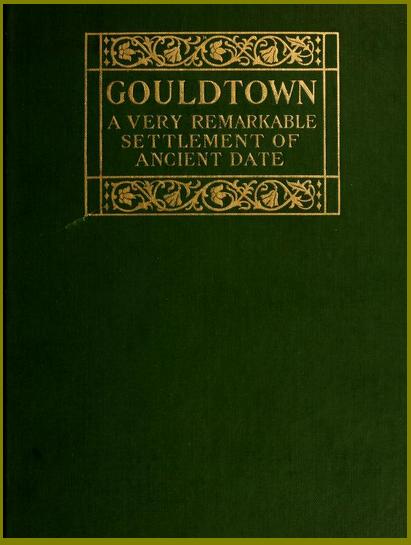
On item caught my attention and I have heard him speak of it before. This was a book about the history of Gouldtown New Jersey and historically black township.  A book was written about this historic town, in 1913, and although there were not many photos of the town known to exist, one of his ancestors was an artist, and she drew from her own memory some images of the town that were included in the book itself. She was a mere 16 years old at the time.

Gouldtown, A book on an historically black New Jersey Town

Image from page 11 of the book Gouldtown. The sketches were made by Mr. Polk's ancestor.

Chapter Vice President Jerry Hynson set up his laptops to share a number of genealogy programs and websites with members. With both laptops going he was able to demonstrate programs and sites to more than one person.

Jerry Hynson with his laptops on display


Some members had prepared some of their family charts to put on display.

One of the family trees on display

As  usual, Noreen Goodson who has remarkable experience working with beginners, ended up teaching a small "Getting Started" session to genealogy novices. She held their attention and got several people inspired to really get started in depth with exploring their family history.

Noreen Goodson, speaking to a class of beginning resarchers

The chapter itself had an impressive display featuring several panels reflecting members their projects and general information about the organization itself.

BAAHGS Chapter Display

BAAHGS member, Dr. Donna Hollie shared some information about her own family history, in an interesting display that also included the recent discovery of her ancestors who were owners of a small telephone company in Midland Virginia. This was possibly the only black owned telephone company of the time, and one of the first in history.

Dr. Donna Tyler Hollie speaking about her own research.

Stock certificate reflecting information on the Elk Run Telephone Company

She also had on display a remarkable photo of her ancestors who had been born as slaves. Whenever she shows this photo I am always captivated by it.  The hands of her ancestors say as much as their eyes.

Ancestors of Dr. Donna Tyler Hollie

One member displayed her own family history by showing the data reflected in her family tree software program.  Several visitors became fascinated by her data and how she discussed her methods of sharing her information with family.

Barnes Family History Data Reflected in Family Tree software

Most importantly the day was a good day as new friendships were formed, new people left inspired to explore their own family history  more in depth. Some received personal advice and others found new ways to document their history through blogging.

The time was well spent, and the day was a very good day! I always enjoy the expos and look forward to one in the future again!

Monday, February 20, 2012

Reflections from the St. Louis African American Genealogy Conference


Program Booklet from St.Louis Afr. American Genealogy Conference Booklet
Photo: Personal Collection


Sarah Cato Call the Conference to Order
Photo: Personal Collection

This past weekend the 3rd Annual St. Louis African American History and Genealogical Society took place at Harris Stowe State College and University campus, in midtown St. Louis. This was a wonderful experience to be a part of and the community of researchers left me with an invigorating experience.

Prior to the opening session a power point of previous events was shown as members poured into the auditorium of the William Clay Early Childhood Development Center. Sarah Cato launched the conference calling the attendees to order. She was an excellent moderator, keeping everyone, and everything on time and moving.

Greetings were also extended to the attendees, by St. Louis organization president, Mr. Charles Brown and Constance Gully of Harris Stowe State University.

Charles Brown, President Greets Attendees at Annual Conference

Constance Gully of Harris Stowe University, also greeted the guests.
Photo: Courtesy of Charles Brown

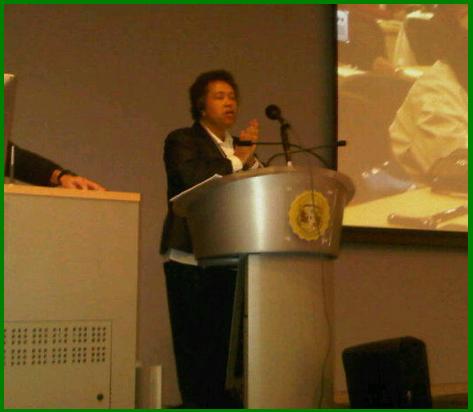
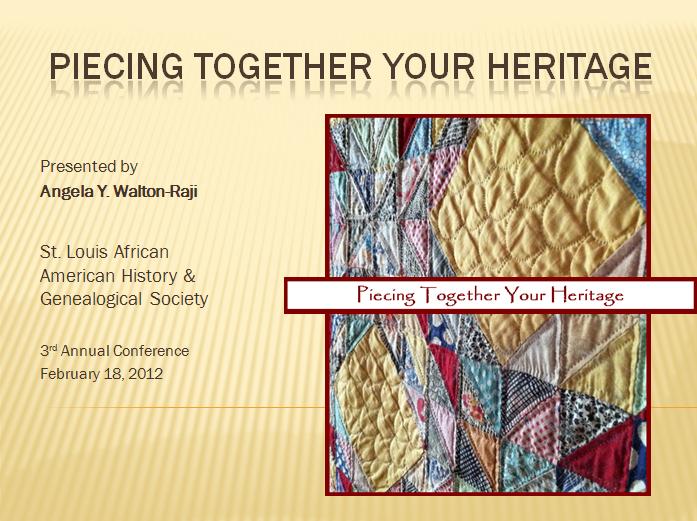
I had the honor of delivering the opening keynote address The conference theme was Piecing Together Your Heritage, A Journey of Discovery and my presentation to the group focused on how we as researchers have many pieces of our own ancestral quilt, and that we have the task to piece our own quilt and tell the story.


Delivering the keynote was a special honor for me. My hope was to set the tone for the event, and to encourage others to begin the journey of the discovery of the wonderful legacy left by the ancestors.

Delivering the Keynote Address on the morning of the conference
Photo: Courtesy of Charles Brown

There were a number of breakout sessions, which provided ideas for members in attendance.


Breakout session


Members Listening to Presentation
Photo: Courtesy of Charles Brown


I was truly excited to sit on in a session conducted by Janis Forte of Chicago. She offered a very detailed introduction to the powerful  Digital Library of American Slavery.  This database is provided by the University of North Carolina at Greensboro, and in her session, she explained methods of using this massive database and how to find data by many categories. This workshop was extremely valuable to me, for I was able to find a useful abstract to a family line that I have been examining for over 20 years. The division of the estate of one of the slaveholding families affiliated with a maternal line was included on that site, so I was delighted that Ms. Forte's workshop opened a door for me!

Janis Minor Forte of Chicago Illinois

Wanda Williams of the National Archives in St. Louis presented a session providing an overview of the holdings at the National personnel record center in St. Louis.

Wanda Williams of the National Archives
Photo: Courtesy of Bernice Bennett

The luncheon was a good opportunity for presenters and attendees to mix and mingle with each other, and just share stories and fellowship. I was happy to have a chance to meet some new people, and to also meet some people who had previously been email contacts only.

Speaker Bernice Bennett & Lisa Landrum


There were a number of exhibitors, and it was a special pleasure to meet one of the exhibitors who was from the Dred Scott Foundation. Lynne Jackson from the foundation, is a direct descendant of Dred and  Harriet Scott.

Lynne Jackson and myself standing near a portrait of her ancestor Dred Scott
Ms. Jackson is the gr. gr. granddaughter of Dred & Harriet Scott


The afternoon, keynote was delivered by Bernice Bennett. She told the story of her success with a line from Edgefield South Carolina. Her delivery had everyone on the edge of their seats and she was a smashing success! It can easily be said that she set the tone and had people talking the rest of the day after she told  her own story of her South Carolina research experience.

Image from Bernice Bennett's Presentation

After the conference, many took time to take photos with new friends old and new. 
Angela McGhee, Bridget Stegall, Bernice Bennett, Charles Brown, 
Angela Walton-Raji, Harold Russell, Janis Minor Forte
Photo: Courtesy of Charles Brown

The day was truly an exciting one, and meeting so many people with such a strong interest in family history is always a special event. In addition, a few faces from the AfriGeneas family also had a chance to connect and meet in real time as well.

AfriGeneas Friends: Bernice Bennettt (bbenn), Lisa Landrum (bearnut2) 
and Angela Walton-Raji (AYWalton)

I truly had a great day in St. Louis and I found the questions asked from the various persons in attendance to be thoughtful, and thought provoking.  I found the atmosphere from the staff at Harris Stowe to be a very warm, and the site was a true state of the art facility. And most importantly, I found the members of the St. Louis African American History and Genealogical Society to be a wonderful group of people. They were delightful hosts, serious in their quest for knowledge and a group that was a true pleasure to meet and spend some time.  

I want to extend a special thank you to them for their kindness, their hospitality and for presenting a wonderful conference.

Friday, February 10, 2012

"I Don't Know Where They Carried Him To"

The Christian Recorder, 1896

All excerpts in this post, are from the same issue of  the January 2,1896 edition of The Christian Recorder a publication of the AME Church. (I was able to access the old copies of this publication through Accessible Archives). Many former slaves used this publication in search of loved ones who were lost to sales and whims of slave holders many decades earlier.  The genealogical value of these letters speak for themselves. The continued pains of slavery are felt in the longing of these former slaves for their parents, husbands, children and siblings. I am sharing a few of them here.

In this first letter, Eliza Holmes of Fayette County Texas is hoping that someone will connect her to her son, but she explains, "I don't know where they carried him to."

Wanted Ad from The Christian Recorder,  
January 2, 1896, Volume XLIII p. 7


In the 1890s letters such as these appeared in African American newspapers throughout the country. These letters represent the true horrors of what happened to people, and true heartbreak of separation. Many such letters were written decades after freedom, and yet loved ones were still be sought--so strongly missed, and clearly leaving holes in the hearts of former slaves.

Some were themselves sold away, and circumstance never allowed them to find their way home. Emma Washington of Meridian Mississippi, was still looking for her mother who was enslaved in Warrenton Springs Virginia. The family data is so rich, although with the passing of time, chances of their being reunited were slim.

Wanted Ad from The Christian Recorder,  
January 2, 1896, Volume XLIII p. 7

So many of these announcements provide rich genealogical data in addition to reflecting the heartbreak of separation. In Pleasant Beal's letter, one can see how often slaves were exchanged, and moved about so frequently. Mr. Beal knew his parents--the Slaters and after three decades still sought their whereabouts and their fate.


In other situations there were men who left. Some left to fight, others left simply to serve in any way they could. They were often counted simply as contrabands, or refugee slaves, but they were still brave men, whoyseized the chance for freedom, and followed the Union soldiers:


Because these poignant letters were written three decades after the war chance of families being reunited were slim. However, the amazing genealogical data and the illustration of a strong sense of family is immediately noticed by the reader.

As overjoyed as so many were to finally be free---the heartache continued for thousands of former slaves throughout the nation. Time was perhaps the only healing balm that soothed so many of their souls. They deserved so much and got so little. I pray that they will never be forgotten

May all of those who suffered be finally at peace.