When searching for enslaved ancestors, the first major frustration comes for the first time researcher, when he or she encounters the slave schedule in the 1860 and 1850 census for the first time. The shock to the researcher is that the "slave census" does not contain the names of the slaves. Only the name of the slave holder is recorded. That is also the first time that one encounters the reality of slaver and its horror---the ancestors were not considered to be people worthy of names. They were simply property and their presence as enslaved people only meant that they would be counted, just as cattle, horses, and other livestock.
And usually upon that discovery, the researcher heaves a very heavy sigh, exclaiming, "if only we knew their names."
And so it goes. But several years ago, while in Chicago attending a conference, I met Belzora Cheatham who was anxious to share a find! One line of her family is from Bowie County Texas and she had just found them on the 1850 slave schedule. With their names!
The document was one of those amazing errors in the census that many whose ancestors were enslaved, wish we could find. The error was a wonderful one---the enumerator wrote the names of the enslaved people--all of them!
I have thought of Ms. Cheatham many times over the years and several years ago, I looked at the records myself, and wrote a piece about them. I recently looked at that small collection of records from District 8 of Bowie County, and decided to write another article, because of its significance.
We recently celebrated the indexing of the Freedmen's Bureau records and how important we can now look at the years between 1865 and 1870 and learn about our ancestors in the early days of freedom. But this slave schedule is equally significant--although it reflects a tiny community---this is 15 years before freedom, and this provides a rare glimpse at people still enslaved, and their names can be called.
We recently celebrated the indexing of the Freedmen's Bureau records and how important we can now look at the years between 1865 and 1870 and learn about our ancestors in the early days of freedom. But this slave schedule is equally significant--although it reflects a tiny community---this is 15 years before freedom, and this provides a rare glimpse at people still enslaved, and their names can be called.
A few years ago I wrote a small article about this collection, but I only included a few images. But upon reflection of the fact that for some--their names would never appear in a census as free people, and in light of our focus on celebrating everyone, enslaved and free, I have decided to include this larger article and share all 23 of the pages. So therefore, I am submitting this two-part piece reflecting the names of the enslaved population, sharing the images themselves. The district was not a large one, and therefore they deserve to be seen, by all.
The images reflect District 8, of Bowie County, Texas. There are only 23 pages reflected in this slave schedule, and all will be shared on this blog. The first 12 are shared below. (Part 2 will reflect the remaining pages.)
1850 Slave Schedule
Bowie County, Texas, District 8
Ancestry.com. 1850 U.S. Federal Census - Slave Schedules [database on-line]. Provo, UT, USA: Ancestry.com Operations Inc, 2004.
Original data: United States of America, Bureau of the Census. Seventh Census of the United States, 1850. Washington, D.C.: National Archives and Records Administration, 1850. M432
Bowie County, Texas, District 8
Ancestry.com. 1850 U.S. Federal Census - Slave Schedules [database on-line]. Provo, UT, USA: Ancestry.com Operations Inc, 2004.
Original data: United States of America, Bureau of the Census. Seventh Census of the United States, 1850. Washington, D.C.: National Archives and Records Administration, 1850. M432


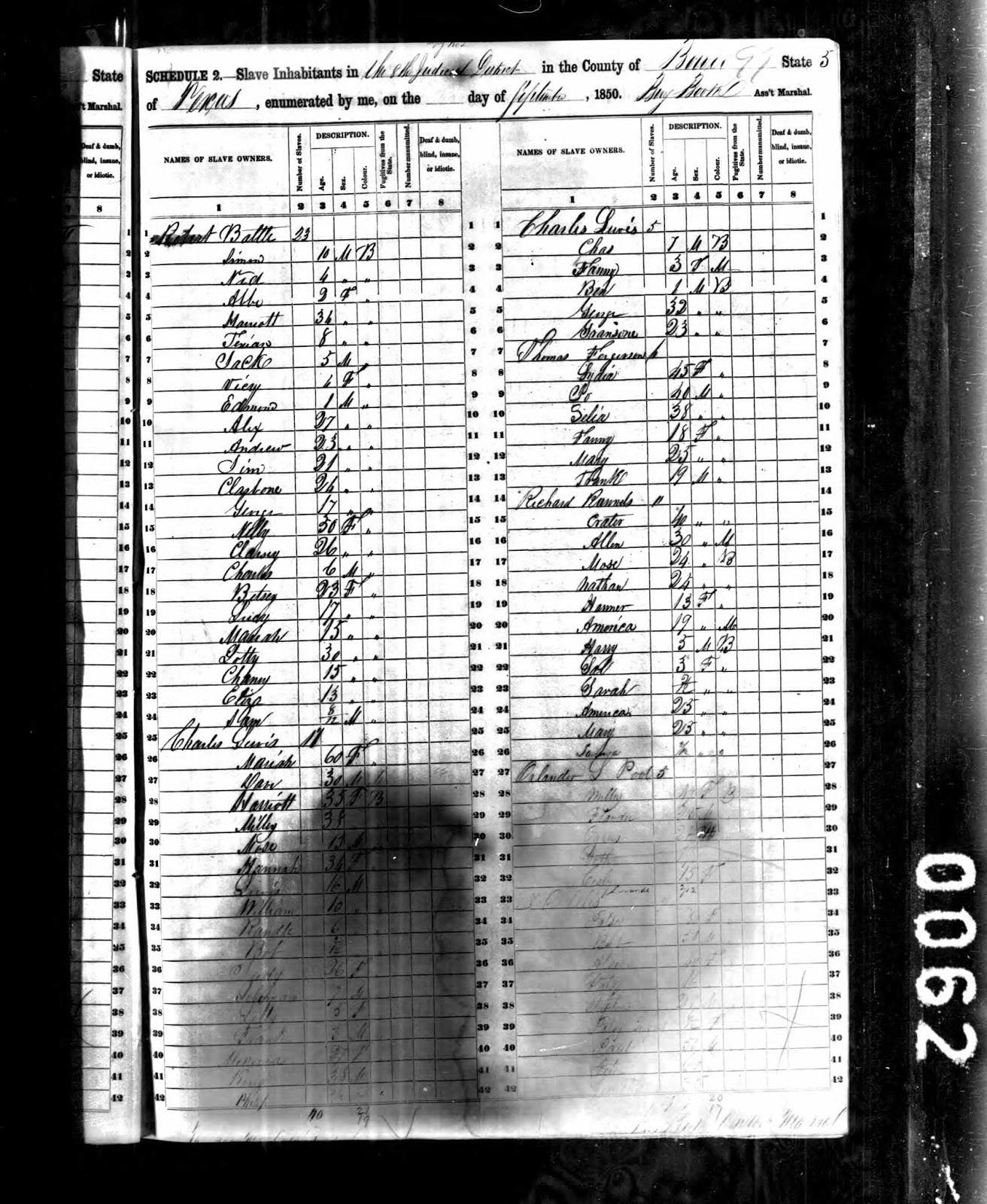

It is clear upon looking at the images that some severe water damage occurred on the pages of the census book. This is most unfortunate, as in many of the pages,the names have simply vanished with the dampness, dissolving the lettering.


As one moves through the pages some of the water damage appears to lessen. And in some places on the page the names of the enslaved people can be read through the water stains.

Though the water stains are still there, hopefully others new to the process will still look at the names of these people who lived during a trying time. My hope is that most did survive and live to breathe the air of freedom.
End of Part 1


