Showing posts with label Slave Schedules. Show all posts

Monday, January 2, 2017

If Only We Could See Their Names - Part 1


When searching for enslaved ancestors, the first major frustration comes for the first time researcher, when he or she encounters the slave schedule in the 1860 and 1850 census for the first time. The shock to the researcher is that the "slave census" does not contain the names of the slaves. Only the name of the slave holder is recorded. That is also the first time that one encounters the reality of slaver and its horror---the ancestors were not considered to be people worthy of names. They were simply property and their presence as enslaved people only meant that they would be counted, just as cattle, horses, and other livestock.

And usually upon that discovery, the researcher heaves a very heavy sigh, exclaiming, "if only we knew their names."

And so it goes. But several years ago, while in Chicago attending a conference, I met Belzora Cheatham who was anxious to share a find! One line of her family is from Bowie County Texas and she had just found them on the 1850 slave schedule. With their names!

The document was one of those amazing errors in the census that many whose ancestors were enslaved, wish we could find. The error was a wonderful one---the enumerator wrote the names of the enslaved people--all of them!

I have thought of Ms. Cheatham many times over the years and several years ago, I looked at the records myself, and wrote a piece about them. I recently looked at that small collection of records from District 8 of Bowie County, and decided to write another article, because of its significance.

We recently celebrated the indexing of the Freedmen's Bureau records and how important we can now look at the years between 1865 and 1870 and learn about our ancestors in the early days of freedom. But this slave schedule is equally significant--although it reflects a tiny community---this is 15 years before freedom, and this provides a rare glimpse at people still enslaved, and their names can be called.

So many of us find the slave schedules for the first time, and then sigh in frustration noting that only the names of the slave holders are recorded. For those who survived enslavement and who lived to see freedom--it would be 20 years before their names would be in print again on a census. And for some--who did live to be free, this is the only piece of evidence that they ever lived.

A few years ago I wrote a small article about this collection, but I only included a few images. But upon reflection of the fact that for some--their names would never appear in a census as free people, and in light of our focus on celebrating everyone, enslaved and free, I have decided to include this larger article and share all 23 of the pages. So therefore, I am submitting this two-part piece reflecting the names of the enslaved population, sharing the images themselves. The district was not a large one, and therefore they deserve to be seen, by all.

The images reflect District 8, of Bowie County, Texas. There are only 23 pages reflected in this slave schedule, and all will be shared on this blog. The first 12 are shared below. (Part 2 will reflect the remaining pages.)


1850 Slave Schedule
Bowie County, Texas, District 8
Ancestry.com. 1850 U.S. Federal Census - Slave Schedules [database on-line]. Provo, UT, USA: Ancestry.com Operations Inc, 2004.
Original data: United States of America, Bureau of the Census. Seventh Census of the United States, 1850. Washington, D.C.: National Archives and Records Administration, 1850. M432


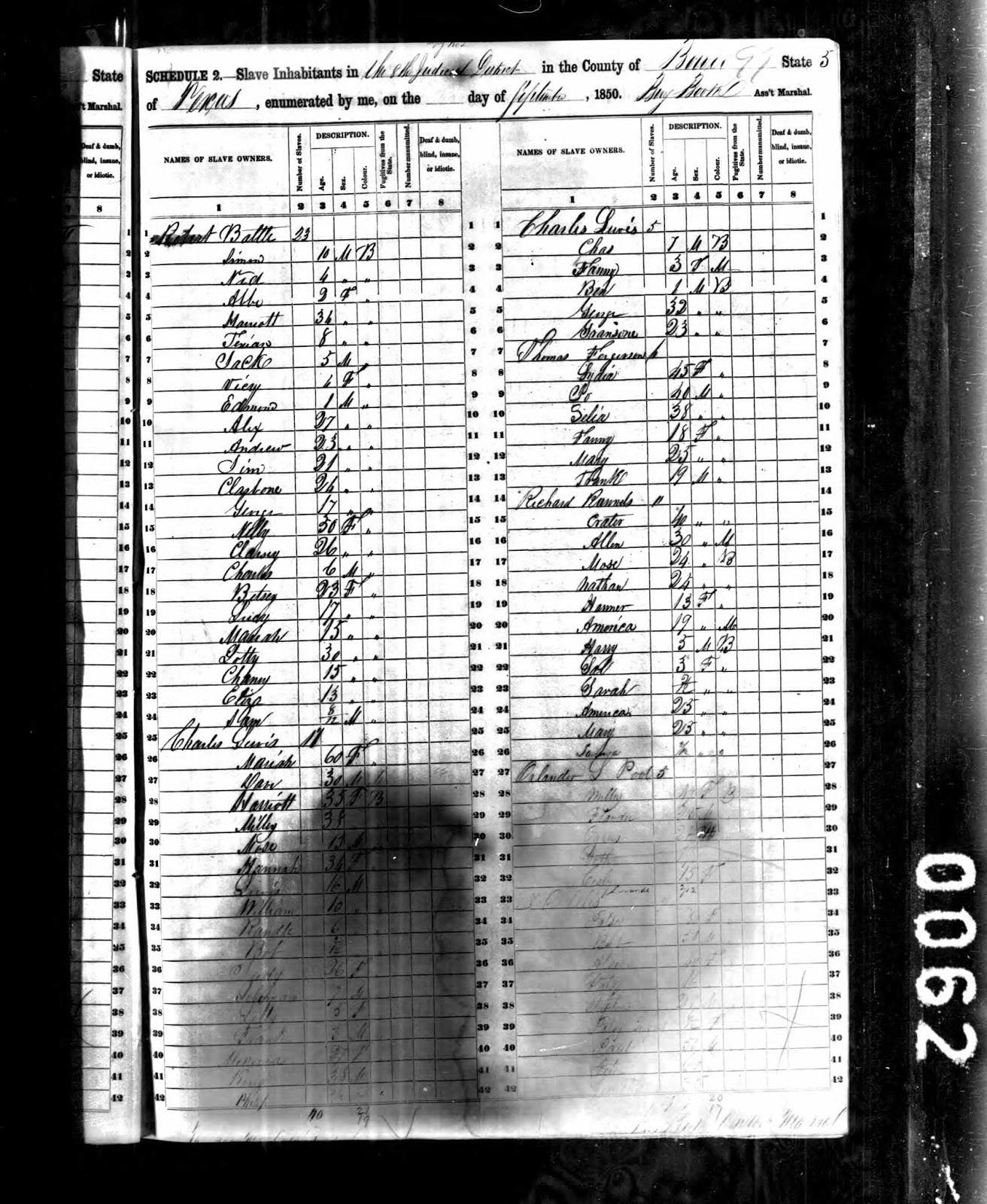


It is clear upon looking at the images that some severe water damage occurred on the pages of the census book. This is most unfortunate, as in many of the pages,the names have simply vanished with the dampness, dissolving the lettering.


As one moves through the pages some of the water damage appears to lessen. And in some places on the page the names of the enslaved people can be read through the water stains. 


Though the water stains are still there, hopefully others new to the process will still look at the names of these people who lived during a trying time. My hope is that most did survive and live to breathe the air of freedom.

End of Part 1


Monday, October 13, 2014

Slave Schedules & A Wonderful Exception to the Rule


I recently shared information about slave schedules in my previous article and how they can be used. One of the points mentioned was that basically data collected on enslaved families, reflected information about the enslaved people, but not who they were.  And for the most part, this is true in the majority of cases.

But there are those rare exceptions when one finds something a bit out of the ordinary. About 20 years ago, a Chicago based genealogist Belzora "Bell" Cheatham made a remarkable discovery. The census enumerator of her ancestral county, Bowie County Texas did not apparently obey the rules while counting the numbers of enslaved people. In this case, the enumerator did what we wish all had done. He recorded their names. 

That's correct. The names of each and every person enslaved in Bowie County Texas was recorded for the year 1850.

Bowie County Texas 1850 Slave Schedule
Every enslaved person's given name is reflected on this document
Ancestry.com. 1850 U.S. Federal Census - Slave Schedules [database on-line]. Provo, UT, USA: Ancestry.com Operations Inc, 2004

It is truly amazing to see 23 pages of the names of enslaved people on this Federal Census slave document! Thankfully they are now all digitized and can be found on several online sites.

The challenge is the pages may have been damaged or exposed to some kind of liquid stain, as there is what appears to be a dark water stain on the bottom portion of each page.

Image from Bowie County Slave Schedule of 1850 revealing stain from a liquid on the page.


However, it does appear that with some tweaking of the image, some names may be partially legible even in the stained portion.

This zoomed in portion does reveal some names if enlarged a tweaked slightly, so some names might still be obtained.

Regardless, this is one of those exceptions that has to be celebrated--because these enslaved people were enumerated by name, and  this could be used by so many people. Texas researchers, Bowie County researchers, community cluster researchers,  and even historians whose focus is slavery can all find this one exception to be useful.

Hopefully someone will study those families in 1870 to learn who survived enslavement and made it to freedom. Others will also be able to study those who may have resided near former slave holders once freed. Of course it is also important to remember that this document was taken in 1850. Twenty years will have passed before their names would appear on a census page, and many things could have transpired.

And of course assumption and speculation should be avoided, but this is still one of those records that could point to and provide useful information, and should be mentioned as one of those rare and valuable exceptions to the rule.


Sunday, October 12, 2014

Slave Schedules - Use Them Properly and Tell The Story

1850 Slave Schedule, Coosa County Alabama


In this season of the ongoing genealogy television programs, many of us enjoy looking at the many records shared with the featured guests. We all watched recently the episode on Finding Your Roots, in which a slave document was shared, reflecting the estate of an ancestor affiliated with featured guest, Derek Jeter. The episode generated much discussion in genealogical circles on the use of slave schedules. Some find the documents to be useful and others are frustrated by the limitations of the 1850 and 1860 Federal slave schedules, and rarely use them for their own research.

Because there are such feelings about slave schedules and their value in the African American genealogical process, I thought I would address some of them here.


How can one properly use the 1850 and 1860 Slave Schedules when exploring family history? 
From the earliest census years, slaves were counted but it was not until 1850 and 1860 census that two interesting census forms were developed and used to document the number of people enslaved. These schdedules provided a) a numerical count of the numbers of persons enslaved, b) information about the person who was the official slave holder, or owner of record, and c) notations about the enslaved individuals, regarding gender, age and complexion.

However for many African American genealogists--the one thing that could take them farther back in time is missing. The names of the slaves. Sadly--page after page contain nothing more than simply the name of the slave holder, and his human "property." This provides no glimpse of the families by name, during those years. So for many genealogists, it is felt that Slave Schedules provide nothing.

But they do hold some value, and it has to be understood that though limited, these records may still be useful in the research process.

What Slave Schedules Provide:

1) Names of slave holders during those census years. (see image above)
2) Numbers of enslaved people held within a specific geographic region
3) Useful glimpse at the size of the slave holder's estate

Partial list of slave owned by James W. Jeter, Coosa County Alabama, 1850
Ancestry.com. 1850 U.S. Federal Census - Slave Schedules [database on-line]. Provo, UT, USA: Ancestry.com Operations Inc, 2004.

4) Composition of real property, with the number of slave houses.


In the case of James W. Jeter, it can be seen below that he had 10 slave houses on his estate. That provides an idea of the size of his property and the number of enslaved men an women to work on the estate and maintain it.

1860 Slave Schedule, reflecting slaves owned by James W. Jeter, Coosa County Alabama


Ancestry.com. 1860 U.S. Federal Census - Slave Schedules [database on-line]. Provo, UT, USA: Ancestry.com Operations Inc, 2010.

5) Acts of Resistance among slaves--number of slaves missing or reported to be "fugitives"


Top of 1860 Slave Schedule provides a column to count runaways


As seen in this full shot of the Jeter estate from 1860, no runaways were listed.


What Slave Schedules Do Not Provide:

1) Names of enslaved men, women, children.


2) The total number of every slave held by that particular slave owner. Slaves were bought, sold, traded, rented and deeded continually.The numbers of people held as chattel changed and depended upon the circumstances within a household, an estate, or the presence of auctions for slaves being brought into a community. The total numbers reflect those in bondage only on the day that the count was made.


So, in the case of James W. Jeter in Coosa County Alabama, a total of 41 people were held in bondage on the Jeter estate, and they lived in a total of 10 houses on the grounds.

3) No specific slaves are reflected on slave schedules and thus are not easily identified. Even if the age of a person on a schedule is exactly 10 years younger that the targeted person appeared in the 1870 census, slave schedules do not pinpoint specific individuals with certainty.

4) Schedules do not reflect data pertaining to the lives of slaves. No occupation, or special skills can be gleaned from slave schedules.

5) Slave schedules do not provide an overview about the quality of their lives, nor how they were treated. 

How to Use Data From Slave Schedules

Though these documents are limited, they can still be a part of the family narrative. The size of the estate, the number of houses on a slave holder's estate and whether or not there were fugitives or runaways still associated with the estate can be gleaned and when speaking about the persons enslaved, one can share this data with family as part of the story. 

Here are some basic rules and precautions to follow.

1) Report What is Shown. Data collected should be studied and analyzed and then told without embellishment.

2) Stick to the Evidence. When sharing the record of enslaved people on the slave schedule, stick to the evidence. Though one "might" be the targeted ancestor, with no name listed, there is no evidence.

3) Avoid Assumption. A person found in the 1870 who was 25, is not guaranteed to be the nameless person on the 1860 slave schedule whose age is listed as 15.

4) Avoid invention. The slave schedule can be a tool and can provide some useful information about the composition of the population held in bondage, in terms of demographics. The ages of fellow slaves, the number of houses their quarters consisted of can be useful information. However, beyond that kind of data, no definitive statements can be shared without supplemental records to tell the story.

It is our responsibility as researchers and genealogists to tell the story accurately, and to maintain the integrity of our research by providing the evidence to support that which we share.