Showing posts with label Five Civilized Tribes. Show all posts

Friday, August 25, 2017

Oklahoma Freedmen Ancestry to be Featured on Blog Talk Radio Show


Many who are active in the genealogy community are quite familiar with the weekly program hosted by genealogist and author Bernice Alexander Bennett. On August 31, her show will feature 4 genealogists who will speak on their genealogical experience as descendants of Oklahoma Freedmen. The Freedmen were those men, women and children once enslaved by citizens of the Five Civilized Tribes. The panelists will share the genealogical process and the documents they used to uncover their family history.

Nicka Sewell-Smith, will speak about her experience documenting her ancestors from the Cherokee Nation. Terry Ligon, will speak about documenting his ancestors who were Chickasaw Freedmen. Ron Graham will share his experiences documenting his family history from the Creek Nation, and yours truly-Angela Walton-Raji will speak about documenting the Walton and Perry ancestors from the Choctaw Nation.

Ms. Smith is a direct descendant of Ike Rogers, the well known US Deputy Marshall who served Indian Territory under Judge Isaac C. Parker. Her family from Vinita, Fort Gibson and other places in the Cherokee Nation is well documented. She shares much of her research on her website Who is Nicka Smith Nicka Smith is also the host of Black Pro Gen, a bi-weekly Google hangout where professional genealogists discuss methods and strategies in a live on camera gathering. She is also a professional photo journalist and documentarian, and serves as a member of the faculty of MAAGI, the Midwest African-American Genealogy Institute.

Terry Ligon's story is fascinating when he shares the amazing genealogical data that he uncovered and learned about his ancestor Bettie Ligon, who was chief litigant in a complex legal case involving over 2000 freedmen. He hosts the blog The Black and Red Journal and also a group on Facebook, called The Indian Territory Reader. He has taught numerous genealogy classes, and was a major instructor in the Choctaw-Chickasaw Freedmen conference several years ago in Oklahoma City. Mr. Ligon has also produced a number of videos on YouTube reflecting not only his history, but many aspects of the complex history of  Oklahoma Freedmen.

Ron Graham is active in many aspects of genealogy of Oklahoma Freedmen. With strong family ties to the Muskogee Creek Nation, Mr. Graham served for several years as president of the Muscogee Creek Freedman Band, a group whose mission is to preserve, and teach history and genealogy of Creek Freedmen. He has conducted genealogy classes and worked with clients seeking assistance with the enrollment process. He continues to be active with the Descendants of Freedmen Association of Oklahoma. He continues to teach throughout Oklahoma and most recently taught a class at the Cherokee Ancestry conference in Talequah Oklahoma.

Angela Walton-Raji hosts the African-Native American Genealogy Blog, the African-Native American genealogy website, and  she hosts the longest running message board focusing on researching Freedmen of the Five Civilized Tribes, on AfriGeneas. Author of Black Indian Genealogy Research, the first and only book devoted to researching the Freedmen of the Five Civilized Tribes, Ms. Walton-Raji continues to devote time and energy to teaching and writing in many arenas. She has the longest ongoing genealogy podcast devoted to African American genealogy, with over 400 episodes available free online. Ms. Walton-Raji is also a founding member and faculty member of MAAGI and coordinates the Writer's Track at the Institute. She has spoken nationally at AAHGS, FGS, Roots Tech, SCGS, and the International Black Genealogy Summit.

Bernice Bennett, host of the weekly program "Research at the National Archives & Beyond" on Blog Talk Radio, is well known for her efforts to feature genealogists, writers and scholars who share a compassion for telling the African American family story. Next week's show will be the first program of its kind featuring the topic of genealogical resources for descendants of the Oklahoma Freedmen.

The show will air at 9pm (eastern time) on Blog Talk Radio. To hear the program simply go to: www.blogtalkradio.com/bernicebennett. Click on the episode's name to hear the live broadcast. To join the live online chat room, log in by creating a free account, or log in through Facebook or Twitter.

Thursday, January 19, 2017

Mapping Slavery in Indian Territory

I am happy to share something that education has never before reflected. I am happy to introduce the first map reflecting the places in Indian Territory black men, women and children were enslaved.

Actual Interactive Map Can Be Accessed HERE.

For over 150 years, countless maps have omitted the presence of slavery in Indian Territory and never have maps been shown to reflect the geographic distribution of slaves within the Five Civilized Tribes. Those tribes specifically are the Cherokee, Choctaw, Chickasaw, Creek, and Seminole Nations. Because slavery is not widely studied west of Arkansas, maps have never reflected this history.

Until now.

Background
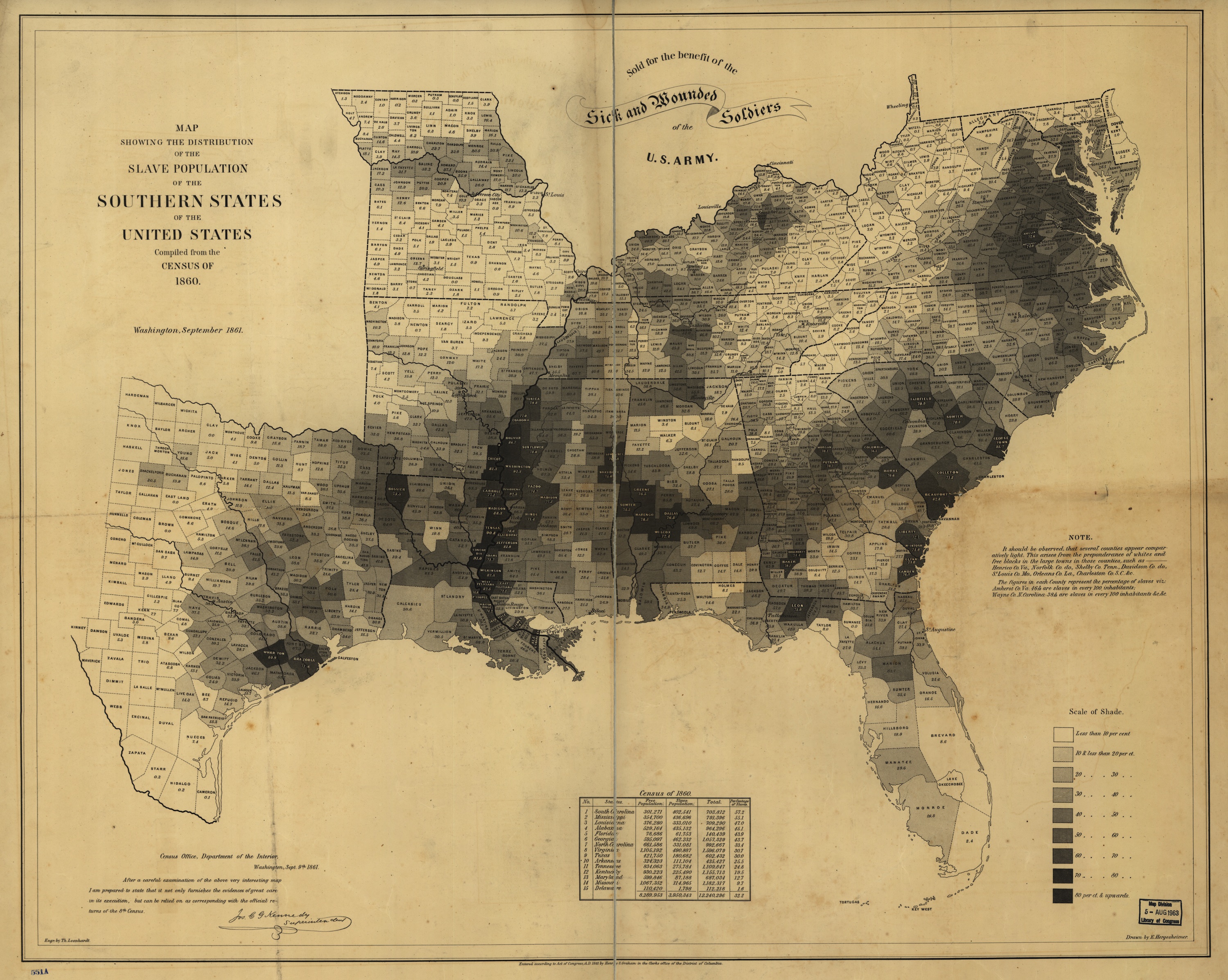
When I see historic maps that reflect slavery in North America, I cannot help but stare at the blank spake right above Texas when I see those maps. But, having ancestors who come from what is now Oklahoma, and knowing that they were enslaved in Indian Territory, I stare at that space, because I know that there were people enslaved in that place, and among them were my own ancestors living in the Choctaw Nation. However, in most texts, the maps always reflect the lands just north of Texas as being a land where slavery was not present. I cannot help but see those historical maps and stare that the big hole in the middle. The "big hole" is the space right above Texas.


Map Showing the Distribution of the Slave Population

of the Southern States of the United States Compiled from the Census of 1860
Washington September, 1861
Map accessed from Mapping the Nation


The map above is the "MASTER" of slavery maps. It was created in 1861 by the US Coastal Survey and was compiled from census data. It is also the map that was presented to President Lincoln to illustrated the prevalence of slavery in the southern states. (A zoom-able version of this map can be found HERE.)

There are other maps such as the one below that fall into the category of "historical geography" that were used to share a policy and where the effects of that policy prevailed. But again, in that map one sees Arkansas, then a vertical line skirting around Indian Territory (now Oklahoma) and into Texas. The map was used to show the "curse of slavery". But the "curse" did extend west, directly into Indian Territory.

Accessed from Mapping the Nation
Map by John F. Smith, in the Library of Congress "Historical Geography" Map, 1888


Now it can be said that the number of enslaved people in Indian Territory was not as high as it was in states like Mississippi, or Alabama. And one might be able to say that the old maps are not wholly inaccurate since there may have been less than 10 percent of the total population was enslaved in Indian Territory. However--that percentage, also cannot be proven, because only free whites and free blacks were recorded in Indian Territory in the 1860 population census. And the Indian population was not tabulated at all in the regular population census at that time. But--there was a census made of the enslaved population--and the slave holders--the Indian slaveholders were listed along with the people whom they enslaved. And the communities were they lived are shown. They were included as part of the Arkansas Slave schedules.

The Arkansas Slave schedule is found on National Archive microfilm population M653 Roll 54. All of the Arkansas counties are listed on the reel of microfilm. Following Yell county, the list of enslaved people in Indian Territory begins.

There are 865 images on that reel of microfilm. On that record, there were slave holders such as Cherokee Chief John Ross, or Choctaw leader Robert Jones who owned hundreds of Black people as slaves.


Yet countless maps omit the presence of slavery in Indian Territory and never have maps been shown reflecting the geographic distribution of slaves within the Five Civilized Tribes. Those tribes specifically are the Cherokee, Choctaw, Chickasaw, Creek, and Seminole Nations. Maps have never reflected this in textbooks. Until now.

For the most part, it is not generally taught that slavery even occurred in Indian Territory. That oversight has made the omission of slavery in the Territory easy to overlook in the American historical narrative. However, slavery did occur in the territory, and it was real, it was painful, and there were runaways, slave uprisings, and efforts among the enslaved to become free from bondage. Therefore, the more I studied maps and records, the more I saw a need to see a map reflecting the land of my own ancestors--the enslaved people of Indian Territory.

Finally thanks to the technology of Google Maps, and using the 1860 slave schedule, a new map reflecting slavery in Indian Territory has been made.

The New Map This new map has made a part of the interactive map on the website, "Mapping the Freedmen's Bureau." By using Google maps, the markers are placed to coincide with the communities that were clearly defined in the 1860 slave schedule. The markers are also placed accurately with the appropriate geographic coordinates. By using Google Maps the markers reflect the actual community where the enslaved families were held. In the years after freedom, many people remained in the same communities especially during the first  years of freedom, so this map also represents these families in both slavery and freedom. And there was an extremely large contraband camp at Fort Gibson, and that encampment site is also marked on the map.

Some Indian tribal Freedmen were even captured in the collection of records from the Freedmen's Bureau. Many lived close to the Arkansas border and used the services of the Bureau in nearby Arkansas. The Fort Smith Bureau reflected Cherokee citizens appealing to the Freedmen's Bureau for help.

Contents of the map
For this map, the Cherokee, Choctaw, and Chickasaw nations are more thoroughly reflected. That is because there was a more thorough assessment of the slave holders of the nation. In the Creek Nation, the slave holders and their slaves were recorded, but the different tribal towns were not indicated on the slave schedule, as the slave schedule would simple describe the residence as "Creek Nation, West of Arkansas." As a result a single marker was placed marking Okmulgee the capital of the Creek Nation. Similarly, for the Seminole nation. Seminole leaders such as John Jumper,  Billy Bowlegs and others were also slave holders, but the enumerator did not go into Seminole country, and thus a single marker is placed over Wewoka, the capital of the Seminole Nation. When and should a better site with a link appear, additional markers will be added for those two communities.

When Using the Map
The map provides a direct link to the Internet Archive where one will find the 1860 slave schedule reflecting the people enslaved in Indian Territory communities. (This includes a direct link to the Creek Nation pages as well.) By hovering the mouse or cursor over a marker, a small pop-up window will appear, and that window will contain a link to the exact pages on the Internet Archive that contain the images of the slave schedule reflecting Indian Territory. By clicking on that pop up, the user will find the direct link in the text about the site description.

About the Slave Record
It is noted that the 1860 slave schedule contains the name of the slave holder and the number, gender, and complexion of the enslaved population kept in bondage. The slave schedule can be used in a community study, or an analysis of the age, gender breakdown, and status-whether runaway or still physically held. Though names of the enslaved were not recorded, the record still provides useful data, when compiling the family narrative particularly whether they were part of a large estate, or a small family held by one person.

In the Cherokee Nation the districts represented are:
Canadian
Delaware
Flint
Going Snake
Illinois
Cooweescoowee (Kooweeskoowee)
Saline
Sequoyah
Talequah

In the Choctaw Nation, the districts represented are:
Atoka
Blue
Botuklo
Cedar
Cole
Eagle
Gains
Kiamitia
Red River
Skullyville
Sugar Loaf
Towson

In the Chickasaw Nation, the districts represented are:
Panola
Pickens
Pontotoc
Tishomingo

In the Creek Nation, the area represented is:
Okmulgee

In the Seminole Nation, the area represented is:
Wewoka

This is the first time that slavery has been "mapped" for Indian Territory, and hopefully in the future, a more thorough representation of the heartbreaking institution of slavery will be shown. Thanks to Google maps, this story can now more accurately be told, and reflected.