Showing posts with label Many Rivers to Cross. Show all posts

Friday, November 29, 2013

"Yet Still, like Dust, We Rise"! Many Rivers To Cross Final Episode


The Final episode of the PBS Series The African Americans. Many Rivers to Cross took the viewers through several decades very quickly and the times were full of contrasts from confusion to cohesion, from powerlessness to empowerment, from war, to peace and back again.

The 1960s brought about so much change--the signing of the 1964 Civil Rights Act by President Lyndon Johnson, started the nation down a new path, towards a new beginning. But the times were not without pain and hardship along the way. Many people paved the way, and they were men and women of true courage and conviction. And I was a young adolescent watching and asking why. Some of these people still stand out in my mind, as they became my heroes.

One of the most heartfelt heroes voices was a poor woman, from Mississippi. Working most of her life on a plantation, she came alive when the voter rights movement took hold. And she fell victim to horrific police brutality in a Mississippi jail, for only fighting for that right to vote. But the beating in jail did not silence her. In fact, she dared to tell her story to the world. This woman told her story at the Democratic Nation Convention in 1964. I was about 12 years old that summer and I sat there listening to this woman tell her story. Oh the horror! Her name was Fannie Lou Hamer and she became my hero.

She had the nation mesmerized as she told the nation about her treatment in Winona Mississippi---a vicious town with cruel law enforcement officers. But yet, they could not beat her spirit---because she told her story. And she told it to the world. For daring to register to vote, she was falsely arrested, then beaten mercilessly in a Winona Mississippi Jail. And she was told by the sheriff that they would make her wish she was dead. But as they made other prisoners beat her, they never broke her spirit. It took weeks to recover from this ordeal, but she made it to Washington, and the law enforcement policies of Winona were exposed to the nation, and to the world. As hard as they tried, they could never beat the spirit of this amazingly brave woman.

Hear this brave woman tell her story.

Fannie Lou Hamer speech at the Democratic National Convention 1964

She ended her speech with the statement of why so much had happened to her:

"All of this is on account we want to register [sic], to become first-class citizens, and if the Freedom Democratic Party is not seated now, I question America. Is this America, the land of the free and the home of the brave where we have to sleep with our telephones off the hooks because our lives be threatened daily because we want to live as decent human beings - in America?"
* * * * *

The passing years brought about change, but it did not come easily. More violence, more terror was in store for people who dared to take a stand. And more blood was shed. With time, the movement evolved from one exclusively of race, but also of class. And in 1968, when Dr. Martin Luther King traveled to Memphis to stand with the garbage workers, his fate was sealed with an assassin's bullet as he emerged from the modest Lorraine Motel. 

And like the funeral of JFK, we were glued to the face of his beautiful wife Coretta as she and the rest of the world watched the funeral services. I was by that time in high school, and I felt so empty as once again, one who stood up for something was taken. I stared at the face of Coretta, his widow and I thought about his children, some of whom were close in age to me. They had lost a husband and father. I had lost a hero.


Coretta Scott King, attending her husband's funeral

But 1968 was not over, because two months later, yet another man of the people was to be taken. Robert F. Kennedy was killed in June 1968 in Los Angeles California. I had been impressed with this young Senator and somehow had a sense of hope, but on that summer night in June, once again, I had lost a hero.

The feeling of sadness and emptiness and loss was expressed for me that year, by one song: 


They say it is always the darkest before the dawn, and eventually the dawn did come. Those years when so much blood was shared by so many people, eventually gave way to new chances. The country somehow became a bit more tolerant and as the vote was finally extended to people some growth occurred and America took a breath and relieved itself of some of it's own misery by recognizing that there were others who were in their midst in the same country, and they too, could call the nation their own.

Other movements came and went. Some bypassed us completely. We never had chapters of the Black Panthers in my part of Arkansas. And the food programs, and health screenings that some people knew the Panthers for, were only learned about years later. Political battles were fought and won, and they were also fought and lost, but eventually change came. 

Racial stereotypes were removed from ads, and from cartoons, and the faces of color even on the TV screen became more than sporadic. We began to see ourselves in the media, and our music, once hidden as "race music" became accepted, and we found our way through the maze of 20th and 21st century society.

The most unbelievable happened in 2008 with the election of a man of color to the highest office in the land. And like all pioneers, he has had to endure indignities never offered to his white predecessors, but, like the elders and ancestors before us, he has endured. And he took the unbelievable had an encore performance---he won a second term. 

And while many of us shake our heads at the unending filibusters and extreme right efforts to render him powerless, he prevails and presides, nevertheless. 

We all know that the battle is not yet over, for it is known that a young man or young woman can be killed for playing music too loudly, or ringing a doorbell, or simply walking down the street with candy. These are the realities, but we know yet that in spite of it all, we rise.....yes, we survive, and we rise. 

Maya Angelou the poet described it so well........

Out of the huts of history's shame, I rise
Up from a past that's rooted in pain, I rise
I'm a black ocean, leaping and wide
Welling and swelling I bear in the tide

Leaving behind nights of terror and fear, I rise
Into a daybreak that's wondrously clear, I rise.

Bringing the gifts that my ancestors gave,
I am the dream and the hope of the slave.
I rise
I rise
I rise.
    ~Maya Angelou!  "And Still I Rise"

* * * * *

This post is the last of posts as part of  the African American Genealogy Blogging Circle project. This is a small group of African Ancestored Genealogists who have been watching the PBS Series: The African American. Many Rivers to Cross.  In response to each episode, the bloggers have been sharing history as they saw it, and they presented it through the lens of their own family history and personal experiences. The bloggers and their blogs.

Between the Gate Posts by Linda Durr Redd
Black and Red Journal by Terry Ligon
Finding Eliza by Kristin Cleage
Into The Light by Renate Yarborough Sanders
Mariah's Zepher by Vicki Daviss Mitchell
My Ancestor's Name by Angela Walton-Raji
Roots Revealed by Melvin J. Collier
Who is Nicka Smith by Nicka Sewell Smith


* * * * *


Thursday, November 21, 2013

"They Never Saw A Child" Many Rivers to Cross Episode #5 Afr. American Blogging Circle

Painting by Normal Rockwell Depicts Ruby Bridges On her Way to School. 
The painting currently hangs in the White House.


Episode 5 of the PBS Series The African Americans, Many Rivers to Cross aired Tuesday November 19th. This particular episode was a poignant one, simply because it covered the years that were part of my own childhood. Much of the film footage I remember seeing when it happened. I was in school when the Civil Rights Movement was in full bloom.  The word "integration" was on the lips of everyone--whether spoken loudly, or in whispers when white people were close by.

I remember the fears some of which resonated in the home. My mother worked for the public school system, and she was often cautious and fearful if her own job might have been in jeopardy, if any relatives were known to be active in the struggle for equal rights. The fears of losing one's job for simply having a belief in equality was real.

In Little Rock, Arkansas we had our own national crisis when Central High School was integrated and the Little Rock Nine, courageously entered the school in 1957. I was too small to fully understand what that meant--but I recall that it was explained to me by my parents, that some teenagers wanted to go to a certain school and a mean governor did not want them to go to that school. That was about all that my 6 year old mind could comprehend. And oh yes---the teenagers were the same color as me.

Elizabeth Eckford Walking into Central High School, Little Rock Arkansas 

I remember seeing those photos and kept wondering why she was not wanted. I was only 6 years old, but heard everybody talking about, and I often stared at the images from the papers, because she looked clean and tidy, and seemed so terribly alone. I kept wondering why the crowd was screaming at her.

I simply did not understand.

And then there was Ruby Bridges, who entered school in 1960. By this time I was a little older ---8 years old, but that was enough to understand the issues of color and race. And I recall images in Jet Magazine of the little girl in Louisiana on her way to school. The real Ruby was a tiny girl, and I recall looking at  her in her dress neatly pressed jumper, with the crinoline slip underneath, in the style of the day. I looked at her, because I had a dress like that! And this little girl did not look different from many of my own school mates.


Ruby Bridges Escorted by US Marshals to School


So Ruby went to school, was also greeted at her new school met with screams of rage and hatred.
I knew that many people did not like people of color, but Ruby was so small, she was a little girl. She could not have harmed them.  But it became clear----they never saw a child.

They saw a color, they saw something that they had been taught by their parents and by the nation, to hate. Nurtured by a culture of  "hate for hate's sake", and encouraged by more than a century of legalized endorsement of that hatred and mistreatment they did what they were taught to do. And as the Ruby Bridges stated in the program, "they never saw a child".

In my town:

I reflected about what happened in my own hometown. I attended a small Catholic elementary school---a segregated Catholic school, of course. (There were 3 white Catholic schools in the city, and there was the black school, St. John's.) The high schools were unique---integration had occurred quietly on the high school level. St. Scholastica Academy had quietly integrated in the early 1950s, without incident, and St. Anne's in the early 60s. The public schools were next. The press and turmoil of Little Rock were on the minds of many in the city, and it was decided that there had to be a less dramatic way to integrate the public schools. Thankfully, there was no major drama, in my hometown. Some of the process was discussed in a video made by the Ft. Smith Historical Society Oral History Project.  (Scroll down to video with Mr. George McGill.)

We knew that our daily experience was not the real story, because restaurants and hotels and other public places were simply off limits, and we all knew growing up that to challenge things was dangerous. We had to obey to apartheid rules of the south, or face dangerous consequences. And always on the mind of everyone was what could happen next?

While watching Many Rivers to Cross, I remember watching most of the film footage that was shown when it aired. And like many children, looking towards a future with hope and wonder, I often feared what the restrictions would be for me.

From those years I learned early on, to ask, the question "do they allow us there?" Many of us know when driving into the country to be cautious--because we know about Sundown Towns.  And countless numbers of people of my generation, when we were children never experienced the "great outdoors", because we knew that if we went the wrong way, many, if not most, would never see the child.

So common events like camping, unless it was truly protected was not a spur of the moment option for any of us. We knew it, and would be foolish to think otherwise. Unless an outdoor swimming hole was on the property of a relative--one would never dare to think that it would be fun to take a splash. We new better and our parents protected us for they also knew that strangers would never see the child.

These words stood out for me in that episode the most, and I was compelled to write some words.

They Never Saw A Child

One day, six year old Ruby went to school, and was met by an angry mob.
But they never saw a child.

Children marched in Selma, and were sprayed with water hose and bitten by dogs.
But they never saw a child.

In Birmingham, children from 6 to12 marched with Dr. King and were thrown in jail.
But they never saw a child.

In far away Soweto, far away, boys and girls took bullets.
Because there too, they never saw a child.

And in today's world, teenager Travon in Florida, walked with candy and tea.
But was killed, when an armed man, refused to see the child.

This 5th episode brought back many memories and emotions for me. These were trying times, but we are obligated to tell those stories.

I have to say a thank you to Ruby Bridges for her innocence and her courage.


* * * * *

Monday, November 18, 2013

African American Genealogy Blogging Circle Continues


The number of bloggers watching the PBS Series The African Americans, Many Rivers to Cross, is expanding and many are using the series as a launch pad to share and tell their own individual family stories. The bloggers are from the genealogy community and have formed a unique circle of of support called, the African American Genealogy Blogging Circle.

And last Thursday a few of the bloggers from the African American Blogging Circle were guests on the Blog Talk Radio Program, Research at the National Archives and Beyond. I had the wonderful opportunity to serve as guest host for that show, and to speak with several of the bloggers about their experience blogging their way through the PBS series. I also allowed them to voice their personal opinions about the program.

Since that time the number of people joining the blogging Facebook group and the circle of bloggers has grown and more are exploring this new venue to tell their own family story, with the PBS series Many Rivers To Cross, as their inspiration, and as the launching pad to propel their writing.

So far, in response to the 4th Episode of the PBS Series, the following posts can be found:

"Going, Leaving" is on the blog: Who is Nicka Smith? by Nicka Sewell Smith

"Gone to Oklahoma"  is on the blog Roots Revealed, by Melvin J. Collier

"Making a Way Out of No Way", on the blog, Between the Gate Posts , by Linda Durr Rudd

"Should We Go, or Should We Stay?" on the blog, Mariah's Zepher,by Vicky Daviss Mitchell.

"Surviving Against the Odds" is one the blog My Ancestor's Name by Angela Walton-Raji

"The Great Migration Continued" is on the blog, Finding Eliza by Kristin Cleage

* * * * *


Tuesday, November 12, 2013

Surviving Against the Odds. Many Rivers To Cross: Episode #4


The first half of the 20th century brought about tremendous changes in the trajectory of the lives of African Americans. For my ancestors living in the early years--some were in the rural south like Horatio Arkansas, while others found their way to larger cities, like Memphis, Nashville and Little Rock. And others made their way on the western frontier and saw Indian Territory enter the Union and become the state of Oklahoma.

But all of my ancestors faced the uncertainties of a future in a land that could bring tragedy at a moment's notice. Events similar to those shown in this fourth episode of Many Rivers, took place in my home town, and some events occurred nearby. Therefore I am looking at history as some of it unfolded in and around Ft. Smith, Arkansas.

A Ft. Smith Lynching:
In the early 20th century, my home town of Ft. Smith took a dramatic turn from the days when Black Marshals worked for Judge Parker. Gone were the days when there was a frontier spirit and the promise of the west was present for black families. Southern Democrats had come into the town and brought a different flavor to the city of southern anti-black hostility. In March of 1912 Sanford Lewis was lynched not far from the First National Bank Building. More can be read here: The Lynching of Sanford Lewis.

A Community Destroyed:
In 1923, not far from my hometown, to the north in nearby Crawford County there was the tragedy of the black settlement of Catcher. What resulted were charges of assualt against three black men, including a 14 year old boy, and the elimination of an entire community 40 families simply removed from their homes, driven off their land and simply wiped off the map of the Crawford County Arkansas landscape where they had lived. The three men accused were doomed to a fateful end, in spite of their innocence, but the horrors did not end there. The small farming community also paid the price for living where they were simply not wanted.


With only minutes to pack---this small farming settlement, of black men, women and children were forced to march out of Catcher into Van Buren and find a new place to live. Property was seized and a church, (St. Paul's Methodist Church) was destroyed and the nearby cemetery was destroyed. Some of the headstones were smashed and some graves were said to have been removed with remains dropped in the Arkansas River. (The few remaining headstones were found several years ago, and were documented by historian Tonia Holleman, and placed on Find A Grave.) Some of the residents of Catcher settled in the city of Van Buren. But many were so terrorized that they left the county, and moved to Ft. Smith and formed a large portion of the community that is now Midland Heights. More can be read here: The Catcher Race Riot.

Survival Amid Segregation:
Like Little Rock, my hometown of Ft. Smith Arkansas was one in which the Black community thrived in spite of the racial climate of the day. A business district arose especially on north 9th Street. 


A Place to Stay
In 1940, if one was driving through Arkansas there were a limited number of places where one could stay. In Ft. Smith there were two places, The Ullery Inn, (719 N. 9th Street) and the home of Mrs. Clara Oliver, (906 N. 9th Street). These were recorded in the Green Book, that was mentioned on the PBS program Many Rivers to Cross. In 1949, The Ullery Inn, and the home of Prof. E.O. Trent would provide space for travelers as "tourist homes".

Images from the 1940 Green Book reflecting Arkansas are found in these three images:


(Images above reflect pages describing safe places for African Americans driving through Arkansas.)


This is one of the two homes where one could stay in Ft. Smith Arkansas in 1940, if you were driving through and needed rest.

The Ullery Inn. (Many know this as the home of Mrs. Ullery and Mr. Arthur Lee Kirksey)

A vacant lot now occurpies the spot where the Clara Oliver Tourist Home once stood.


A 1949 issue of the Green Book still included the Ullery Inn as a tourist home and that of Prof. E.O. Trent was now listed. 


Trent Family Home. A "Tourist Home" in 1949


During the years of segregation, my hometown like many southern cities was a divided city. There were the schools for black children and those for white children. There were the restaurants where we could not eat--which was virtually all of them, with exception of the small cafeterias in the Black community (Mingo's, and the Ranch Burger, are the two that I remember.)

Churches were clearly divided by color for every denomination. And socially there were simply those lines that were never crossed.

Times have passed, of course, but this fourth episode of Many Rivers To Cross, did address the times in which our families had to cope during trying times, so many indignities endured by our elders, were superseded by their resilience and decision to survive, so that we are here today in a slightly better world.


* * * * *     * * * * *     * * * * *
This blog post is part of a collaboration of posts being shared by a group of bloggers who are part of the African American Genealogy Blogging Circle. We are sharing our own personal family stories, as the series air on PBS. 

The Bloggers are:


Kristin Cleage, Finding Eliza
Melvin Collier (Roots Revealed)
George Geder (Wanders, Wonders, Signs)
Terry Ligon, (Black and Red Journal)
Vicky Daviss Mitchell (Mariah's Zepher)
Yvette Porter Moore , (The Ancestors Have Spoken)
Nicka Sewell Smith (Who is Nicka Smith)                               
Drusilla Pair (Find Your Folks)
Angela Walton-Raji (My Ancestor's Name)


Wednesday, October 23, 2013

Who is My "Priscilla"? Many Rivers to Cross - Episode 1

Silhouette of an African Girl

The first episode of The African Americans, Many Rivers to Cross, aired on Tuesday evening on PBS. In that beginning episode, the story of the beginning of the African slave trade was outlined. In that segment, the harsh cruelties of the slavery system revealed a complicated story taking captive Africans from West Africa to North America.  

I watched the program, and reflected on how my own family story is incorporated into the story that unfolded in the documentary. As a genealogist with over 25 years of research, I have had the fortune of being able to take several lines of my family history to the original places in America where my various lines were planted. And thanks to DNA, I can also determine where in Africa at least three different lines began.From my maternal line, I know that a female who started out in Nigeria, ended up in Virginia. From my father's side,, I know that at least two of his gr. grandparents have lines that began as Balanta people in Guinea Bissau. But there is a wide gap from a that of a captive in West Africa, to being an enslaved woman or man in Virginia, or Tennessee. 

After watching the program, I decided for this first piece to look at one of my lines in more detail and to tell part of that story from the perspective of that one line. I was most captivated by the story in "Many Rivers to Cross" with the story of Priscilla from the Ball Plantation. This is a story that I have read about before, and seeing it on the program made me pause, and then I knew where I would go after this first episode. I begin with a simple question:


Who is my "Priscilla"?

I don't know her name, but I do know her daughter, or her granddaughter.

My oldest documented female ancestor on my maternal line is a woman called Martha. Martha was born in Virginia, about 1795. But her mother---her name is never mentioned--it is only known that she was "brought to Virginia."  But from where?  From the West Indies? Or directly from Africa?

Ages, as we know are approximate, and at best this birth year is an estimate, but her daughter Martha was born, it is said in Virginia about 1795, and I know that she gave birth to a daughter in the 1820s called Amanda. It was through Amanda that the few slivers of early family data are known, But thanks to mitochondrial DNA testing, Martha's line is said be directly descended from the Yoruba and Fulani, in Nigeria and Niger.

Nigeria! While knowing this tiny piece of data, I ask, what kind of journey did Martha's mother make, And who was this young African girl? Was she alone, with her mother, or orphaned like Priscilla?

And what route did she make from the Yoruba kingdom to America? There are many maps that reflect the countless numbers of voyages to the Americas from West Africa. Which one was my young girl on? And when did she arrive? In the 1700s---but when?

Image: Copyright 2003  Pearson Education


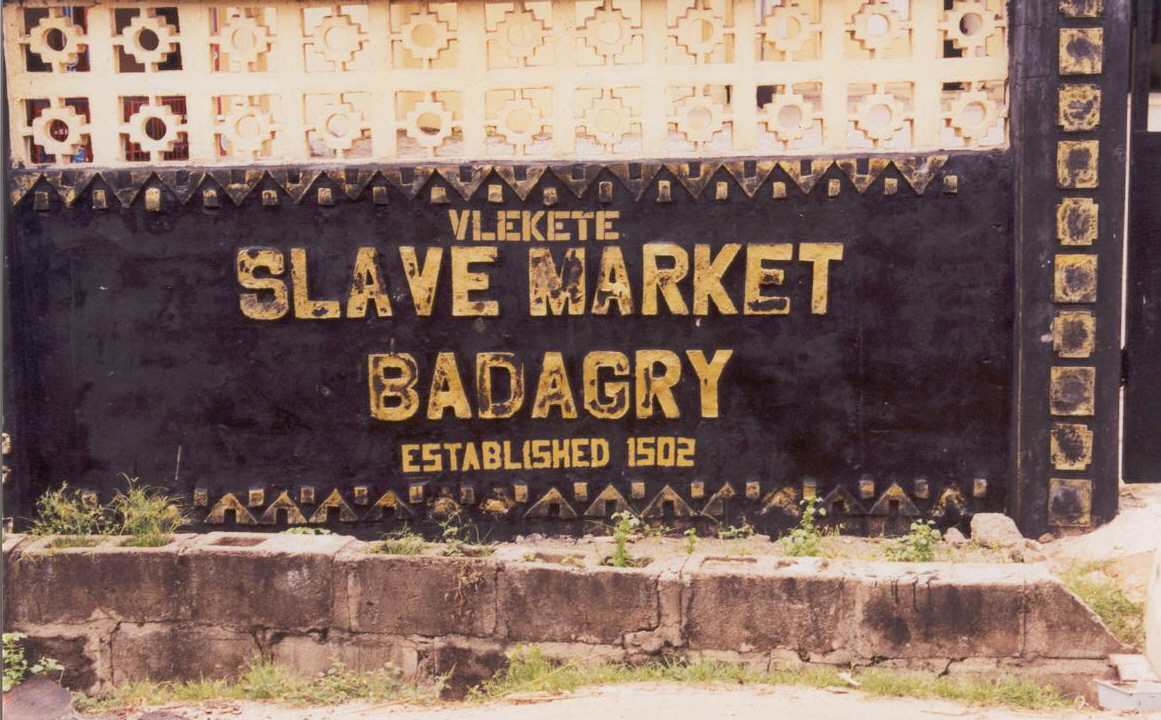
From where she may have lived, Martha's mother most likely journeyed from inland Yorubaland to the coast. And since her origins point to Nigeria, and specifically to the Yorubas, I also ask if her point of departure was Badagry? This is the largest slave market in western Nigeria, and had she come from this region, her small tiny footsteps definitely had to have trod through this area.


The town of Badagry sits on the coast of Nigeria not far from the Benin border. Signs throughout the town point to many places reflecting the history of the town as a center of slave the Nigerian slave trade. 

One can easily note that more than one family, and more than one group of people were involved in the slave trade in Badagry, a town where I have personally traveled. When I visited there in the late 1980s there was not a lot of emphasis on the town's slave history, But today, at least six different sites point to the era of the slave trade, and invite visitors and tourists to come and learn more about what happened. 

I cannot help but ask, whether Martha's mother passed through one of these places that today bring those visitors and tourists:


Did Martha's mother walk along the beach behind this wall to an unknown fate?
Badagry Slave Port


Was Martha's mother, held in a Barcoon cell similar to this one in Badagry known as the Brazilian Baracoon that held thousands before they were taken to the Americas?


And would she have been branded at this market before being placed on the vessel that would take her to an unknown future in Virginia in British North America?

Slave Market in Badagry, on the coast of Nigeria


Somehow in spite of the horrors of the unimaginable, the young girl who would become Martha's mother survived.  

Who was she, and how did she fare?
Who first enslaved her?
Did she have have any tenderness or kindness shown to her in her life?
Was her only joy to have been the mother's joy at birth when Martha was born?
And did she live to see Martha for long in her life, or was her child sold away from her?

Only a few details remain and they come through the few facts about Martha, her daughter. Martha, though born in Virginia was taken at some time from to Tennessee, enslaved by "Squire" Robert Campbell of Maury County Tennessee. Martha would give birth to several children during the 1820s. It is known that Martha and her children were living in the 1830s and would live through the Night the Stars Fell. By the 1850's some of Martha's children would be taken to Mississippi, as slaves of William "Tandy" Young, of Tippah County, in the town of Ripley. The Tennessee slave holder died and Martha's children "were taken in the draw" as the slaves in the estate were divided. Martha's children and grandchildren would live to see freedom and and the other chapters in that family line would eventually unfold.

But I still must pause and ask, who was Martha's mother?  

Who was my "Priscilla?"

* * * * *

(The African American Blogging Circle is a group of genealogy bloggers who have decided to share their family stories seen through their own lens. As the PBS Series The African Americans: Many Rivers to Cross Airs, the bloggers will be sharing their stories as seen through their own personal lens. Click here for a list of the participating bloggers.)


Looking at Many Rivers To Cross - Blogging Through the Series


Many within the African American community have been awaiting the series "Many Rivers to Cross". A smaller group within the African American genealogy community has also been awaiting the same series, as we will be blogging our way through the series. 

Our goal is to put our own historical and genealogical spin on the story as well. We have therefore created a blogging circle in which we will share our own family saga in relation to the time periods reflected in each episode.

The series is divided into many six time periods:
Episode 1: The Black Atlantic  (1500-1800)
Episode 2: The Age of Slavery (1800 - 1860)
Episode 3: Into the Fire (1861 - 1896)
Episode 4: Making a Way Out of No Way  (1897-1940)
Episode: 5 Rise! (1940 - 1968)
Episode 6: It's Nation Time  (1968 - 2013)

We shall share pieces of our own histories in relation to the program and also give our own insights into our personal stories as we reflect upon our own family's journey through the American experience.

My fellow bloggers include:
*Melvin J. Collier, Blogger and Author of two books on his family history. His blog is: Roots Revealed.
*Vicky Daviss Mitchell, Genealogist and Blogger. Her blog is: Mariah's Zepher,
*George Geder, Activist and award winning blogger. His writings will appear on Medium.
*Terry Ligon, Genealogist and videographer Chickasaw Freedman researcher. His blog is Black And Red Journal.
*Drusilla Pair - Genealogist, University administrator and blogger. Her blog is Find Your Folks.
*Nicka Smith - Genealogist, Photographer, and Blogger. Her site is Who Is Nicka Smith?
*Angela Walton-Raji, Author, Genealogist, Blogger and Podcaster. The blog is My Ancestor's Name.

The first episode has just aired and in the following days, the relevant blog posts will be posted. Join us as we embark upon the same genealogical journey together.