Showing posts with label Genealogy. Show all posts

Monday, January 2, 2017

If Only We Could See Their Names - Part 1


When searching for enslaved ancestors, the first major frustration comes for the first time researcher, when he or she encounters the slave schedule in the 1860 and 1850 census for the first time. The shock to the researcher is that the "slave census" does not contain the names of the slaves. Only the name of the slave holder is recorded. That is also the first time that one encounters the reality of slaver and its horror---the ancestors were not considered to be people worthy of names. They were simply property and their presence as enslaved people only meant that they would be counted, just as cattle, horses, and other livestock.

And usually upon that discovery, the researcher heaves a very heavy sigh, exclaiming, "if only we knew their names."

And so it goes. But several years ago, while in Chicago attending a conference, I met Belzora Cheatham who was anxious to share a find! One line of her family is from Bowie County Texas and she had just found them on the 1850 slave schedule. With their names!

The document was one of those amazing errors in the census that many whose ancestors were enslaved, wish we could find. The error was a wonderful one---the enumerator wrote the names of the enslaved people--all of them!

I have thought of Ms. Cheatham many times over the years and several years ago, I looked at the records myself, and wrote a piece about them. I recently looked at that small collection of records from District 8 of Bowie County, and decided to write another article, because of its significance.

We recently celebrated the indexing of the Freedmen's Bureau records and how important we can now look at the years between 1865 and 1870 and learn about our ancestors in the early days of freedom. But this slave schedule is equally significant--although it reflects a tiny community---this is 15 years before freedom, and this provides a rare glimpse at people still enslaved, and their names can be called.

So many of us find the slave schedules for the first time, and then sigh in frustration noting that only the names of the slave holders are recorded. For those who survived enslavement and who lived to see freedom--it would be 20 years before their names would be in print again on a census. And for some--who did live to be free, this is the only piece of evidence that they ever lived.

A few years ago I wrote a small article about this collection, but I only included a few images. But upon reflection of the fact that for some--their names would never appear in a census as free people, and in light of our focus on celebrating everyone, enslaved and free, I have decided to include this larger article and share all 23 of the pages. So therefore, I am submitting this two-part piece reflecting the names of the enslaved population, sharing the images themselves. The district was not a large one, and therefore they deserve to be seen, by all.

The images reflect District 8, of Bowie County, Texas. There are only 23 pages reflected in this slave schedule, and all will be shared on this blog. The first 12 are shared below. (Part 2 will reflect the remaining pages.)


1850 Slave Schedule
Bowie County, Texas, District 8
Ancestry.com. 1850 U.S. Federal Census - Slave Schedules [database on-line]. Provo, UT, USA: Ancestry.com Operations Inc, 2004.
Original data: United States of America, Bureau of the Census. Seventh Census of the United States, 1850. Washington, D.C.: National Archives and Records Administration, 1850. M432


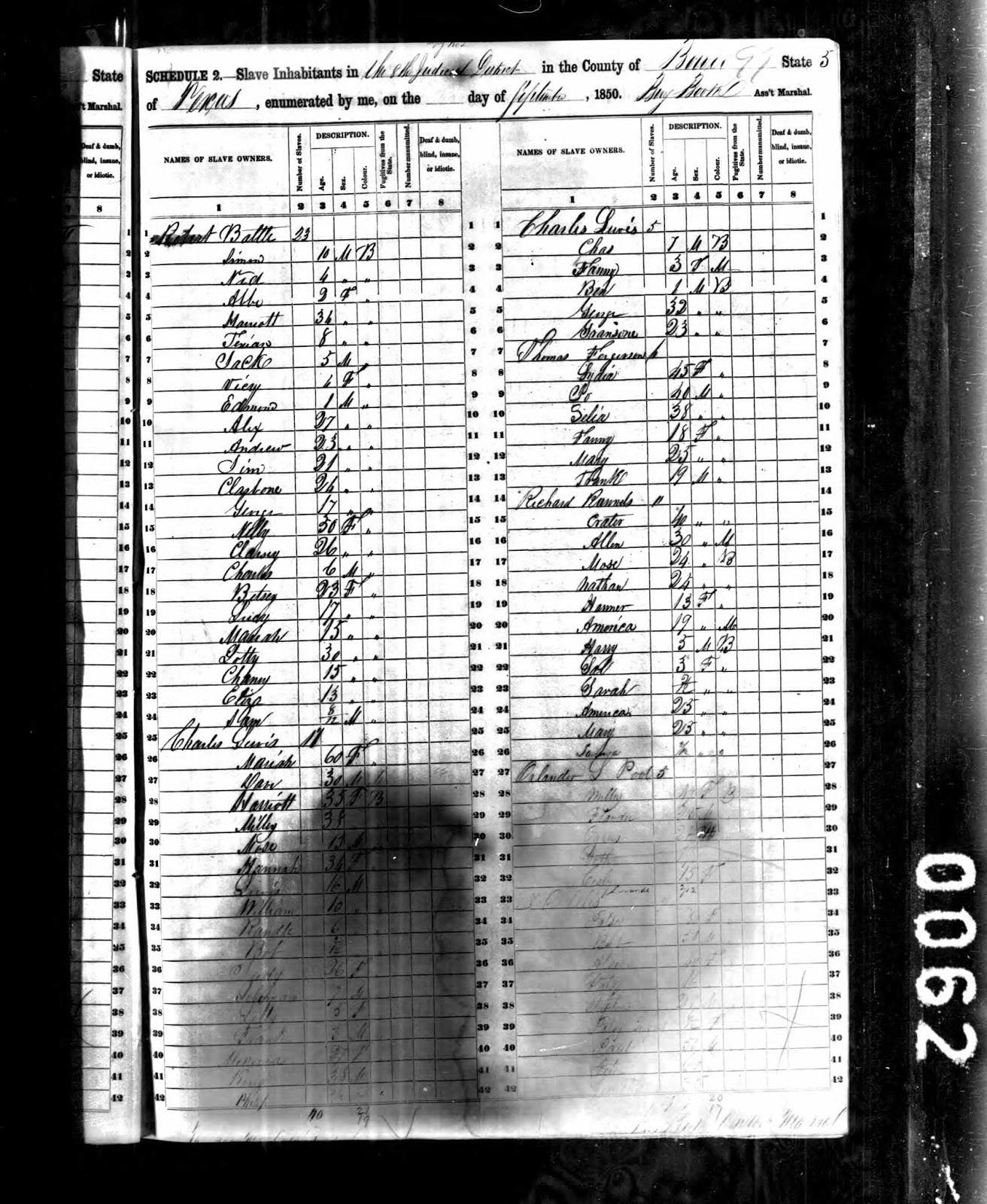


It is clear upon looking at the images that some severe water damage occurred on the pages of the census book. This is most unfortunate, as in many of the pages,the names have simply vanished with the dampness, dissolving the lettering.


As one moves through the pages some of the water damage appears to lessen. And in some places on the page the names of the enslaved people can be read through the water stains. 


Though the water stains are still there, hopefully others new to the process will still look at the names of these people who lived during a trying time. My hope is that most did survive and live to breathe the air of freedom.

End of Part 1


Tuesday, November 8, 2016

Honoring the Ancestral Voters and Committing to Voting Today

Source of Image: AfroTexan

Did my ancestor's vote? I have evidence that many of them did, and so did many freed people take advantage of their ability to participate in a process denied to them for centuries.

Well, one of the treasure in researching my Bass family is that of an 1867 voting record, of Uncle Napier Bass. He is the first of many cousins bearing his name. He was taken to Texas in 1860 from Elkton Tennessee. He remained there after freedom, and made Fayette County Texas his home. His name appears on a Voter Registration document from the county that was made in 1867. His name on this record reflects the first time an ancestor's name appears on a record reflecting his having been a voter. It is therfore, fitting that on election day that I share this image.


The oldest document reflecting one of my ancestors as a registered voter.

Texas, Voter Registration Lists, 1867-1869 Fayette County
Image Source: 1867 Voter Registration Lists. Microfilm, 12 rolls.
Texas State Library and Archives Commission, Austin, Texas.
Accessed from Ancestry.

Having cast my ballot this morning, I feel a remarkable sense of relief. So glad that what has been an 18 month process with early televised debates, I am so happy that it is finally coming to an end. And this year's process has been remarkably disturbing with one candidate offending almost every segment of society. The candidate of hate (who shall not be named) has made this a frightening time for me and for those whom I love to be in this country, has made me fearful of the future. As a person of color the hateful tone of this election season and the support of the candidate of hate, reflects widespread support for a bigoted man. And more disturbing has been to see the support even coming from those who once had my respect, and this has been most unsettling. I know now that I might not be safe around them. I shall have to note more closely my movements and associations in the future.

Harper's Weekly, November 16, 1867 p. 1
Sketch by A. R. Waud


However today, after casting my ballot, I feel a sense of relief and calm.

The long lines this morning were comforting to see. Heavy voting suggests that the people have a voice and they are determined to see that some good things will happen and that some things will not happen. And I am grateful for those leaders of the past that made the past two elections possible.


As many of my friends and relatives in the south only got to vote in the 1960s, I also think of the many who were terrorized, beaten, and killed for simply trying to vote. They are honored every time that I vote, and I am humbled when I think of them.

And as a woman, I am also humbled. I think of the many who fought for voting rights for many years, and who also suffered. Women like Fannie Lou Hamer, endured beatings and who fought nevertheless for voting rights in Mississippi. She dared to tell her story to all in 1968.  Yet, many who saw her speak then, still defend their support of a hate filled candidate (who shall not be named) who wishes to go back to the "great days" that were not so great for people of color, when Fannie would be beaten for her work.

Fannie Lou Hamer at the Democratic Convention in 1968

And I think of the women also who further back in time fought and marched so that women could also vote. The women were truly souls of courage and grace, deserving our respect and honor. From the unknown suffragettes such as Hattie Redmond of Oregon to the well known Susan B. Anthony, I was truly honored to vote today.

Lesser known Hattie Redmon, suffragette in Oregon
Source of Image: Oregon Encyclopedia


And the most moving image of the day has been watching a live broadcast of people in Rochester New York, visiting the grave of Susan B. Anthony. On a day in which a woman's name is on the ballot for president, it is fitting that on a day when history is being made, to see people visiting her grave, and thanking her for her work. This has truly moved me.
Image from Live Feed of Visitors to Susan B. Anthony Grave
(Courtesy of WROC-TV. Rochester NY)

I reflect and know that recent efforts by an obstructionist Congress to suppress the 14th Amendment and the 15th Amendment have been disheartening to say the least and destructive to the country, and their efforts have instilled fear in my heart. My sense of safety and well being have been affected by such blatant racism and hatred being shown by elected leaders.

But for some reason, I now have a feeling now of optimism and that the nation has seen the evil emanating through endorsement of hate coming forth, and I pray that they will stop the descent and rise.

The long lines at the polls today told me that the suffering of the 1960s were not in vain. The long lines told me that when we speak through our vote, we shine, and we can win.

What an awesome power lies within one's ability to vote. I feel therefore inspired to share a few images from the past of people once denied, finally exercising this incredible task of voting. It is a right and a responsibility to make a nation better. And it is a responsibility to keep it from back-sliding into a era of blind intolerance, bigotry and racial superiority.

The heinousness of it all can and will be blocked by the actions of a people who will not allow it to happen.


I care, therefore I vote!

Thursday, May 12, 2016

Gems from the Black Press: Remembering Western Baptist College


Today's Focus
Advertisement for Western Baptist College in Missouri
from The Missouri Messenger January 26, 1900

Source:
Ancestry.com. U.S., African American Newspapers, 1829-1947 [database on-line]. Provo, UT, USA: Ancestry.com Operations, Inc., 2013.
This collection was indexed by Ancestry World Archives Project contributors.
Original data: Negro Newspapers for the American Council of Learned Studies. Washington, D.C.: The Library of Congress.


One of the pleasures that I enjoy when conducting research is to explore the amazing articles and ads that I find in old publications. I am particularly attracted by the articles from the African American press that reflect many aspects of the African American Community over a century ago. I have noticed that a good way to learn about one's local community is to examine the classified section of early black newspapers for they reveal businesses, churches and schools in their early years. Some of the ads reflect activities of institutions long forgotten, while others reflect schools that have morphed into larger entities.

I decided to take a look at "The Missouri Messenger" a publication that was said to be "the organ of 35,000 Baptists". In that particular edition, I learned about an institution with which I was unfamiliar. The classifieds of a 1900 edition of the paper brought to my attention an ad reflecting Western Baptist College, a small Baptist college located in Macon, Missouri.

(Source: Same as above)

The college offered Christian education, and elementary and a normal school, with training for the ministry as well. Western Baptist was a boarding school as well as as a day school. Upon researching the history of the school, it was amazing to find out that the school still exists to this day. It is the first and only religious affiliated institution west of the Mississippi founded exclusively by African Americans.

The history of the school goes back to 1889 when a special meeting of  Baptists took place in Sedalia Missouri, and from the series of meetings in that state, it was decided to lease an old church building for 5 years for the purposes of establishing a school. After arrangements were made, the school opened in January of 1890 enrolling 14 students. Within a year's time an offer for a permanent location of the school was accepted from parties in Macon Missouri. There was immediate interest in the school and its legacy was established. Petitions for funding for the college were met and granted from multiple parties including endorsements from local white Baptist churches in the local area, as well as the Baptist Home Mission Society based in New York that donated $1200 to the school. (Source of historical information.)

The school was strongly supported by the Baptist church and it was common that members of the Church's hierarchy often visited the school. The same edition of the Missouri Messenger reflected the visit of pastors from St. Louis to the campus.

(Source: Same as link from above image)

Like many Historically Black Institutions, Western Baptist offered a preparatory school in addition to the normal college programs. The school began offering programs to both males and females, and eagerly sought assistance for the erection of a dormitory for girls on the school's grounds.

(Source: Same as above.)

For over 30 years the school thrived in Macon, and in 1920, the school moved to Kansas City Missouri. It was located at first on Woodland Avenue of the city and later Tracy Avenue in the city. Over time the focus became centered on higher education and that became the focus and continues to this day.

Today the school still operates as Western Baptist Bible College as a four year institution devoted to Christian education. The school has also expanded now to operate on several campuses throughout the states of Missouri and Kansas. In Missouri campus are located in Kansas City, and St. Louis. In Kansas campuses are now located in Topkea, Wichita, Olathe, and Junction City. College Commencement will take place this year on May 12, 2016 on the at 8th Street Baptist Church in Kansas City Missouri.

The Missouri Messenger is a unique paper reflecting not only the Baptist community that it served, but also a unique school with an interesting legacy and history. It can be viewed on Ancestry in the collection of African American newspapers.

Wednesday, April 13, 2016

Notes from the Colored Convention, Little Rock Arkansas 1865

Image from Colored Convention Nashville TN, Frank Leslie's Illustrated Magazine, May 6, 1876


                              We dream no more, our country wakes at last.
                              And reads wise lessons from the stormy past.
                              The spirit of the nation, proud and free
                              Might err and wander reft of memory.

                              But linked to truth, magnetic poles of yore
                              The dead sense wakens and she sins no more.
                              The drama moves, the people fill the stage
                              And virtue will restore the golden age.

~Words from the Colored Convention, 1865, Little Rock Arkansas

Throughout the south in the years after the Civil War, newly freed African people assembled in large numbers to discuss the future, share their common goals and to publicly declare their directions and hopes for the future. These gatherings were known as Colored Conventions and though they are seldom mentioned today, these were critical first steps made by the ancestors on the brink of a new direction and life course.

Such a convention took place in Arkansas in the state capitol in Little Rock in 1865. Most of the delegates were from Pulaski County, but several from other counties also participants. I was glad to see that George Sewell of "Sebastine(sic)" county was there. 

The minutes and proceedings of those meetings are left behind and as we make the effort to tell the family story--we need to incorporate the impact that such meetings may have had on the larger population.

The delegates of the Arkansas Colored Convention were:

From: Proceedings from the Convention of the Colored Citizens of Arkansas Held in Little Rock, Thursday, Friday & Saturday Nov. 30, December 1 and 2, 1865


These pages reflect notes emanating from that first Colored Convention in Arkansas. The minutes of this convention other conventions held throughout the south are found on a wonderful website called "Colored Conventions" .


Although I did not recognize the names of the delegates to the convention, it is still part of the local Arkansas history and these proceedings reflect a strong step that the newly freed population took to determine its own life course, and this is a story that needs to be told.

Sunday, January 3, 2016

Black Genealogy Webinars for 2016

Webinars Offering African Ancestored Focused Sessions

Happy New Year!

Now that the new year has arrived we are all looking ahead to new opportunities to share, and to learn! For those that are unable to travel, there are a number of webinars and live online presentations that will allow everyone to take advantage of and hear some interesting presenters. And if African American ancestry is an area of interest there are several opportunities to watch for the coming year!


February 2016
February 9th

The Illinois State Genealogical Society, offers a webinar once a month throughout the year. On February 9th, at 8pm Central time, I have the honor of presenting a session entitled, "Reconstructing Black Community Life Through Benevolent Societies". This workshop will explore the various 19th and early 20th century groups that impacted the social fibre of black communities for many decades. The session will methods of identifying the presences of these groups in the ancestral community. Click HERE to register for this session.

February 17th
The Southern California Genealogical Society will feature Nicka Sewell-Smith on February 17th, at 9pm eastern time, as she presents the workshop, "The Family Historian's Publishing Primer". In this session Ms. Smith takes you beyond your family history database, where she will show you how to plan, manage produce the publication and how to promote the book upon completion.Click HERE to register for this session.

March 2016
March 18th
The No. Carolina Genealogical Society will feature J. Mark Lowe on March 18th. His topic is "Researching Black Ancestry in a White World" at 9:00 pm. He will also present the same topic in April. To register for this event click HERE.

April 2016
April 8th
Legacy Family Tree Webinars will feature Melvin Collier on the 8th of April. His focus is: "Confirming Enslaved Ancestors Using DNA". In this session, author Melvin Collier will illustrate how DNA evidence connected descendants previously unknown to each other and how they solved a family mystery when DNA pointed them to each other. To register for this event click HERE.

June 2016
June 10th
Legacy Family Tree Webinars will sponsor a webinar called, "Introduction to the Freedman's Bureau". I personally have the honor of presenting that workshop. Many people hear references to the Freedmen's Bureau, (which was officially the Bureau of Refugees, Freedmen and Abandoned Lands), but they have no clear idea of the diversity of records, and the diversity of the people reflected in those records. Southerners, both white and black, and also white northerners who worked in the Bureau are also reflected in these records. This session will provide an introduction to the Bureau and its holdings of interest to genealogists and historians. To register for this event click HERE.

August 2016
August 12th
Legacy Family Tree Webinars will sponsor an interesting webinar focusing on Homestead Records. Bernice Bennett will a case studying looking at family from Livingston Parish Louisiana,that acquired land, and the inter-connected families that are found within that file. To register for this event, click HERE.

I hope that this listing of webinars will be useful and that some will be added to your genealogical calendar. 

As more events are planned, this schedule will be updated.

Wednesday, June 17, 2015

Freedmen's Bureau Indexing Initiative Begins June 19th


Live Announcement to be streamed online

A major initiative will be announced live on Friday June 19th at 1:00 pm EDT. Coming live via video stream from California, Family Search will announce that the genealogically critical records from the Bureau of Refugees Freedmen and Abandoned Lands---the Freedmen's Bureau, are now available online for genealogists to study. And for this critical record set to be used best by the genealogy community, Family Search is putting forth a call to action to get these records indexed!

Genealogists of all backgrounds will find the amazing records of the Bureau, to be vital to all 19th century southern research. The Bureau is also known by many researchers and scholars as National Archives Record Group 105. Now thanks to digitization genealogists with ancestors throughout the south, will be able to explore labor contracts, transportation records, hospital records and much more.

All Cultures Are Reflected in the Bureau Records

One thing must be emphasized---Record Group 105 should be of interest to all Americans, white, black and even Native American. The "refugees" served by the bureau were white southerners. The Freedmen were black people once enslaved, and newly freed, and the abandoned lands belonged to the white land owners, left abandoned during the years of the Civil War. This record set will allow many people to find their ancestors during those critical  years between 1865 and 1870 when they appear in the first Federal census as citizens in the land of their birth. And many southern whites whose families were left without land and resources after the Civil War will also find their ancestors receiving rations and petitioning for aid after the surrender.  Those whose ancestors served in the Union Army will find their ancestors among the workers of the Bureau, and others may find them as teachers in the Freedmen schools throughout the south. In western field offices like Ft. Smith Arkansas, one will even find Cherokee citizens being served by the bureau.

Early Marriages Recorded
For many, a particular treat will come with the dozens of Field offices of the Freedmen's Bureau that allowed formerly enslaved men and women to have their marriages recorded. Some of the records appear as simple ledgers while others are full elaborate certificates. These ceremonies were often recorded by the chaplain stationed at the military post that became the site of the Bureaus's field office. In some field offices full pre-marriage data was collected, in the form of co-habitation records as well. This name-rich record set will provide new information for researchers, and the access to these records is going to open doors once considered closed to many researchers whose ancestors were enslaved.

In previous posts I have shared samples of records from the Bureau. Hospital Records as well as marriage records, and transportation records reflect the vast amount of data found in the various field offices. In addition, bounty records reflecting payment of US Colored Troops after the war are also among the wonderful records to be found.

In 2011, I wrote a piece devoted to the Ft. Smith Arkansas marriage records that reflected ceremonies performed by Chaplain Francis Springer. 


The Challenge
The challenge is to get them indexed, so that families can be found. 

Many unwritten chapters in American history lie among the millions of pages to be indexed. 

Our charge is to get to them, and bring forth their names so that we can bring forth their stories!

We can get this done!


Friday, June 5, 2015

Southern California Genealogy Jamboree Begins


The Southern California Genealogy Jamboree is now underway! 

I had the honor to share a panel with Bernice Bennett, and Nicka Smith for the panel "Reaching Out and Reaching In" early this morning. This was the first session offered in the African American track at the Jamboree. 

(courtesy of Felicia Addison)
Our panel listening to comments from audience.


A very poignant discussion unfolded and the interactive action that we desired, unfolded smoothly. And delightfully there was good audience participation. They found the topic to be a much needed one, and everyone shared their thoughts and ideas.

Bernice Bennett served as moderator of the panel and raised several key questions,

What does reaching out reaching in mean to each of us?

Why isn't there diversity?

What is the community?

Who "owns" the African American story?

Where do we begin?

As a presenter I was delighted to see the participation from the audience, and their willingness to share their stories with each of us.

After the session ended, I had the honor of meeting a gentleman whose family history I had researched and blogged about in 2013. He had printed the article  and asked me to autograph it for him. What a humbling thing to meet him and to know that he had appreciated the article.  He, Mr. Tommy J. Clark of San Diego, is a direct descendant of Chickasaws, Samuel Chawanochubby and Mason Clark.


Awaiting the opening of the exhibit hall later and I shall be posting things from there. But the day is off to a great beginning!

Sunday, April 5, 2015

First Marriages in Freedom, Sevier County Arkansas 1865

First Marriages of Formerly Enslaved Men and Women, Sevier County Arkansas 1865
Source: 
"Arkansas, Freedmen's Bureau Field Office Records, 1864-1872," images, FamilySearch (https://familysearch.org/pal:/MM9.3.1/TH-1942-46287-8953-41?cc=2328125&wc=9VR9-BZC:1076659111,1076659115 : accessed 5 April 2015), Paraclifta (Sevier County) > Roll 18, Register of marriages, copies of indentures, and register of purchase vouchers issued, 1865-1867 > image 5 of 21; citing NARA microfilm publication M1901 (Washington, D.C.: National Archives and Records Administration, n.d.).


One of  the first acts of freedom when the Civil War ended, was the opportunity for men and women, once held in bondage to freely marry whom they wished to marry, and to have their marriages recorded so that their commitment to each other would be known by all. This act was so important to former slaves, since up until that time, their spouses could be snatched away, sold never to be seen again. Thankfully a few such records of those first marriages could be found.

In Sevier County Arkansas, one of my ancestral communities, I found three couples who are among the very first African Americans who dared to have a ceremony performed by an official at the Freedman's Bureau. The community was Sevier County Arkansas located in the southwest portion of hte states. In December 1865 three couples were married by the chaplain in charge of the Paraclifta Field office. They are not related to me directly, but one of the names did stand out, as it was a name that my family mentioned over the years as being close neighbors, and even tenants in later years on and in recent generations even cousins.

The Freedman's Bureau, officially known as the Bureau of Refugees, Freedmen and Abandoned Lands, operated in multiple states, and the purpose was to provide some assistance to newly freed slaves.

One can only imagine the fears of having to suddenly "conduct business" in a community where before the war, one could not even walk on the roads without a pass, or permit. Therefore finding these marriages--one can imagine the fears of approaching the courthouse to obtain a marriage license, when, before the war, the closest one came to the courthouse was when one was being auctioned to the highest bidder--as property--human property.

So, the significance of these three marriages, written in a Freedmen's Bureau ledger, is significant. These three couples were married, and their marriages were from this time forward to be recognized as legitimate bonds between two people who loved each other. This is one of those times in which their status as human beings was being inscribed for the first time in the county where they had lived, toiled, and their ancestors had died.

I was thrilled to find these names and hopefully descendants of these families will someday find this ledger, print and appreciate it for the gem that it is. At the creation of this simple marriage ledger, the trajectory of these three families was forever changed. They were no longer human chattel to mistreat, ignore, and trade. They were husbands, and wives, who would become the matriarch and patriarch of families now free to move forward in a new world.

I share their names here:

Marriages:
Groom: Charles Clark
Bride:  Louisa Boshell

Groom: Alexander Dilahunter
Bride: Nancy Sherrott

Groom:  James Hollman
Bride:  Jinsey Coulter

I recognized the "Dilahunter" name. My grandmother who was the daughter of Louis Mitchell Bass, often spoke about her neighbors the "Dillahunts". I later noticed that the "Dillahunts" were actually "Dillahunty" and the name sometimes appeared in the records also as "Dilahunter".

Seeing the names of the first Black marriages performed in the very year that slavery ended, is humbling indeed. Also it should be noted that the 13th Amendment to the US Constitution was officially ratified in December of 1865, the same month in which these marriages were performed.

It took some time for the larger white community to acknowledge that those once held as property were indeed free men and women. But these six people--these three couples were among those who courageously took some of the first steps and dared to make their mark upon the ledger of the free.


Wednesday, February 11, 2015

On the Eve of Roots Tech


Well it is amazing how a day can be truly full even before the conference begins. I arrived in Salt Lake City yesterday afternoon, and was settled in at the Radisson hotel with two genea-buddies, Shelley Murphy, and Bernice Bennett. And after a good night's rest we arose to the various tasks that awaited us.

After a wonderful breakfast at the Radisson, I then needed to officially register, to obtain my conference badge and plan the day. The conference guide is an attractive, and streamlined journal that meticulously outlined the workshops in both conferences, and included biographies and so much more. (For those that don't know, Roots Tech and FGS are taking place at the same time, in the same facility--the Salt Palace Convention Center.)

Front page of Conference Guide Book

There are over 130 pages in the book that has a slim and sleek appearance. The conference guide has a sleep and professional look to it, with a full description of events to unfold in the next three days. The size is perfect as it easily slips into a purse or folio.

The thin size still consisted of 130 pages of RootsTech/FGS events

I spent some time in the business center of the Radisson hotel, polishing my presentation for later in the week. With some free time on my hands, I was able to engage in my favorite exercise--research.
So, I went down to the Family History Center. While there, I was able to copy more than 70 documents and put them on my flash drive.


Family History Library, Salt Lake City

One thing about attending an event this large is that one must truly be prepared to walk, alot. The Salt Palace Convention Center is huge, and though the hotel is next to the facility, that does not reduce the walking. While going through two huge exhibit halls that were being set up for the next several days, then going down the long never-ending halls, does make one appreciate health. Add to that fact that the city is in the mountains, so that means slower walking for those not accustomed to thinner air. Thankfully the weather was beautiful walking outside was not too hard.

I took a break to have something for dinner, after which, I returned to the Family History center to continue my research. After another two hours went by quickly fatigue set in and I knew I need to come back to the hotel for rest. The opening session is tomorrow, and the day will unwind with lots of things to do, thousands of people to see and two entire exhibit halls to roam tomorrow.

And so it goes, on this eve of  Roots Tech, and all I can say is "bring it on"! 

Tuesday, February 3, 2015

Source: Harper's Weekly, 1867
The image from Harper's Weekly always warms my heart. In the image one sees men of color participating in the affairs of government, by voting. That simple act of casting a vote is so well reflected in the image. One sees a man dressed as he may have been a farmer. A suited man stands behind him, and then there is the soldier. All are standing proud as men ready to participate in the voting process for the first time, in country of their birth. This was a privilege that until February 3, 1870, that they had not had. But finally when given the opportunity, they did cast their votes so proudly.

On this day in 1870, the 14th Amendment to the US Constitution was ratified. This amendment state that  "right of citizens of the United States to vote shall not be denied or abridged by the United States or by any state on account of race, color, or previous condition of servitude."

Of course the next century would see continuous efforts to prevent the vote from being extended equally to all. And many states would rescind claiming states rights to prevent people of color from exercising this right. Until 1964 and the Voting Rights Act, efforts to prevent the descendants of former slaves from having equal rights. The struggle was a long and painful one. I recall as a young girl listening to a courageous Fannie Lou Hamer  speak of how she was so brutally beaten for fighting for that simple right to cast a ballot. It was hard to understand how after almost a full century after ratification, the battle for the right to vote was still being fought in this land.

Although this is not a widely known data in American history, it should be, especially in this season of Freedom. So we must pause and understand the importance of February 3 and not forget its significance.

The right to cast a vote was ratified, and to all who fought to keep that right and to defeat illegal laws that were put in place to supress that right, this day should be commemorated.

It is our history. It is American history.


Friday, September 19, 2014

One Newsaper, Two Homes


Over a year ago, I was fascinated when doing some research to come across a digitized image of a Black newspaper called the Broad Ax.  This newspaper started out in Salt Lake City, and had an amazing history from an amazing editor.

Julius Taylor was a unique man with unique ideas that covered many aspects of politics. He traveled from Virginia, to the Midwest before settling in Salt Lake City Utah in 1895. A year later he launched the Broad Ax, from his base in Utah. This is amazing since at that time, there were so few people of color in the state of Utah. It is estimated that there were less than 1000 African Americans in the state at that time. It has been noted that in 1890, the population was less than 600. (1)

Taylor was often in conflict with people of varying opinions politically and religiously, but stated in his newspaper that people of varying opinions could respond to his thoughts "so long as their language was proper, and responsibility is fixed." [2]

Taylor could be described as a man of interesting politics in many ways. At a time when most Black Americans were politically leaning to the policies of the Republican party in the late 1800s, he was one who encouraged Black readers to consider more the politics of the Democratic party. Interestingly, that shift would occur decades later in the 1960s after the Voting Rights Act. Black registered as Democrats and those with more conservative and sometimes "anti-black" sentiments began to shift in larger numbers to the Republican party. Taylor often lectured how the preferred party of the time had abandoned the Lincoln values and had shifted away in a different direction. He particularly deplored the actions of the Republican Party convention of 1896 nominated persons of all religious and ethnic backgrounds except African Americans.

Julius Taylor did become a strong voice against the lynchings throughout the nation of black people and often was a spokesperson against lynching in The Broad Ax. He also worked tirelessly to encourage the placement of Blacks in Salt Lake City city council, where he met much opposition from a strongly conservative population.

Taylor did not have strong religious feelings and often spoke against issues and conservative policies of the Mormon church and other faiths as well.

His strongest interests were continually equality for all people and the sentiment was found often in his editorials.

Three  years after publication, Taylor left Salt Lake City, and after efforts to have involvement of people of color  and relocated the offices of The Broad Ax to Chicago, where he worked within a city that had a more sizable black population. (2)

************************

1.  Utah Digital Newspapers, Creating Citizen Historians [Link to quotation]

2, A detailed article about Julius Taylor and The Broad Ax can be found in a digitized copy of the Utah Historical Quarterly, Volume 77, No. 3, Summer 2009 p. 204.

Tuesday, July 15, 2014

Reflections from MAAGI 2014


The second year of the Midwest African American Genealogy Institute took place last week in St. Louis Missouri at Harris Stowe State University, and it was an honor to be a part of it once again!

I can only say that the energy put into the classes, by both faculty and participants alike was truly amazing and so many had their genealogical process enhanced and expanded by the experience.

Was MAAGI Just Another Conference?

Not at all! This was a teaching institute and there was a good amount of "hands on" work, homework and projects. The participants were kept busy and they found that much of what they worked on, could be put to use immediately.

Last year, someone asked if this was an event "where people just talked about their own family history"! Nothing could be further from the truth!

And in fact, one only has to look at the courses offered to see that no such thing is a part of MAAGI and shall never be! And the structure of the institute guarantees that the program will not be a platform for people simply show what they did with their own family tree.

MAAGI is an institute where instructors teach and do not simply talk. From Technology, to Broadcasting, and from the scrutiny of pension files to planning their own blogs and platforms, the participants emerged as activists in the genealogy community. So no, it is not a conference at all and one will not find themselves bored with a story of how someone documented their own family.

On any day, one could peer into the classes and see small groups analyzing Civil War Pension files looking for briefs, or rehearsing for a radio broadcast, or even analyzing selective service records. As an educator, I appreciated seeing the hands on activities that kept participants engaged.

A real highlight was to watch an evening study group form and to watch how so many worked hard with their instructor on personal time lines, and got assistance from each other over a periods of several hours.

Professor Shelley Murphy gave every single person in the group individual attention, and to see that group in the hotel working around a table with laptops and notepads.

Renate Sanders of Virginia works on her laptop while a colleague looks on.
(Photo: Courtesy of Charles Brown)

Gary Franklin of Ohio listens closely as another group member speaks
 (Photo: Courtesy of Charles Brown)


Professor Shelley Murphy explains ancestral time lines as others listen.
(Photo: Courtesy of Charles Brown)


Pat Meredith of St. Louis takes copious notes during study session.
(Photo: Courtesy of Charles Brown)

It was fun to observe and later to listen to participants in Track 4 as they began to organize and plan the radio broadcast for Blog Talk Radio. Konnetta Alexander took the lead and directed some of the initial discussion for the group, working on the white board as the participants organized their possible topics for their broadcast.

Konnetta Alexander of Nashville TN records suggestions from Track 4 group.

It was exciting to walk around during break time and it was not unusual to see group members connecting and having intense discussions about research challenges and solutions.

Hazel Moore of Baltimore, and Argyrie McCray of Windsor Mill MD 
engage in detailed discussion of their research.
(Photo courtesy of Shelley Murphy)

There were also some amusing times such as when the photographer came to capture the Technology Track on camera, and they decided to take a photo of the photographer. The result is this fun shot of the classes with their camera's capturing their own image of the official photographer.

Technology Track photographs the photographer
(Courtesy of Nicka Sewell Smith)

The Faculty

We were honored to have two noted speakers of international fame speaking at MAAGI. Thomas Macentee of Geneabloggers returned bringing his technology skills with him, and Judy Russell, the Legal Genealogist dazzled two different tracks by sharing the legal policies that affected the lives of the families that we research!

Thomas Macentee of Geneabloggers and HiDefGen
(Courtesy of Nicka Sewell Smith)


Judy Russell, the Legal Genealogist


Janis Minor Forte, genealogists and author engages her class 

Nicka Sewell Smith shared the process of documenting the research process
(Courtesy of Bernice Bennett)

Bernice Bennett leads a session on DNA
Courtesy of Linda Bugg-Simms

Drusilla Pair answers a question for student
(Courtesy of Renate Sanders)

Shelley Murphy working at the white board
(Courtesy of Linda Bugg-Simms)


Angela Walton-Raji on break between sessions
(Courtesy of Linda Bugg-Simms)

It is difficult to describe an intense learning experience, but it has to be pointed out that this year's institute was truly engaging, stimulating and also lots of fun! I appreciate the seriousness in which everyone approached the class and the class assignments, and it was a special joy to be part of the team that helped to make it happen. I can only look ahead with enthusiasm towards the future.