Showing posts sorted by relevance for query bounty. Sort by date Show all posts

Monday, June 9, 2014

Missouri Notes from Arkansas Freedman's Bureau Records


The value of the Freedman's Bureau records can not be over emphasized. One often hears people with ancestors from border states referring to the Bureau having little to nothing for them as their ancestral state did not have a Bureau office.

However, it is always wise to look at neighboring states, with the same concept of studying the neighbors in the census records. Just as our ancestors did not live in a vacuum, the states did not conduct business in a vacuum. People crossed county lines and state borders when they needed to and in the case of Missouri which did not secede, there were still people in those Missouri that used the services of the Freedman's Bureau, who made claims of varying types.

While recently examining the Arkansas Freedman's Bureau office and the Ft. Smith field office, I noticed the letterhead on one of the documents. The letterhead reflected that the Bureau served multiple communities, including Indian Territory as well as Missouri the neighboring state to the north.

The following document was submitted by a father of a deceased Civil War soldier who lived in Missouri. The father's name was Alexander Yaeger, who pointed out that he was a free man before the Civil War. In this document he declared that his son Peter Gibbs Yaegar was also not enslaved, and was also a free man. 

He requested that any bounty to be paid to his son, now be paid to him, as his son was deceased. He also requested that the bounty be sent to him in at his residence in Missouri.


Source of Images: Family Search Digitized Image of Freedman's Bu-reau Records
Arkansas Field Offices, Freedmens Bureau 1864-1872, Claims Division, Roll 1, Letters and Miscellaneous Papers May - Oct 1866, Image #4 of 46
Link: HERE

Another part of the same record contains the statement by two others who could verify that the soldiers Peter Gibbs Yaeger was indeed a free man of color and not enslaved. His free status would then have made his father eligible to receive the bounty for his now deceased son who served in the 79th US Colored Infantry. (see second image above.)

This is the kind of document that could be missed by a Missouri based researcher, if it was assumed that Arkansas Freedman's Bureau records would not be essential for the Missouri based family.

When this massive record set becomes indexed, the chances of the Missouri researcher finding data in the Arkansas based records may be higher, however, there still remains the possibility that one might choose to overlook the document based on geography. It is always wise to still examine any records that can be found and to widen one's search to include neighboring states.

Tuesday, September 24, 2013

The African American 1865 Census of Huntsville and Athens Alabama

A Census & Bounty Registry of Huntsville and Athens Alabama


Many African American researchers are hoping that there will another record that will provide a glimpse of ancestors once enslaved. Most African Americans find their ancestors in the 1870 census listed as free people at long last, and with their full names. For too many researchers, the work reaches a brick wall, simply because nothing more is known. Who was the last slave holder, and where else can one look to find their names? Occasionally that rare document arises, and it should be shared.

Some time ago,in the AfriGeneas daily lunchtime chat, Selma Stewart mentioned a special census record that she had come across. The group discussion was focused on Alabama and Tennessee and how many of the African American families in north Alabama have ties to other families from Giles County Tennessee.

Ms. Stewart who happens to be president of the Hampton Roads AAHGS  joined the conversation. She mentioned the 1865 Negro Census of two northern Alabama Communities. This was incredible--an 1865 census! This was the very year that thousands of families were finally freed-officially freed! And here was a census conducted at that very time!

I decided to explore this record to see what kind of data was collected. What a surprise  Not only were the names of the former slaves listed, but the names of the last known slave holder was captured on the record as well!!! This kind of information is so essential and most often missing! With this one piece of data-the last slave holder, more data on the family can be found!

Top of the 1865 Negro Census of Huntsville & Athens Alabama
Source: Volume: RG 105, Alabama Reel 19 - Records of the field offices for the state of Alabama, Bureau of Refugees, Freedmen, and Abandoned Lands, 1865-1872 - Huntsville and Athens (Claims Agent) Census of Black Citizens and Register of Bounty Claims Received and Forwarded Volume (79 ½) 1865 and June-July 1868 

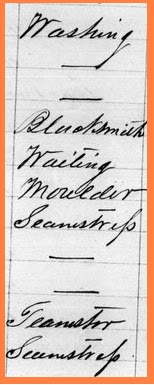
When examining the record it was fascinating to see the variety of occupations of the population. Some were basic laborers but others were skilled workers from blacksmiths to seamstresses, moulderers and other interesting occupations.  The record provides an interesting glimpse into life right after the Civil war.

Close up view of the occupations column  in the 1865 Colored Census of Huntsville & Athens AL


The resource for records such as these all come from National Archives Record Group 105, in which one will find the Bureau of Refugees, Freedmen and Abandoned Lands, also known as the Freedman's Bureau. 

The years immediately after the war brought such dramatic change, movement, and sometimes chaos in the lives of newly freed people. It is understood that these records vary from state to state, however, one should look at such records even if there are not family ties to that state. In some cases, the records reflect the lives of persons before they relocated to another community. In other state records, such as this one, a rare post slavery era census and a pre-1870 census view is found that reflects critical history of formerly enslaved people. Therefore, a record such as the 1865 Colored Census provides essential data for Alabama and Tennessee researchers.

Special thanks to Selma Stewart for sharing this valuable data.  


Wednesday, June 17, 2015

Freedmen's Bureau Indexing Initiative Begins June 19th


Live Announcement to be streamed online

A major initiative will be announced live on Friday June 19th at 1:00 pm EDT. Coming live via video stream from California, Family Search will announce that the genealogically critical records from the Bureau of Refugees Freedmen and Abandoned Lands---the Freedmen's Bureau, are now available online for genealogists to study. And for this critical record set to be used best by the genealogy community, Family Search is putting forth a call to action to get these records indexed!

Genealogists of all backgrounds will find the amazing records of the Bureau, to be vital to all 19th century southern research. The Bureau is also known by many researchers and scholars as National Archives Record Group 105. Now thanks to digitization genealogists with ancestors throughout the south, will be able to explore labor contracts, transportation records, hospital records and much more.

All Cultures Are Reflected in the Bureau Records

One thing must be emphasized---Record Group 105 should be of interest to all Americans, white, black and even Native American. The "refugees" served by the bureau were white southerners. The Freedmen were black people once enslaved, and newly freed, and the abandoned lands belonged to the white land owners, left abandoned during the years of the Civil War. This record set will allow many people to find their ancestors during those critical  years between 1865 and 1870 when they appear in the first Federal census as citizens in the land of their birth. And many southern whites whose families were left without land and resources after the Civil War will also find their ancestors receiving rations and petitioning for aid after the surrender.  Those whose ancestors served in the Union Army will find their ancestors among the workers of the Bureau, and others may find them as teachers in the Freedmen schools throughout the south. In western field offices like Ft. Smith Arkansas, one will even find Cherokee citizens being served by the bureau.

Early Marriages Recorded
For many, a particular treat will come with the dozens of Field offices of the Freedmen's Bureau that allowed formerly enslaved men and women to have their marriages recorded. Some of the records appear as simple ledgers while others are full elaborate certificates. These ceremonies were often recorded by the chaplain stationed at the military post that became the site of the Bureaus's field office. In some field offices full pre-marriage data was collected, in the form of co-habitation records as well. This name-rich record set will provide new information for researchers, and the access to these records is going to open doors once considered closed to many researchers whose ancestors were enslaved.

In previous posts I have shared samples of records from the Bureau. Hospital Records as well as marriage records, and transportation records reflect the vast amount of data found in the various field offices. In addition, bounty records reflecting payment of US Colored Troops after the war are also among the wonderful records to be found.

In 2011, I wrote a piece devoted to the Ft. Smith Arkansas marriage records that reflected ceremonies performed by Chaplain Francis Springer. 


The Challenge
The challenge is to get them indexed, so that families can be found. 

Many unwritten chapters in American history lie among the millions of pages to be indexed. 

Our charge is to get to them, and bring forth their names so that we can bring forth their stories!

We can get this done!


Monday, June 22, 2015

Understanding and Exploring Freedmen's Bureau Records


Many of us watched the announcement several days ago of the new indexing project presented by Family Search, elders of the LDS church, and leaders from the African American genealogy community.  It is encouraging to know that an effort to index these records has now unfolded.

As genealogists, our task is not only to collect information, but also to tell the story, cite the correct record group for our data accurately, and to present it clearly for others to follow. As we begin to negotiate these post Civil War records, it is important that the records are fully understood.

So what are these records?
These records reflect the business conducted by the US military after the Civil War. The goal was to assist the communities affected by war, and to assist with bringing order throughout the south.

What is the official name of this agency?
The official name is the Bureau of Refugee, Freedmen and Abandoned Lands. It has been a part of the National Archives records categorized as Record Group 105.

Who were the people served by the Bureau?

Refugees were southern whites, left destitute and homeless after the  Civil War.
Rations Issued to white refugees in Ozark Arkansas.
Source of Image: Internet Archive


Freedmen were people of color, black people, recently freed from bondage.
Roster of Freedmen employees in Sevier County Arkansas
National Archives M1901 Roll 18


Abandoned Lands pertained to property of white land owners of plantations and farms abandoned during war.

Document reflecting lands abandoned in Jacksonport Arkansas
National Archives M1901 Roll 6


What kind of records are there to be found in the Bureau?

*There are ration records, reflecting people who receive rations of food and clothing. Recipients of these rations were white, black and in western Arkansas, there were even cases of Indians receiving rations.

*There are marriage records reflecting many former slaves wanting to have their marriages officially recorded.

*There are bounty records reflecting payments to Union soldiers, many of whom were US Colored Troops.

*There are transportation records of freedmen being relocated to other states, fleeing terror in their old communities.

* There are school records, some reflecting student enrollment of black children being taught to read without punishment.

* There are hospital records, from the many freedmen hospitals that were created during and after the war. Some suffered from disease, such as measles, typhod, cholera, and others from injuries.

*There are countless letters from citizens requesting assistance in bringing children back, still held in bondage. Other letters reflect decisions made to settle disputes between Freedmen and employers refusing to pay former slaves wages.

The potential is there for many more chapters to be opened in America's post Civil War story. The need is for all of the genealogy community to get involved, and hopefully the appeal to bring these records to life will be felt by all.

To find the field offices for the bureau, visit Mapping the Freedmen's Bureau. The records of the Bureau of Refugees, Freedmen, and Abandoned Lands, belong to all of us. It is an American record set with an American story, still to tell.


Join the Indexing Project