Monday, November 28, 2011

Monday Mapping Exercise: Locating Contraband Camp Sites

Excerpt from Map of Washington DC Showing 2 Contraband Maps

Having ancestors who lived in a contraband camp in Memphis during the Civil War has created enormous interest in the history of the "Contrabands" themselves--the refugee slaves who freed themselves during that time of conflict.

My ancestor Mary Paralee Young was the sister of my gr. gr. grandmother Amanda Young Barr. During a raid into northern Mississippi, in 1864 Union soldiers entered the small town of Ripley. Able bodied black men joined the Union forces readily, obtatining much longed for freedom. Later that same night, those remaning slaves who could travel, left also following the route taken by Union soldiers.

My ancestor Paralee Young described what happened the night they left the estate of Tandy Young of Tippah County Mississippi:

Deposition of Mary Parlalee Young Taken from Pension File Application of Amanda Young Barr, widow of Berry Young, Civil War soldier.

Upon arrival in Saulsbury Tennessee, she and dozens of others were sent on to Memphis where they would live out the war in a contraband camp, called President's Island.

Mary Paralee Young Tells of Being Taken to President's Island Contraband Camp

Paralee Young and her children lived on President's Island till 1866 when she later settled in Memphis, where she would spend the remainder of her life. 

After reading about her being taken to President's Island, I wanted to know more---where was this place, this contraband camp, and where there other such places?  I have learned how throughout the south---such facilities arose near the Union lines and wherever there was an encampment of Union soldiers with newly recruited black men as part of the line.

After asking questions for a long time, I eventually learned that this Memphis site is now a peninsula that extends into the Mississippi River directly from downtown Memphis. But I have yet to find any maps that reflect the area, so I decided to use Google Maps to find my own map and to get an image of the area.

A View of President's Island using Google 

I realize that today the island is used mostly for industrial purposes, however, I learned that until the 1960s, people still lived on President's Island, and that there was even a small schoolhouse on the island as well. The schoolhouse has since been moved and the community left the island in the 1960s. Searches for any remnants of this historically black settlment leave me baffled--as there appears to be nothing found online--neither map nor photo, nor evidence that this was once a Civil War era Contraband Camp.  

The few images of President's Island speak only to the current use as an industrial park and nothing of this once being a home for runaway slaves, can be found in current maps and images.  

I did find an aerial view of President's Island as it is today. This is from the President's Island Industrial Association website.


The  Association's site did present a brief history of the island. However no images have surfaced yet of this being a settlement for many years after the war ended.

Earlier this year, a friend and genealogy research colleague share with me a map of Hampton Virginia. This map reflected the community of Hampton roads during the years after the Civil War.  I became profoundly interested, when I examined the map and spotted a very large contraband camp that occupied much of what is today downtown Hampton.  

The camp eventually became an area referred to as Slabtown.
Image of Slabtown that grew from the Grand Contraband Camp in Hampton VA


Hampton Neighborhood Today Once Part of Slabton--Grand Contraband Camp


On another map I was looking at a Washington DC map showing a route that President Lincoln took to go from the White House to the Soldier's Home.  On the map, his route was outlined, and two places caught my eye---they both indicated that they were Contraband Camps.  Their location surprised me as they were not far from Logan Circle in Washington DC.
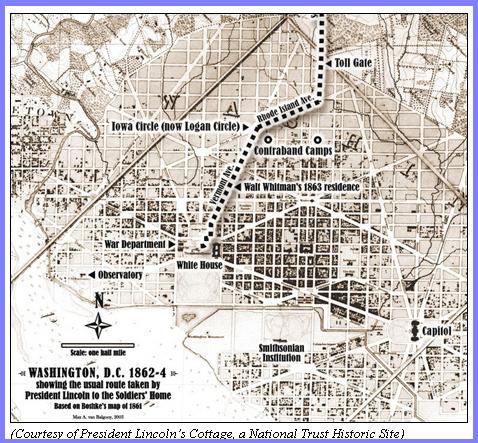
Image of Washington DC Map Showing Two Camps off Logan Circle

Location of Camp Today Using Google Map


12th and O Street NW Washington DC Looking West- Site of Old Contraband Camp

12th and O Street NW, Washington DC Looking East -Site of Old Contraband Camp

These locations are important, and need to be known.  This history of the camps, the people in those camps represent part of the untold story of the Contrabands of War America's Forgotten Freedom Seekers. 

 They and their history deserve to be replaced on America's historical landscape once again.

There are other sites still to be uncovered and stories still to be told.  I am currently interested in documenting the sites of contraband camps that I have learned of in Arkansas from Pine Bluff, to Ft. Smith, and even westward to Ft. Gibson in Indian Territory.

As one whose history is connected also with the Civil War Contrabands, I look towards finding more evidence of these courageous men and women and moving them from being mere footnotes to history, but true players in the winning of their own freedom.


Thursday, November 24, 2011

Thankful For Family

A Collage of Family Faces from Some of My Family Lines

On the day that we give thanks, I find special joys in my family near and far, distant and close. 

I am also thankful to the ancestors upon whose shoulders we stand, and am grateful for the next generation that takes the family forward to the future.

Happy Thanksgiving!

Friday, November 11, 2011

Such Men of Honor Shall Not Be Forgotten


Harlem Hellfighters - Black Soldiers from America Incorporated into the French Army in World War I.


From America they came, these men- ready to serve. These American men served in an army that did not want them, but they served, fought and even died.  Known as the Harlem Hell fighters, these men marched under an American flag, but wore French uniforms and used French arms.  Their contribution was noted and they were later honored in a monument to their bravery and history. 

From my own family history comes my own soldier who was a hero of World War I. My grandfather was Pvt. Samuel Walton who was drafted into the army from his native Oklahoma. He served in the 809th Pioneer Infantry. One of the only photos that I would ever have of my grandfather was the one taken of him in uniform

Pvt. Samuel Walton, 809th Pioneer Infantry

As I watch the film on the Harlem Hellfighters, I wonder if he ever saw them, and ever met them.  I would like to think that he did. I know that one of his best friends was his bunk mate, Seles Bates, from New York.   

Pvt Seles Bates, New York, New York

Did Pvt. Bates have other friends from Harlem who served?  Did he know some of the Harlem Hellfighters personally?  I hope that he did. He lived in New York and lived in Harlem.

I know that many soldiers returned to their lives as second class citizens and would only hope that the liberties that they fought for in France would someday be experienced by the next generation..  The parades afforded World War I veterans in New York City, would indeed symbolically represent the hope of the future, that someday they too would be respected as men, and honored for their bravery by a nation yet to grow in this direction.

I hope that my grandfather got to see some of his army buddies again. I hope that they shared the comradeship of men, who fought for a just cause in a far away land.  My hope too, is that all of them will be remembered as heroes.


Bonus Footage of the Harlem Hellfighters Return Home


Sunday, October 23, 2011

National Black Genealogy Summit - Second Day


Another day of presentations for me

Well Saturday was a full day for me. Two more presentations (after having given two the day before) and there was much interest from the audience and I truly enjoyed the sessions.

I decided to sit in on an interesting session Genealogy in the Electronic Age presented by Tony Burroughs were some unique websites were shared with the audience.
Workshop, "Genealogy in the Electronic Age

So much of the fun came from the opportunity to meet people from other states.

Charles Brown of St. Louis brought a bus load of society members from his organization.

Three new friends leave the Wayne Center, Argyrie McCray, Bertha Curtis and Vicki Daviss Mitchell

There was a lot of sharing and I appreciated the time that I had on Thursday to do some research. I especially enjoy looking at the rare books and journals in the library. But the greatest pleasure I must admit was the feeling that I got as I observed friends helping strangers in their quest to know something of their past. On Thursday we all enjoyed watching Shelley Murphy of Virginia, assist a stranger in finding his grandmother's  maiden name. We later watched her assist another new friend, in locating data on her family as well.  Later, in the hotel room, Argyrie McRae of Baltimore assisted the same lady while chatting, and there in the hotel late at night, more genealogical gems were shared with her. Our evening ended with an informal genea-pajama party with friends laughing and sharing great times with each other, and we then prepared for early morning departures.

Sunday morning ended with a ride back to Maryland, through the beautiful Allegheny Mountains. What a wonderful evening to a great genealogy-filled weekend. 

Autumn beauty seen on the way home.

Saturday, October 22, 2011

National Black Genealogy Summit Opens With a Bang

Argyrie McCrae (Maryland) Lisa Lee (California) Charles Brown (Missouri)


The first official day of the National Black Genealogy Summit went extremely well. This was the opportunity for many researchers from from all corners of the country to meet and share ideas, thoughts and have questions answered.

One of those opportunities was especially poignant when a beginning researchers received some assistance from another researcher and she found some information on her family online.

Ms. Bertha Curtis examined her notes after being shown some information on her family online.

 It was exciting to see so many groups that had arrived. Several groups were present also--St. Louis African American Genealogy Society arrived on a charted bus, as did a group from Chicago and Baltimore. Many from the local area were also in attendance.  Friday was an opportunity for many to also meet several authors from and have books autographed as well.

Tony Burroughs (Illinois) and Bernice Bennett (Maryland) 

Although I had two presentations yesterday myself, I was glad to be able to attend some sessions myself. I particularly enjoyed the session by Lisa Lee on Search and Reward Notices. This session illustrated the need to use newspapers in a different way, and how exploring data in Search and Reward Notices one can see how often times multiple generations are reflected in many of the ads found in black newspapers around the country.


Also present was noted author and scholar Dr. Carla Peterson, author of Black Gotham, a book describing life of free people of color in New York City.

Author Dr. Carla Peterson

The exhibitors were present and among them were those representing the AfriGeneas.com website. Several people took advantage of the opportunity to learn more about the website and the many features to be found on the site.

Vicki Daviss Mitchell explains the AfriGeneas website to an inquiring visitor.

The conference banquet speaker was Robin Stone of Essence Magazine. She shared the story of how the genealogy-focused article published in the February 2011 came to be published.

Robin Stone, Banquet Speaker

The conference banquet was enjoyable as it allowed participants to relax, share a wonderful meal and to listen to the presenters.


The final day unfolds on Saturday October 22.


Thursday, October 20, 2011

Ft. Wayne Pre Summit African American Genealogy Conference


I am attending the National Black Genealogy Summit  Today was the Pre-Summit event held at the Allen County Public Library.

After a long ride from Maryland to Ft.Wayne Indiana, and a good night's sleep, it was great to get into the library again and to see old friends. The check in process was a smooth one with a friendly team of library staff on hand to greet everyone.


Seeing old friends, and meeting new friends is always a great part of any conference. Several of the conference presenters were already on hand and ready to interact with the crowd.

Argyrie McCrae of MD, Tim Pinnick of IL, and Bertha Curtis of MD meet in the lobby.

Many in attendance were anxious to get upstairs to the genealogy library and quickly found a comfortable space and got to work.

These two Maryland researchers quickly found a comfortable place and got to work.

Before settling down to work, I had to take a few moments to appreciate a beautiful exhibit of quilts on display currently at the library.  The quilt exhibit is called Sisters of the Cloth. This is a quilting guild based in Ft. Wayne Indiana. The quilts on display are stunning!

One of the quilts from the Sisters of the Cloth Exhibition


The lunch hour consisted of a brown bag lunch meeting and it was well attended.  There were a number of people in the audience who were quite engaged and asked poignant questions.


I had a great chance to show some support to some members of the AfriGeneas Team.  Ms. Vicki Daviss Mitchell of Phoenix Arizona, and Mr. Art Thomas of Dayton Ohio shared with participants some highlights of  the massive AfriGeneas website.  I was able to get a little bit of footage of that session as well.


Vicki Daviss Mitchell and Art Thomas Present a Session on Navigating the AfriGeneas Website


In the afternoon, I was at a table and observed how an experienced Shelley Murphy of Charlottesville Virginia took out time to assist a gentleman from Michigan who needed some help with a family line. She was able to find the maiden name of his grandmother. In addition, she also was able to provide the name of the gentleman's grandfather's first wife--an name previously unknown to him.  He was most appreciative and said that with the help that he had received, he was more than satisfied with her assistance, and was, in fact quite moved.  He continually thanked her and their exchange was so touching I was able to get a photo of them together.

Shelly Murphy and a new genea-friend after she assisted him with a puzzle about his family history

Afterwards it was back to work, and enjoying research.
Vicki Daviss Mitchell and I reviewed a document on my computer.

Well after a full day, it was back to the hotel, and time to turn in. I have two presentations tomorrow and am looking forward to both.

Monday, October 17, 2011

Reflections as I View My Ancestral Painting From 23AndMe


Well, there it is. 
My ancestral painting as reflected by the DNA company 23AndMe.com It is an image reflecting a geographic and ethnic source from which my 23 chromosomes are from.

The green segments reflect African sources, the blue segments reflect European and the orange segments reflect Asian/Native American.  (Note---since DNA companies do not distinguish Asian DNA markers from Native American markers it should be understood that the "Asian" in my case is most likely Native, especially in light of my documented ties to the Choctaw Nation.)

The Percentages:

Geographic Origin of my DNA markers

When asked about how I feel about having the non-African markers----well I feel the same way I have always felt---like me! 

The European markers I knew were there and the Native (or Asian) markers I knew were also there--but I could have never said how much, and of course none of this provides names that would tell the stories that I want to hear.

I have tested with DNA companies before---African Ancestry, FamilyTreeDNA and the National Genographic Project.  I am fully aware of the ties to Nigeria on one line and to the ties to Guinea Bissau on another line. I am thrilled to know so much of this. 

Yet does this knowledge change me or my feelings about my ancestry?  Does this knowledge affect the way I review myself having non-African ancestry? Is there any closer sense of ties to the non-African side? Understanding that 30% of the markers that I have come from a non-African source is there a new feeling or an enlightened feeling about the past?

Actually, the non-African lines have been understood all along. As a descendant of many people who were enslaved  and as a descendant of women who were mixed who also had children that were fathered by men who were not of African ancestry is information that was known ahead of time and that has been documented, as well.

And the reality of slavery as it occurred in America, is what it is. It happened, and many families have histories similar to mine and have ancestors who have a similar past.

Now this information does confirm the likelihood that there were more than one, two or perhaps even three lines from whom these non-African lines come. 

But I already knew of two of these lines from my own documentation. Does this ancestral painting mean that there are more?  Perhaps so. And it makes the genealogical process more complex, no question.

But from a culturally and experiential perspective, I come form my mid 20th century life and experience, from an African American cultural context into which I was born and in which I live. I married into a family from Ghana and Nigeria, which makes my own life stories fascinating and richly seasoned with wonderful experiences.

All of the other lines--the documented Choctaw gr. gr. grandmother, Sallie and her mother who was  enslaved in the same Choctaw Nation community are as much of my history as my gr. gr. grandfather Patrick Drennan of Van Buren Arkansas, and his white father. And they are as much of my history as my slave ancestor Martha, born in the 1790s in Virginia, to an unknown African slave woman.  All of them are mine, 

And yes, this includes the Choctaw slave owner, the white slave owner, both of whom are also 3rd gr. grandfathers.  Like the many Africans who are part of my ancestral cirle--they all are part of who I am. And I face the world with a proud African American imprint from my life imprinted and put upon my by two wonderful and loving parents---and it is their strength and guidance with which I face the world.  

Now having this ancestral  painting to ad to my knowledge of self is a good thing. And yes, I might wonder as glance at my gr.grandmother, if I see her African mother or her Choctaw father. I look at my mother's image and wonder, if I am seeing an ancestral Fulani/Yoruba smile from the old  photos, or is there another ancestor from another line smiling through?  And other ancestors do make me wonder if there is some trait from the European ancestor as well showing through.  Does it change who I am inside and who I am as a person?  No.

I am glad to know just a little bit more through this ancestral painting, and now with that information, 
I can say that it is all good.  

It is who I am.