Showing posts with label St. Louis. Show all posts

Wednesday, July 15, 2015

A Cemetery Visit: Honoring Dred Scott

He was a simple man, who had many odds against him. Born a slave, his name gained the attention of the world when he sued for his freedom. I had always heard of Dred Scott and I had the chance to visit his gravesite on Monday July 6th.

I arrived St. Louis, on an early flight on Monday, when I arrived to attend and to teach at the Midwest African American Genealogy Institute, (MAAGI). This early arrival allowed time for a pleasant lunch with genealogy friends. Upon leaving, it was suggested that we visit the gravesite of Dred Scott. I had never known where he was buried, and finally I got to stand over the final resting place of this man whose name will be forever known.

After a brief stop at the office of Cavalry cemetery, we were given a map that would direct us to his gravesite. Driving through this massive cemetery was amazing, with rolling hills and magnificent monuments to those long gone. After turning onto a nearby road, a glance to the left revealed a small yet neat stone bearing the name, Dred Scott. The stone is simple yet elegant.


Additional words about his life describe the significance of Scott's struggle for freedom and the impact of the Dred Scott decision. It is eloquently stated, "In memory of a simple man who wanted to be free."


Another small memorial stone next to  Dred Scott's stone is dedicated to his wife Harriet. That memorial marker was dedicated in 1999. Harriet Scott is believed to be buried at Greenwood Cemetery in St. Louis County.


Over the years visitors to the Dred Scott grave have started a tradition of leaving evidence of their visit to his gravesite by leaving a coin. The typical momento is to leave a copper penny at his grave. In respect for the tradition, my colleague Noreen Goodson and I, both left our pennies on the headstone, as well. A thank you for his struggle for freedom and a prayer that he and Harriet continue to rest in peace was said while standing there.


 To mark the occasion of this visit to the gravesite of Dred Scott, my colleague Noreen, and I posed for a photo next to the stone.

Few facts about the early life of this man are really known. He lived as a free man very briefly and facts about the lives of his wife and daughters in the years before the freedom suits are few. However, some poignant facts were collected a few years ago in a book about the lives of Dred and Harriet Scott, when genealogist and author Ruth Hager wrote a book that provided some insights into the life of the Scott family. The book is entitled, Dred and Harriet Scott: Their Family Story. 


In 2012 while attending a conference of the St. Louis African American Genealogy Society, I had the pleasure of meeting Dred Scott's direct descendant, Lynn Johnson, his gr. gr. granddaughter. She is now the director of the Dred Scott Heritage Foundation and works to keep the legacy of her ancestor alive.

Angela Walton-Raji and Lynn Jackson, standing near portrait of Dred Scott.

There are many notable names in history who struggled against the yoke of slavery. Some fought for themselves and their loved ones such as Dred Scott. Others fought for the freedom of others, like Harriet Tubman. We read about them, and remember their names, but the chance to visit their gravesite is rare. I am grateful that I was able to visit the gravesite of this man, whose struggle, and landmark case deferred a mighty dream. 

He was an ordinary man, a simple man who only wanted to be free. I am humbled by the chance to say that his battle mattered.

Tuesday, July 15, 2014

Reflections from MAAGI 2014


The second year of the Midwest African American Genealogy Institute took place last week in St. Louis Missouri at Harris Stowe State University, and it was an honor to be a part of it once again!

I can only say that the energy put into the classes, by both faculty and participants alike was truly amazing and so many had their genealogical process enhanced and expanded by the experience.

Was MAAGI Just Another Conference?

Not at all! This was a teaching institute and there was a good amount of "hands on" work, homework and projects. The participants were kept busy and they found that much of what they worked on, could be put to use immediately.

Last year, someone asked if this was an event "where people just talked about their own family history"! Nothing could be further from the truth!

And in fact, one only has to look at the courses offered to see that no such thing is a part of MAAGI and shall never be! And the structure of the institute guarantees that the program will not be a platform for people simply show what they did with their own family tree.

MAAGI is an institute where instructors teach and do not simply talk. From Technology, to Broadcasting, and from the scrutiny of pension files to planning their own blogs and platforms, the participants emerged as activists in the genealogy community. So no, it is not a conference at all and one will not find themselves bored with a story of how someone documented their own family.

On any day, one could peer into the classes and see small groups analyzing Civil War Pension files looking for briefs, or rehearsing for a radio broadcast, or even analyzing selective service records. As an educator, I appreciated seeing the hands on activities that kept participants engaged.

A real highlight was to watch an evening study group form and to watch how so many worked hard with their instructor on personal time lines, and got assistance from each other over a periods of several hours.

Professor Shelley Murphy gave every single person in the group individual attention, and to see that group in the hotel working around a table with laptops and notepads.

Renate Sanders of Virginia works on her laptop while a colleague looks on.
(Photo: Courtesy of Charles Brown)

Gary Franklin of Ohio listens closely as another group member speaks
 (Photo: Courtesy of Charles Brown)


Professor Shelley Murphy explains ancestral time lines as others listen.
(Photo: Courtesy of Charles Brown)


Pat Meredith of St. Louis takes copious notes during study session.
(Photo: Courtesy of Charles Brown)

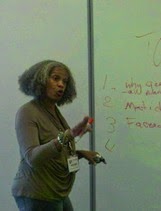
It was fun to observe and later to listen to participants in Track 4 as they began to organize and plan the radio broadcast for Blog Talk Radio. Konnetta Alexander took the lead and directed some of the initial discussion for the group, working on the white board as the participants organized their possible topics for their broadcast.

Konnetta Alexander of Nashville TN records suggestions from Track 4 group.

It was exciting to walk around during break time and it was not unusual to see group members connecting and having intense discussions about research challenges and solutions.

Hazel Moore of Baltimore, and Argyrie McCray of Windsor Mill MD 
engage in detailed discussion of their research.
(Photo courtesy of Shelley Murphy)

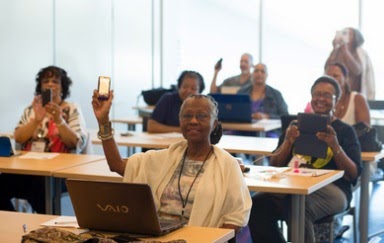
There were also some amusing times such as when the photographer came to capture the Technology Track on camera, and they decided to take a photo of the photographer. The result is this fun shot of the classes with their camera's capturing their own image of the official photographer.

Technology Track photographs the photographer
(Courtesy of Nicka Sewell Smith)

The Faculty

We were honored to have two noted speakers of international fame speaking at MAAGI. Thomas Macentee of Geneabloggers returned bringing his technology skills with him, and Judy Russell, the Legal Genealogist dazzled two different tracks by sharing the legal policies that affected the lives of the families that we research!

Thomas Macentee of Geneabloggers and HiDefGen
(Courtesy of Nicka Sewell Smith)


Judy Russell, the Legal Genealogist


Janis Minor Forte, genealogists and author engages her class 

Nicka Sewell Smith shared the process of documenting the research process
(Courtesy of Bernice Bennett)

Bernice Bennett leads a session on DNA
Courtesy of Linda Bugg-Simms

Drusilla Pair answers a question for student
(Courtesy of Renate Sanders)

Shelley Murphy working at the white board
(Courtesy of Linda Bugg-Simms)


Angela Walton-Raji on break between sessions
(Courtesy of Linda Bugg-Simms)

It is difficult to describe an intense learning experience, but it has to be pointed out that this year's institute was truly engaging, stimulating and also lots of fun! I appreciate the seriousness in which everyone approached the class and the class assignments, and it was a special joy to be part of the team that helped to make it happen. I can only look ahead with enthusiasm towards the future.