On that fateful day--we were all one America.
Sunday, September 11, 2011

Monday, August 15, 2011
"The Help" From My Family Stories

Last week, I read the popular book, "The Help" by Kathryn Stockett. My plans are to see the film in the next several days. Although the story is fiction, I do appreciate the fact that the African American women in this novel were depicted as having feelings, emotions, and a sense of self.
The stories were realistic, because many families have women who at one time worked and toiled as "The Help". And of course, historically until the mid 1800s--we were "the help" with no recourse, or ability to leave if the situation was not pleasant.
However, I began to think of stories that I heard as a child, how the women in the family worked an struggled to contribute to the family and to assist their husbands with supporting their families.
In different generations stories abound--some of the stories simply addressed the long tedious hours in the homes of others, while their own children were not always so privileged to have their mother close by. One of my ancestors chose not to work in the homes of others, and she chose to take in laundry instead.
As a genealogist, of course I first ran into "the help" when I was looking for my gr. grandmother Harriet Young. I knew she and her mother Amanda Young, lived in Ripley Mississippi. I went looking for Harriet, her sister Violet and Amanda, and found them---but with a different surname---Barr. After learning that Gr. Grandma Amanda remarried after the Civil War--- so, I went looking for her daughters Harriet and Violet Young (or Barr) Sure enough, I found them---the were living as "The Help" in the home of Dr. John Murray of Riley Mississippi.

Year: 1870; Census Place: Ripley, Tippah, Mississippi; Roll: M593_750; Page: 151A; Image: 309; Family History Library Film: 552249
Harriet and her sister Violette were living in the Murry home in 1870 and were enumerated with them. In the Civil War deposition for her mother Amanda Young Barr, she mentioned that she lived away from her family and was hired out as a young girl.

From Civil War Deposition of Harriet Martin, daughter of Amanda Young Barr.
The Years in Ripley after the Civil War

Home of Dr. John Murry, Ripley, Mississipppi.
Harriet's mother was Amanda Young, who was a slave of Wm. Tandy Young. In 1864, her husband, Berry, as well as her father and son left the Tandy Young estate, right behind the Union troops, and she never saw any of them ever again. He went to join the Union Army with so many young men who seized their freedom. She waited, but Berry never came back. He died someplace on an unknown battlefield.
When her husband never returned, she remarried a man who had earlier been enslaved by James Giles. Pleasant was his name--Pleasant Barr. Pleas had his own story of sorrow. He was originally from So. Carolina, and he was taken away from his loved ones, and taken to Ripley Mississippi, and would never see his wife or children again. (The recent book 150 Years Later by Melvin Collier describes the fateful day when Pleas stood on the wagon as his family disappeared from his sight. He had been sold to a man called Giles and was now on his way to Mississippi.)
Amanda married Pleas after the Civil War and together they made a life in Ripley, now that freedom had brought some order into their lives, at last. Pleasant Barr joined other men and helped to establish a church--St. Paul's Methodist Church which still stands to this day. (But sadly, Pleas never got to see his family anymore in So. Carolina, where he once had a wife and children. This was the fate of so many who were enslaved--families ripped apart forever, upon the decision and sometimes whim of the owner.) In spite of the separation, from family and life with Giles, Pleas did choose not to retain the name of Giles after freedom. Clearly his identity was with Barr name for that was the only tie he had left to his family left behind. Pleas died in the 1880s and Amanda had to work out of her home once again.
In the 1890s, Amanda also began her efforts to try to obtain a pension from her first husband Berry, who had joined the Union Army. She gave many depositions in that process. From one of her depositions I learned that after Pleas died, she worked as a cook for Col. Faulkner. I also learned where she and husband Pleas Barr lived in those years in Ripley.

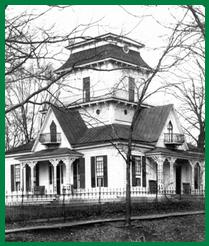
Home of Col. Falkner, Ripley Mississippi, where Amanda worked and "never missed a day."
Source of Photo: http://www.rootsweb.ancestry.com/~mstippah/Falkners-Ripley.html

Home of R.J. Thurmond, where Amanda also lived, presumably as"the help"
Source of image: http://www.rootsweb.ancestry.com/~mstippah/Falkners-Ripley.html
20th Century

Viola Wynn, Daughter of Harriet, Granddaughter of Amanda Young Barr
Harriet Young married Council Martin and they moved to Arkansas from Ripley. Viola was Harriet's daughter, and she also had to work. She however, preferred not to do day's work in the homes of others, but she "took in" laundry where she washed and ironed clothes and then returned the fresh clothes back to the homes of her employers. She wanted to avoid some of the situations in which others in Little Rock had to endure working in homes away from their own families. She would be the last in that line to work as a domestic worker.
A Pleasant Story

Susan Bass Clardy, of Phoenix Arizona
On a different side of the family, a distant cousin, Susan Bass Clardy worked as "The Help" for the Robb family of Phoenix, Arizona. She helped to raise Charles Robb, until he was 8 years old. Thankfully, her experience was a positive one, and she had very strong feelings for the Robbs, and this feeling was also shared by them towards her. She was treated with respect and dignity and she spoke with strong feelings about the Robb family continually.
A highlight for her occurred in 1967, when she was invited to be among 500 guests at the White House for the wedding of Lynda Byrd Johnson, daughter of President Lyndon Baines Johnson, to Charles R. Robb. The Robb family wanted her to be there, when their son Charles married, and she accepted their invitation to attend. I was a child at the time, but I remember when our family got phone calls from cousins in Arizona, because cousin Susie was going to be on the evening news. Sure enough, she was interviewed and had her 5 minutes of fame on national television!
Since this story did get the attention of the media, even briefly, it was suggested that I see if she was mentioned in the black press. So, of course I had to check the one weekly publication that might mention her experience--- I decided to see if there was a mention in Jet Magazine. For decades Jet has covered news events of interest to the black community. So, I pulled up some back issues on GoogleBooks, from 1967, and sure enough Cousin Susie was mentioned! On the December 28 issue of Jet her trip to Washington was mentioned.

Jet Magazine, December 28, 1967, page 38
After reading The Help I am appreciative of the fact that the women were treated with dignity, and as persons with thoughts, feelings and lives. So many domestic workers, cooks, maids, suffered many indignities and they had no choice but to endure them. Thankfully, those in my family did what they did to survive, and they worked hard at what they did so that generations that followed had lives with more choices.
I am glad that the stories about these women and what they endured are being told. They bear the shoulders upon whom so many of us now stand.
These were the women who raised a nation that sometimes did not respect them---but yet, they endured.
I am proud of all of my ancestors, especially those who were "The Help" at a time, when legally they had no other choice.
May more of their stories be told!
Monday, July 25, 2011
Mappy Monday - The Mystery of an old "Negro Settlement"

US General Land Office Map - 1879
Several months ago on another blog, I posted a story about a community that had no name----it was only known for almost three decades as simply Negro Settlement.
For 30 years, this simall and mysterious black community lived in Indian Territory, just north of the Chickasaw Nation. They were not transients because a number of cartographers documented them for more than three decades. Then they vanished----with no trace, and no local knowledge of who they were. And what was this settlement really called? Surely those who lived there called it something---but what? Who were the people?

1887 Map Reflecting the same settlement
Chicago: Henry S. Stebbins, 1887; From Crams Universal Atlas of the World

1893 Rand McNally Map


Possible site near Slaughterville Oklahoma where the old Negro Settlement thrived.
There is still today little activity along the banks of Walnut Creek which is nearby, and also the railroad running close by.
My hope is that I might be able to locate also some of the narratives from the Indian Pioneer Papers---1930's era interviews conducted in Oklahoma that might make a reference to the old settlement.
The mystery continues but I am anxious to apply some mapping skills to learn much more.
Friday, July 8, 2011
Always Searching and Sometimes Finding

Page from Educable Children's List Tippah County Mississippi, 1878
Source: Family Search Image 66 0f 135
A member of the AfriGeneas community recently shared information on the main Genealogy message board that the Educable Children's List from Mississippi was now online through Family Search.
I decided to take a look at the list for Tippah County. My gr. gr. grandmother Amanda Young Barr and her children lived there. Amanda was now remarried to Mr. Pleasant Barr after the Civil War when her husband Berry Young did not return. She and Pleas had one child Elijah, and Pleas helped her raise her younger children as well. Well, several years ago I located Amanda and Pleas Barr and the family in the 1870 and 1880 census for the town of Ripley Mississippi. Today I decided to see if I could find any of Amanda's children, and if I could recognize any names that I knew from the family research. The roster was simple with names of the children their ages and the race of the child.

The roster (in 1878) asks for Name, Age, Sex, and two columns for race
My first surprise came when I saw the name of my gr. gr. grandfather. He was clearly one of the oldest students--but literacy must have been important to him. There he was Counsulle Martin, (later it was written by the family as Council), and he was listed as 20 years old. This was five years before he married my gr. gr. grandmother Harriet Young.

Mr. gr. gr. grandfather Counsulle Martin's name appears on this page.
Source: Family Search page 60 - 135
I continued to look at the record and there on page 66 were three of the four names that I had hoped to find. There was Aunt Frances Young (her nickname was Frank and she was listed as Frank on the document), Aunt Violet Young, and there was Elijah Barr. Elijah was the son of Amanda and Pleasant Barr. I know that education was important to the family and the Barrs were fairly well known in the Ripley Mississippi community. (Elijah's father Pleasant was one of the founders of the St. Paul's Methodist Church which still exists in Ripley, to this day.)

Frank (Frances) Violet, and Elijah were listed together on this 1878 list.
I was also delighted to see another set of relatives, the children of Amanda's sister Nancy. She had married into the Gambell family and sure enough there were her children as well!

The Gambell cousins were also listed on the same list, in the town or Orizaba
I was disappointed that my gr. grandmother Harriet did not appear on the list. She would have appeared with
her sisters Frank (Frances) and Violet Young, and her brother Elijah Barr. However,---finding the ancestors that I did find was a great treat and adds another dimension---they were clearly interested in learning and literacy was so important for former slaves. I know that education was strongly emphasized by Amanda and her husband and this interest in education carried forth into later generations from which several teachers and educators came.
I did not find my relatives in the 1885 list, but the find in 1878 was still a wonderful find. But 1892 was also interesting. My gr.gr. Aunt Frances (aka Frank) had a child by that time. The child's name was Cora, and this is truly a name unknown to me before! And Cora was listed next to a child whose name was G. May(?). The parent was S.E Bryant, and name I recognized, for S.E. Bryant (Sam Bryant) was the man who married Alice Young---one of Amanda's daughters. So in 1892---there are two additional names previously unknown to me.
In 1892, the name of the parent or guardian was listed first, followed by the name of the child.

Two more finds from the same collection.
A small announcement on a message board took me to this collection, and visiting the site was truly worth the time. I pay attention to such announcements of new databases as they become available, and I always look to see if I can use it.
Usually I continue with my efforts to document the community---but today's finds prove how if one is always searching----you will sometimes find a new data to add to the family file.
I am always searching and sometimes I find!
Tuesday, June 28, 2011
From Virginia to Arkansas, and Back to Virginia - A Freedman's Bureau Migration Story

Letter to Freedman's Bureau
Source: Virginia Freedman's Bureau Letters 1865-1872
National Archives Record Group 105, Reel #44 Image 349
(Also Family Search Image: #4150377)
(see transcription below)
(see transcription below)
Researching African American ancestry is not without its challenges. The 1870 census provides a glimpse at a community of individuals who were a mere 5 years living in freedom.
But sometimes the assumption is often made that the individuals were living in the communities where they had been enslaved, and had not ventured far from their home.
It possible that in most cases this is true, however, if one studies the thousands of non-indexed pages from NARA Record Group 105--(the Freedman's Bureau) a wealth of data can be found that might reflect stories otherwise not known.
The Haney Family - A Case Study
In 1867 a woman Jane wrote to the Freedman's Bureau office in search of her sons. Upon first glance I would have thought that Jane's sons had been sold away from her, and she was seeking assistance to find them.
However in this case---they did not leave Virginia until 1866. They had signed a contract in Alexandria Virginia to travel to eastern Arkansas, to work for a year, with their father. Meanwhile, in Arkansas, the father of the two boys died after a short illness and their mother was seeking information about their return.
The letter reads:
Alexander Va.
August 16th, 1867
Col. S. P. Lee
Sub. Asst. Commr.
Alexander Virginia
Sir,
I have the honor to apply to you to assist me in procuring my two sons Lewis Haney age 13 yrs, and Joshua Haney aged 16 yrs who are now in the vicinity of Helena Arkansas.
With their father Joshua Haney, they made a , 1866 contract April 16th in your office to work for one year with the firm of Van Belk, & Co., of Helena Arkansas. They remained with Van Belk & Co. until their year expired and were discharged. After this they were employed by Mr. Briant Lynch of St. Francis Co. Ark until the 27th of July last when the father (my husband) died after an illness of nine days. The boys are now without any one to care for them and on account of their age I am anxious to have them under my care and protection.
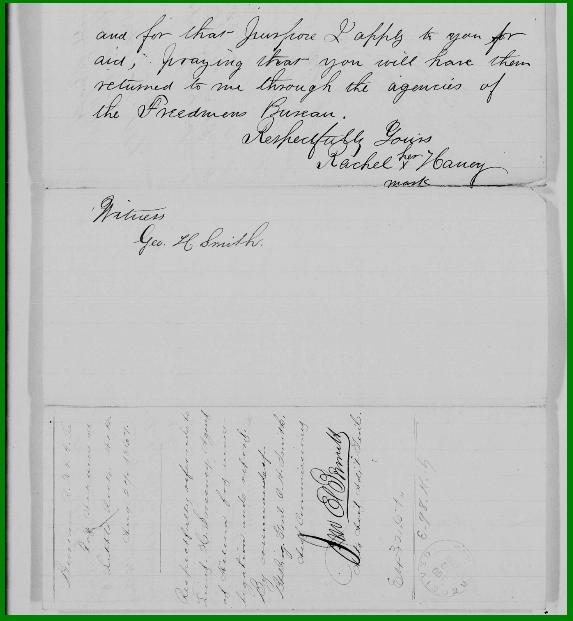
Source: Virginia Freedman's Bureau Letters 1865-1872
National Archives Record Group 105, Reel #44 Image 350
(Also Family Search Image: #4150377)
(next page)
and for that purpose I apply to you for aid, praying that you will have them returned to me through the agencies of the Freedman's Bureau.
Respectfully yours,
Rachel (her X mark) Haney
Witness Geo. H. Smith
* * * * *
Rachel's letter was interesting for several reasons. Was Rachel in search of children who had been sold from her? Not at all!
She lived in Virginia and it appears that a contract was made with the Bureau to provide labor in eastern Arkansas. Upon reading this letter one cannot wonder what the circumstances were that Arkansas needed to send for workers? There were thousands of former slaves along the Mississippi River, and there was a Freedman's Bureau field office in many places in eastern Arkansas to assist with labor contracts.
With there being no shortage of labor in eastern Arkansas, what were the circumstances for the recruitment of workers from Virginia?
There must have been steady communication between Rachel and her family since she was clearly aware of what had happened to her husband as well as the status of her sons, when their contract had ended. This is significant, particularly because this reveals a part of history that is just simply not well known. This tells the story of what happened in those critical years between 1865 and 1870.
In this case---we see that a contract was made to send a large number of former slaves from Virginia to work in Arkansas. This was organized by the Bureau of Refugees, Freedmen and Abandoned Lands---the Freedman's Bureau.
She lived in Virginia and it appears that a contract was made with the Bureau to provide labor in eastern Arkansas. Upon reading this letter one cannot wonder what the circumstances were that Arkansas needed to send for workers? There were thousands of former slaves along the Mississippi River, and there was a Freedman's Bureau field office in many places in eastern Arkansas to assist with labor contracts.
With there being no shortage of labor in eastern Arkansas, what were the circumstances for the recruitment of workers from Virginia?
There must have been steady communication between Rachel and her family since she was clearly aware of what had happened to her husband as well as the status of her sons, when their contract had ended. This is significant, particularly because this reveals a part of history that is just simply not well known. This tells the story of what happened in those critical years between 1865 and 1870.
In this case---we see that a contract was made to send a large number of former slaves from Virginia to work in Arkansas. This was organized by the Bureau of Refugees, Freedmen and Abandoned Lands---the Freedman's Bureau.
So----what happened to Rachel's children?
A report in the Freedman's Bureau files describes what happened to them.


A report in the Freedman's Bureau files describes what happened to them.

Source: Virginia Freedman's Bureau Letters 1865-1872
National Archives Record Group 105, Reel #44 Image 703
(See transcription below)
Hd Qrs Ass Com Dist of Va
Richmond Va, Oct 4, 1867
Filed:
Respectfully returned to Brt. Lt Col. S.P.Lee S.A.C.inviting attention to understatement of E.G. Barker, Agent.
Madera Ark. Sept 14th, 1867
Respectfully returned to Lieut. H. Sweeney Agt. at Helena Ark. with the information that the children Lewis and Joshua Haney are still with Mr. Bryant Lynch of this County, and who has a contact with them appeared at this office. Their compensation is $9.00 for the oldest and $7.00 for the youngest per month the contract expiring on the 25th day of Dec of 1867. Mr. Lynch is a prominent man in St. Francis Co. and I think is treating the children kindly: they will be looked after by the Bur in this co. and in my opinion would do well to remain until the expiration of their contract.
* * * * *
My question----was this common for persons from Virginia, once enslaved and later freed, to be sent under contract to work in places as distant as Arkansas?
Were there others from the same community sent there as well?
If so---were there many or were they just a small number whose story is mere anecdotal?
Well, further investigation revealed so much more. And the answers were found in the Virginia Freedman's Bureau. Thankfully all of the reels are digitized and one tenacious researcher in Virginia is going through each and every reel, looking for interesting stories to share. (Thank you Selma Stewart!)
In fact----she located the very answers to those questions, including a contract with the names of the Haney children and others from Alexandria Virginia. On reel 52, images 826 - 829 answer those questions. (see image and transcription below)
A signed Article of Agreement in which the Haney children and their father and many others from Alexandria agree to go to Arkansas to go to Arkansas to work, was dated 13th of April 1866. The contract expired on January 1, 1867. It appears that the same Haneys mentioned in the letter by Rachel are her family--Henry, Joshua and Lewis Haney. The wages were $15.00 per month, and Lewis is was stated was to receive $8.00
.

Source: Virginia Freedman's Bureau Letters 1865-1872
National Archives Record Group 105, Reel #52 Image 826
The surprise was to find a list of names of dozens of people including the Haneys who were from Virginia and sent to Arkansas under contract to work, right after the Civil War.

Close up view of contract
Source: Virginia Freedman's Bureau Letters 1865-1872
And a few pages later, came the names of dozens of people.

Partial View and Close Up of document from FB where workers were contracted for Arkansas
Source: Virginia Freedman's Bureau Letters 1865-1872
National Archives Record Group 105, Reel #52 Image 827
Surprisingly more pages of names of former slaves from Alexandria Virginia appeared on following pages!

Source: Virginia Freedman's Bureau Letters 1865-1872
National Archives Record Group 105, Reel #52 Image 828
This particular story had a happy ending----the Haney children returned to Virginia and they are found in the 1870 census in Alexandria Virginia.
The question must be asked however----what of the others? Did they all return to Virginia, leaving Arkansas after their contracts ended?
And what if they stayed?
What are the implications for the genealogist?
One thing is clear---there is a potential for error.
If some of the Virginia people chose to remain in Arkansas, or move elsewhere they won't appear in the Federal census until 1870. Will their origins from Alexandria Virginia be known? Probably not.
If the story of being contracted by the Freedman's Bureau did not survive family oral history---how will the genealogist be able to tell this critical and significant story?
Sandy Nash A Case Study
Let's look at the case of Sandy Nash. His name also appears on the document of former slaves from Alexandria Virginia sent to Helena Arkansas.

Close Up View
Source: Virginia Freedman's Bureau Letters 1865-1872
National Archives Record Group 105, Reel #52 Image 829
Sandy Nash's name appears on line 306.
I searched for Sandy Nash in Virginia and did not find him there and then I decided to see if I could find Sandy Nash in Phillips County Arkansas in 1870 and sure enough---he was right there. He had chosen to remain in the west and not return to Virginia.

Excerpt from 1870 Federal Census Reflecting Sandy Nash
Source: Year: 1870; Census Place: Planters, Phillips, Arkansas;
Roll: M593_60; Page: 63B; Image: 128; Family History Library Film: 545559.
Ancestry.com. 1870 United States Federal Census [database on-line]. Provo, UT, USA:
Ancestry.com Operations, Inc., 2009. Images reproduced by FamilySearch.
Now---if a descendant of Sandy Nash who might still be living in Arkansas, he or she will find Sandy in 1870 in Phillips County.
The researcher---if following the advice of the masters--will look for him in 1860, and then begin the search to find his last slave owner, presumably in Arkansas.
Genealogists are taught-- that after determining that a black person was not free in 1860, then one can start to look for the last slaveholder in the same community.
But in this case----Sandy Nash's last slave holder was in Fairfax county Virginia and was never in Phillips County Arkansas. It is usually recommended to African American researchers that when beginning the search for the last slave owner, that one begins in the community where one finds the former slave.
And if this was not known via oral history---then how will the research ever know where in Virginia to find Sandy Nash?
Chances are---the researcher may hit this brick wall and remain there for years. Even should the researcher turn to Freedman's Bureau records, the first move would be to use the Bureau records from Arkansas. And all of this data came from Virginia!
There are several points that I have learned from the cases above.
1) It is important to share what you find. Had a research colleague living in Virginia not shared this with me, I would never have known about these workers, several hundred----of them being contracted to go to Arkansas to work after the Civil War. She happened to know that Arkansas is one of my states and generously shared it with me.
2) It is important to avoid making assumptions In this case--the researcher might hit a brick wall, unable to find the last slaveholder in the local community. One might have to think outside of the box and ask about other resources that reflect the community and the time period--especially in those critical years after the Civil War. One should not assume that the former slave found in 1870 was a slave in the same place before the war.
3) Utilize all available Reconstruction Era records. In the case of the Haneys, the researcher might find the Haney children in 1870, with little additional information about the family. However, the Freedman's Bureau letters contain a wealth of data found in the letter from their mother telling the story of their being in Arkansas. She mentioned them by name, and also mentioned the name of their father, who died while in Arkansas. If no known death record was known to exist--her letter might be the only piece of data about the father--his name and approximate time of death are in her letter.
We conduct our research because of the love of history and a desire to see that stories are told, and in this case---stories can be found when we least expect them.
Special thanks to Selma Stewart of Newport News Virginia, who in her effort to look at every reel of microfilm that is now digitized, and available on Family Search, she shared the letters to me, and she opened my eyes to new possibilities.
Sunday, June 19, 2011
In Appreciation of Fathers, & Men in the Family Who Provide Love and Guidance

In Memory of My Father Samuel Lewis Walton

In memory of Mohammed Raji, Patriarch of the Raji Family

In Memory of My grandfather, Samuel Walton

Honoring my brother Samuel Walton

Honoring Nephew Fred Walton

Honoring Nephew Kevin Dedner
The Uncles

In memory, "Uncle John" John Martin, Patriarch of the Martin Line
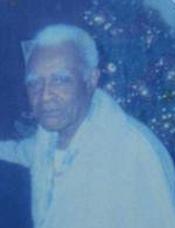
In memory of Uncle George Bass, Patriarch of the George Bass Line
And of course, my dear husband:

Honoring Ganiyu Raji, "Big Daddy" to many and faithful husband to me.
Happy Father's Day!
From Oak Hill Cemetery to the Lab and Departure

Listening to the Director at Oak Hill Cemetery
The Friday session of the maps class began with a field trip to Oak Hill Cemetery, the oldest cemetery in Birmingham. We were greeted by the cemetery caretaker who gave the group a small introduction to this beautiful burial ground.
We were given a thorough orientation to the layout of the cemetery by director Stuart Oakes.

Headstone of Rev. William Pettiford, leading minister and educator in Birmingham
Two other researchers were busy documenting the same section.

Crystal Simmons and LaDonna Garner study map of cemetery before marking the perimeter on GPS
The exercise at the cemetery was followed by a session in the computer lab where we learned how to take the data using ArcGIS Explorer to present the data captured on the GPS devices.

Computer Lab, Capturing Data from GPS
Sadly, the last session came to an end. We discussed the points that we enjoyed most and shared ideas for next year's institute.
This experience at Samford had been wonderful for me, and I must say that I can only look forward to next year. New friendships were made, and old ones were re-established. I learned so much from both the faculty and also from the participants. My head is full of new ideas, and after I catch up on my rest I have some new things to try, to enhance what I do----to tell the story better.
Thank you to all who worked so hard to make the Samford experience, once again a great one. And alas, farewell to that beautiful campus!

Samford University, a beautiful campus.
Subscribe to:
Posts (Atom)