Showing posts with label African American. Show all posts

Monday, January 2, 2017

If Only We Could See Their Names - Part 1


When searching for enslaved ancestors, the first major frustration comes for the first time researcher, when he or she encounters the slave schedule in the 1860 and 1850 census for the first time. The shock to the researcher is that the "slave census" does not contain the names of the slaves. Only the name of the slave holder is recorded. That is also the first time that one encounters the reality of slaver and its horror---the ancestors were not considered to be people worthy of names. They were simply property and their presence as enslaved people only meant that they would be counted, just as cattle, horses, and other livestock.

And usually upon that discovery, the researcher heaves a very heavy sigh, exclaiming, "if only we knew their names."

And so it goes. But several years ago, while in Chicago attending a conference, I met Belzora Cheatham who was anxious to share a find! One line of her family is from Bowie County Texas and she had just found them on the 1850 slave schedule. With their names!

The document was one of those amazing errors in the census that many whose ancestors were enslaved, wish we could find. The error was a wonderful one---the enumerator wrote the names of the enslaved people--all of them!

I have thought of Ms. Cheatham many times over the years and several years ago, I looked at the records myself, and wrote a piece about them. I recently looked at that small collection of records from District 8 of Bowie County, and decided to write another article, because of its significance.

We recently celebrated the indexing of the Freedmen's Bureau records and how important we can now look at the years between 1865 and 1870 and learn about our ancestors in the early days of freedom. But this slave schedule is equally significant--although it reflects a tiny community---this is 15 years before freedom, and this provides a rare glimpse at people still enslaved, and their names can be called.

So many of us find the slave schedules for the first time, and then sigh in frustration noting that only the names of the slave holders are recorded. For those who survived enslavement and who lived to see freedom--it would be 20 years before their names would be in print again on a census. And for some--who did live to be free, this is the only piece of evidence that they ever lived.

A few years ago I wrote a small article about this collection, but I only included a few images. But upon reflection of the fact that for some--their names would never appear in a census as free people, and in light of our focus on celebrating everyone, enslaved and free, I have decided to include this larger article and share all 23 of the pages. So therefore, I am submitting this two-part piece reflecting the names of the enslaved population, sharing the images themselves. The district was not a large one, and therefore they deserve to be seen, by all.

The images reflect District 8, of Bowie County, Texas. There are only 23 pages reflected in this slave schedule, and all will be shared on this blog. The first 12 are shared below. (Part 2 will reflect the remaining pages.)


1850 Slave Schedule
Bowie County, Texas, District 8
Ancestry.com. 1850 U.S. Federal Census - Slave Schedules [database on-line]. Provo, UT, USA: Ancestry.com Operations Inc, 2004.
Original data: United States of America, Bureau of the Census. Seventh Census of the United States, 1850. Washington, D.C.: National Archives and Records Administration, 1850. M432


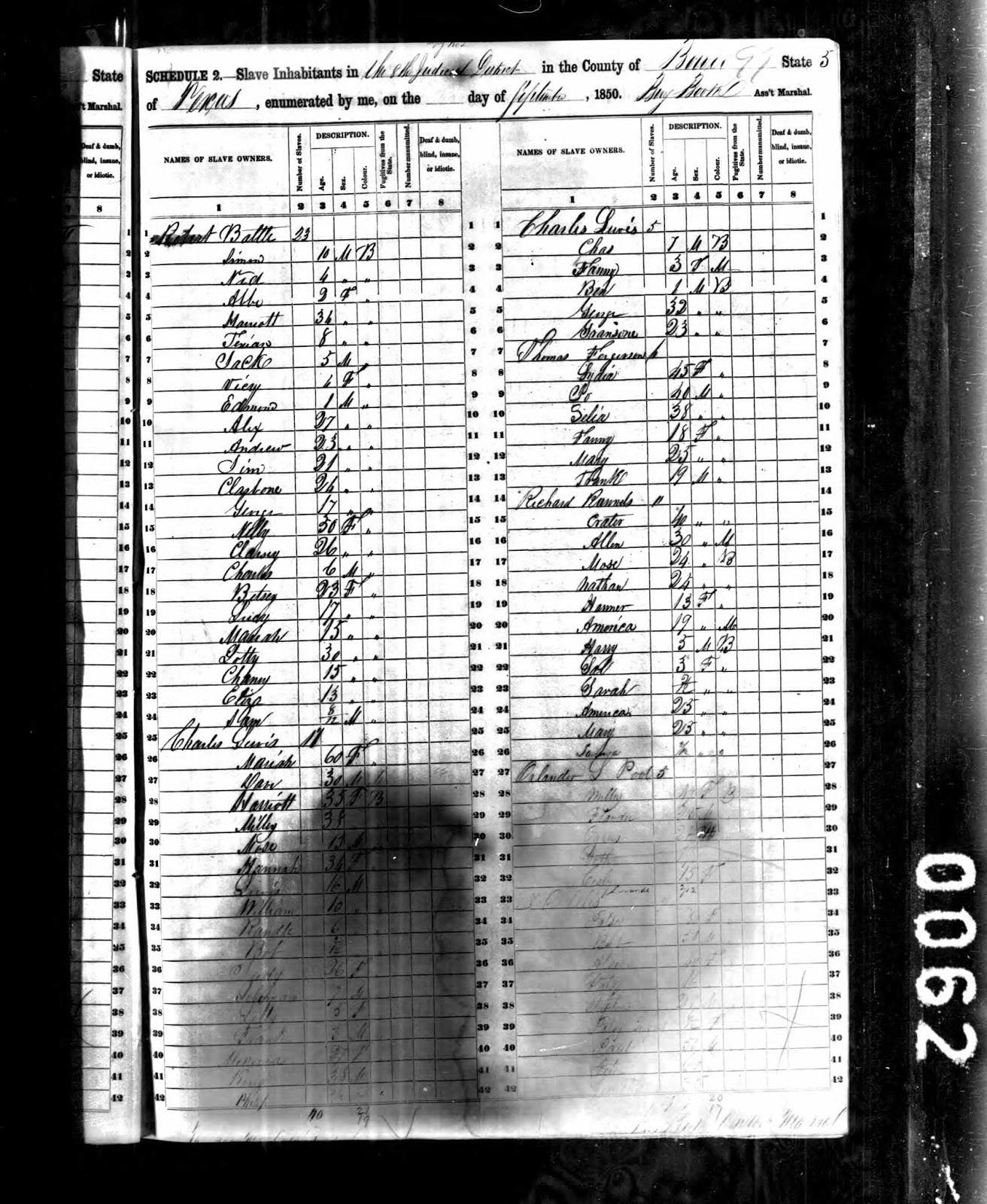


It is clear upon looking at the images that some severe water damage occurred on the pages of the census book. This is most unfortunate, as in many of the pages,the names have simply vanished with the dampness, dissolving the lettering.


As one moves through the pages some of the water damage appears to lessen. And in some places on the page the names of the enslaved people can be read through the water stains. 


Though the water stains are still there, hopefully others new to the process will still look at the names of these people who lived during a trying time. My hope is that most did survive and live to breathe the air of freedom.

End of Part 1


Friday, March 11, 2016

Gems From the Black Press: Remembering Eckstein Norton University


This article is part of a series  of articles whose purpose is to share each week an interesting article from early black publications of the late 19th and early 20th centuries. As previously noted,the articles found inside of these long forgotten publications contain rich history that reflect  the early years of African America life in the first decades of freedom. Some are publications of fraternal or benevolent societies, and some were more community based. All  pieces shared in this series provide a close up to history and culture of times long past.


Today's Focus
Ohio Falls Express, Louisville KentuckyJuly 11, 1891
Advertisement for Eckstein Norton University


One of the things I like about old newspapers are the classified ads. They reflect the ordinary business of the people, and from such ads, one can find out about the products used by many in the community. In addition, one can learn about the people and the services that they offered and that they were seeking. Businesses are often reflected in those publications, as well as places of worship, and educational institutions. One such institution caught my attention, and it was one of which I had never heard before. The school was Eckstein Norton University, located in Louisville, Kentucky.


Source of Image:
Ancestry.com. U.S., African American Newspapers, 1829-1947 [database on-line]. Provo, UT, USA: Ancestry.com Operations, Inc., 2013. This collection was indexed by Ancestry World Archives Project contributors.Original data: Negro Newspapers for the American Council of Learned Studies. Washington, D.C.: The Library of Congress


Having worked in higher education for over 25 years, I recognize the names of many institutions including the numerous Historically Black Colleges & Universities or HBCUs as we call them. But what a surprise to see an institution that was never known to me, out of Kentucky. Eckstein Norton University based in Louisville.

An advertisement about the school appeared on the front page of the Ohio Falls Gazette on July 11,1891.


Eckstein Norton University was located at Cane Springs, in Bullitt County Kentucky. The school was founded in 1890 in a hostile community that had never accepted the concept of "colored" schools. The first schools for Freedmen established by the Freedmen's Bureau were burned and the county continued to exhibit hostility towards any institution that would aid the population of newly freed slaves. The freedmen's school in Shepherdsville was continually threatened and in 1867 the Noble school was burned. According to resources at the University of Kentucky, small schools in Black churches were also burned. But the desire of former slaves to learn was strong, and prevailed. In spite of much public resistance against freed blacks at least eight schools did manage to prevail in the extremely hostile climate.

In 1890 Eckstein Norton was opened. It was named for the president of the Louisville and Nashville Railroad, who had donated funds for the school.The school was located along the Bardstown branch of the railroad, and consisted of seven buildings. The academic program offered a primary school, a normal school and a Bachelor of Arts and a Bachelor of Science degree. degree program. (1)

In 1911 it was decided to merge Eckstein Norton University with Lincoln Institute and the school closed officially in 1912.

Only a few images remain of the school, and the exact location of the school is not state on the few sites devoted to its brief history. But the advertisement itself reveals much about the school and its location and the kind of environment that it provided for the students.


Unfortunately, Eckstein Norton University had a short history. The institution merged with Lincoln Institute in 1912 and this small institution closed it's doors.


Additional Information on Eckstein Norton University:


Monday, September 28, 2015

Unexpected Depositors of the Little Rock Freedman's Savings Bank

Black Churches Were Among Account holders at Freedman's Savings Bank
Source: "United States, Freedmen's Bank Records, 1865-1874," database with images, FamilySearch
Linked Image HERE

Roll 3, Feb 27, 1871-July 15, 1874, accounts 153-1359 > image 22 of 165; citing
NARA microfilm publication M816 (Washington, D.C.: National Archives and Records Administration, 1970).


In the years after the Civil War, a major adjustment was made in the lives of those once enslaved. The need for work, for pay, and how to handle one's wages for the first time was not without its challenges. It is well known that the roll of the Freedman's Saving's Bank was put in place to assist the formerly enslaved with the practice of saving money as well.

There are many genealogists who access these records and who have appreciated information gleaned from the depositors in the Freedman's Savings Bank. In many cases family data was also collected and the information from the list of depositors has opened many doors for researchers. Among the depositors however, were not only individuals, but also institutions. Many African American churches in the post Civil War Black communities had placed their funds also into the Freedman's Savings Bank. In addition to the churches, various committees within the churches also held single accounts.

While recently looking at the depositors in the Little Rock Arkansas branch of the Freedmen's Bureau, I noticed several Little Rock churches that had accounts. Some of those churches held accounts for different ministries within the church. An unnamed Baptist Church held an account as did Bethel AME, the Missionary Baptist Church, and also Wesley Chapel, which was and still is an active Methodist Church in Little Rock.

Bethel AME Church of Little Rock Arkansas held several accounts with the Freedman's Savings. By examining these records, one can learn a lot about the structure of the church as well. In 1871, several accounts were opened by various committees at Bethel. There was the Widow's and Orphans Fund,  The Ladies Church Aid Society, The Arkansas Conference of the A.M.E. Church Preachers Fund, The A.M.E. Church Concess., J.T. Jennifer for Wilberforce University, Steward's Fund of Bethel A.M.E.,


At Wesley Chapel, the Ladies Aid Society also held an account.


One interesting group of depositors affiliated with a Baptist church, was found with the account for the Sisters of Faith, Hope, and Charity, of the Missionary Baptist Church.


In addition to the churches themselves, in many cases the pastors affiliated with the same churches that held accounts in the Freedman's Bank also had personal accounts themselves with the same church. J.T. Jennifer, pastor of Bethel A.M.E. Church held a personal account with the bank.


The trustees of Bethel A.M.E. held a separate account as well.


Researchers of Pulaski Arkansas Black History are urged to examine the records of the Little Rock Branch of the Freedman's Saving's Bank. The data is rich and a few pages of missing history might be found with these images. And the larger lesson is for researchers from other states, to examine ALL of the names of the depositors--not just the name of an ancestor. It is easy to abandon the greater story of the community, once we fail to find an ancestor's name. Embrace the larger story, for it too is part of our own story to tell.


Wednesday, June 17, 2015

Freedmen's Bureau Indexing Initiative Begins June 19th


Live Announcement to be streamed online

A major initiative will be announced live on Friday June 19th at 1:00 pm EDT. Coming live via video stream from California, Family Search will announce that the genealogically critical records from the Bureau of Refugees Freedmen and Abandoned Lands---the Freedmen's Bureau, are now available online for genealogists to study. And for this critical record set to be used best by the genealogy community, Family Search is putting forth a call to action to get these records indexed!

Genealogists of all backgrounds will find the amazing records of the Bureau, to be vital to all 19th century southern research. The Bureau is also known by many researchers and scholars as National Archives Record Group 105. Now thanks to digitization genealogists with ancestors throughout the south, will be able to explore labor contracts, transportation records, hospital records and much more.

All Cultures Are Reflected in the Bureau Records

One thing must be emphasized---Record Group 105 should be of interest to all Americans, white, black and even Native American. The "refugees" served by the bureau were white southerners. The Freedmen were black people once enslaved, and newly freed, and the abandoned lands belonged to the white land owners, left abandoned during the years of the Civil War. This record set will allow many people to find their ancestors during those critical  years between 1865 and 1870 when they appear in the first Federal census as citizens in the land of their birth. And many southern whites whose families were left without land and resources after the Civil War will also find their ancestors receiving rations and petitioning for aid after the surrender.  Those whose ancestors served in the Union Army will find their ancestors among the workers of the Bureau, and others may find them as teachers in the Freedmen schools throughout the south. In western field offices like Ft. Smith Arkansas, one will even find Cherokee citizens being served by the bureau.

Early Marriages Recorded
For many, a particular treat will come with the dozens of Field offices of the Freedmen's Bureau that allowed formerly enslaved men and women to have their marriages recorded. Some of the records appear as simple ledgers while others are full elaborate certificates. These ceremonies were often recorded by the chaplain stationed at the military post that became the site of the Bureaus's field office. In some field offices full pre-marriage data was collected, in the form of co-habitation records as well. This name-rich record set will provide new information for researchers, and the access to these records is going to open doors once considered closed to many researchers whose ancestors were enslaved.

In previous posts I have shared samples of records from the Bureau. Hospital Records as well as marriage records, and transportation records reflect the vast amount of data found in the various field offices. In addition, bounty records reflecting payment of US Colored Troops after the war are also among the wonderful records to be found.

In 2011, I wrote a piece devoted to the Ft. Smith Arkansas marriage records that reflected ceremonies performed by Chaplain Francis Springer. 


The Challenge
The challenge is to get them indexed, so that families can be found. 

Many unwritten chapters in American history lie among the millions of pages to be indexed. 

Our charge is to get to them, and bring forth their names so that we can bring forth their stories!

We can get this done!


Friday, June 5, 2015

Southern California Genealogy Jamboree Begins


The Southern California Genealogy Jamboree is now underway! 

I had the honor to share a panel with Bernice Bennett, and Nicka Smith for the panel "Reaching Out and Reaching In" early this morning. This was the first session offered in the African American track at the Jamboree. 

(courtesy of Felicia Addison)
Our panel listening to comments from audience.


A very poignant discussion unfolded and the interactive action that we desired, unfolded smoothly. And delightfully there was good audience participation. They found the topic to be a much needed one, and everyone shared their thoughts and ideas.

Bernice Bennett served as moderator of the panel and raised several key questions,

What does reaching out reaching in mean to each of us?

Why isn't there diversity?

What is the community?

Who "owns" the African American story?

Where do we begin?

As a presenter I was delighted to see the participation from the audience, and their willingness to share their stories with each of us.

After the session ended, I had the honor of meeting a gentleman whose family history I had researched and blogged about in 2013. He had printed the article  and asked me to autograph it for him. What a humbling thing to meet him and to know that he had appreciated the article.  He, Mr. Tommy J. Clark of San Diego, is a direct descendant of Chickasaws, Samuel Chawanochubby and Mason Clark.


Awaiting the opening of the exhibit hall later and I shall be posting things from there. But the day is off to a great beginning!

Tuesday, February 11, 2014

Little Rock, Arkansas Freedmen Marriages 1864-1866 (Surnames A - M)


One of the first acts of self determination when Freedom came to those formerly enslaved was the right to marry, a person of their own choice. Many of these men and women had considered themselves already husband and wife, but their personal relationship meant nothing when they lived in enslavement. If a slaveholder chose to sell one from one's spouse this was done with no consideration of the parties involved. So even before the end of the Civil War, as Union soldiers moved into those communities, appeals were made to those emampments where many found freedom, and one of the first duties was to employ the chaplains and to perform marriages.

The Bureau of Refugees, Freedmen and Abandoned Lands, often became the site where most of these marriage ceremonies were held. The records that remained recorded these marital union and these records are the very first records of African American marriages, even before the local courthouse welcomed black men and women. In the state of Arkansas, at the Little Rock Arkansas Freedman's Bureau, many such marriages were performed, and what follows is a list of the marriages performed. Some of the ceremonies were conducted a early as 1864, well before the war ended.

From a genealogical perspective, this data is priceless. While going through reel 18 of Arkansas Freedman's Bureau records of Pulaski County, I found several ledgers that reflected the marriages. Many of those whose marriages were recorded lived in Little Rock, but others lived in other communities such as Pine Bluff, Duvall's Bluff and even a few were recorded as residents of Ft. Smith, in the western part of the states.

This is the first half of the images of the marriages performed and recorded by the Little Rock Arkansas Field Office.
Source of documents:

National Archives Publication M1901 Roll 14, 
Little Rock Pulaski County, Register of Marriages, 1864-1866

A

B

C


D

E


F

G

H

I

J

K

L


M


M (continued)


These pages are presented merely to provide a preliminary glance at these valuable records. There is so much more data that is recorded, included ages of bride and groom, and interestingly the complexion of the parties getting married.  In addition to that, the complexion of the parents is also noted on these ledgers.


One will also note that some of the marriages recorded were those of men who were on active duty as soldiers in the US Colored Troops. 


In other cases, some of the parties that were marrying had long been married, and were in the latter years still having their marriages recorded, and several of the parties were in advanced  years.


Data on previous spouses was captured including those who had been separated. The most heart-breaking ones to see were those who were separated by the whim of the slaveholder, and simply sold away.


The list above represents the first half of the Little Rock marriages, recorded at the Field Office if Little Rock Arkansas, between 1864 and 1866. They are partial images of the marriage pages that were recorded. These are found digitized on the Internet Archive. 


Wednesday, October 23, 2013

Who is My "Priscilla"? Many Rivers to Cross - Episode 1

Silhouette of an African Girl

The first episode of The African Americans, Many Rivers to Cross, aired on Tuesday evening on PBS. In that beginning episode, the story of the beginning of the African slave trade was outlined. In that segment, the harsh cruelties of the slavery system revealed a complicated story taking captive Africans from West Africa to North America.  

I watched the program, and reflected on how my own family story is incorporated into the story that unfolded in the documentary. As a genealogist with over 25 years of research, I have had the fortune of being able to take several lines of my family history to the original places in America where my various lines were planted. And thanks to DNA, I can also determine where in Africa at least three different lines began.From my maternal line, I know that a female who started out in Nigeria, ended up in Virginia. From my father's side,, I know that at least two of his gr. grandparents have lines that began as Balanta people in Guinea Bissau. But there is a wide gap from a that of a captive in West Africa, to being an enslaved woman or man in Virginia, or Tennessee. 

After watching the program, I decided for this first piece to look at one of my lines in more detail and to tell part of that story from the perspective of that one line. I was most captivated by the story in "Many Rivers to Cross" with the story of Priscilla from the Ball Plantation. This is a story that I have read about before, and seeing it on the program made me pause, and then I knew where I would go after this first episode. I begin with a simple question:


Who is my "Priscilla"?

I don't know her name, but I do know her daughter, or her granddaughter.

My oldest documented female ancestor on my maternal line is a woman called Martha. Martha was born in Virginia, about 1795. But her mother---her name is never mentioned--it is only known that she was "brought to Virginia."  But from where?  From the West Indies? Or directly from Africa?

Ages, as we know are approximate, and at best this birth year is an estimate, but her daughter Martha was born, it is said in Virginia about 1795, and I know that she gave birth to a daughter in the 1820s called Amanda. It was through Amanda that the few slivers of early family data are known, But thanks to mitochondrial DNA testing, Martha's line is said be directly descended from the Yoruba and Fulani, in Nigeria and Niger.

Nigeria! While knowing this tiny piece of data, I ask, what kind of journey did Martha's mother make, And who was this young African girl? Was she alone, with her mother, or orphaned like Priscilla?

And what route did she make from the Yoruba kingdom to America? There are many maps that reflect the countless numbers of voyages to the Americas from West Africa. Which one was my young girl on? And when did she arrive? In the 1700s---but when?

Image: Copyright 2003  Pearson Education


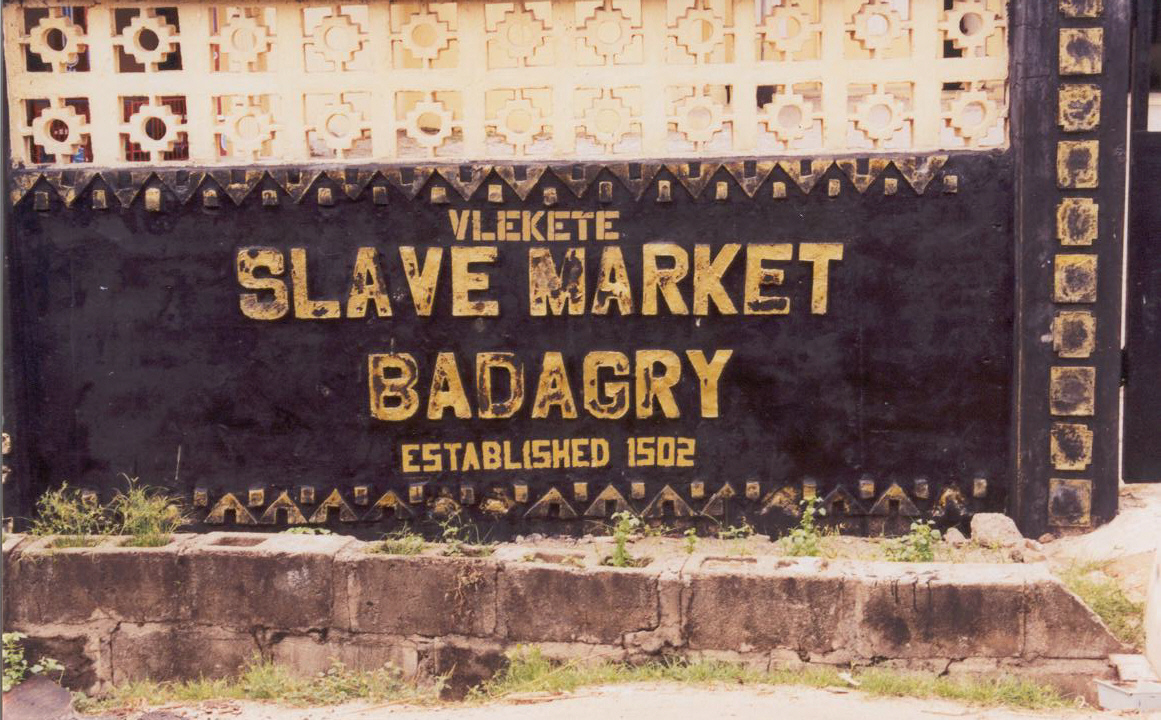
From where she may have lived, Martha's mother most likely journeyed from inland Yorubaland to the coast. And since her origins point to Nigeria, and specifically to the Yorubas, I also ask if her point of departure was Badagry? This is the largest slave market in western Nigeria, and had she come from this region, her small tiny footsteps definitely had to have trod through this area.


The town of Badagry sits on the coast of Nigeria not far from the Benin border. Signs throughout the town point to many places reflecting the history of the town as a center of slave the Nigerian slave trade. 

One can easily note that more than one family, and more than one group of people were involved in the slave trade in Badagry, a town where I have personally traveled. When I visited there in the late 1980s there was not a lot of emphasis on the town's slave history, But today, at least six different sites point to the era of the slave trade, and invite visitors and tourists to come and learn more about what happened. 

I cannot help but ask, whether Martha's mother passed through one of these places that today bring those visitors and tourists:


Did Martha's mother walk along the beach behind this wall to an unknown fate?
Badagry Slave Port


Was Martha's mother, held in a Barcoon cell similar to this one in Badagry known as the Brazilian Baracoon that held thousands before they were taken to the Americas?


And would she have been branded at this market before being placed on the vessel that would take her to an unknown future in Virginia in British North America?

Slave Market in Badagry, on the coast of Nigeria


Somehow in spite of the horrors of the unimaginable, the young girl who would become Martha's mother survived.  

Who was she, and how did she fare?
Who first enslaved her?
Did she have have any tenderness or kindness shown to her in her life?
Was her only joy to have been the mother's joy at birth when Martha was born?
And did she live to see Martha for long in her life, or was her child sold away from her?

Only a few details remain and they come through the few facts about Martha, her daughter. Martha, though born in Virginia was taken at some time from to Tennessee, enslaved by "Squire" Robert Campbell of Maury County Tennessee. Martha would give birth to several children during the 1820s. It is known that Martha and her children were living in the 1830s and would live through the Night the Stars Fell. By the 1850's some of Martha's children would be taken to Mississippi, as slaves of William "Tandy" Young, of Tippah County, in the town of Ripley. The Tennessee slave holder died and Martha's children "were taken in the draw" as the slaves in the estate were divided. Martha's children and grandchildren would live to see freedom and and the other chapters in that family line would eventually unfold.

But I still must pause and ask, who was Martha's mother?  

Who was my "Priscilla?"

* * * * *

(The African American Blogging Circle is a group of genealogy bloggers who have decided to share their family stories seen through their own lens. As the PBS Series The African Americans: Many Rivers to Cross Airs, the bloggers will be sharing their stories as seen through their own personal lens. Click here for a list of the participating bloggers.)