Thursday, February 13, 2014

Sometimes There Are No Words, But I Still Call Their Names

Slave Receipts from an Atlanta Merchant and "Negro Dealer"

Someone suggested that I look at the image above, and when I did, I was almost without words. But I did look and then I began to see them.

Recently four documents were shared on AfriGeneas, on one of the message boards. They are images of four receipts for the sale and purchase of human beings. The receipts were dated 1862. And they stood out to me, because  and even in spite of the turmoil of the Civil War, slavery was clearly a business that was still thriving in Atlanta, war or no war.

Upon closer examination, there was a lot more to be learned. These were pre-printed receipts documenting the slave of human beings by one Robert M. Clarke of Atlanta to the purchaser Joseph Silver. Pre-printed receipts where one only had to write in the name of the person being "sold" and the amount pad. How horrible and how sad, but we need to see them.

 There are so many things jump off from these four receipts that demand scrutiny. First of all, this is the first image of a pre-printed slave sales receipt that I have ever seen. Upon discussion with a genealogy friend and mentor, the first question to emerge was whether this image of the four receipts was even real. And not only was the transaction on a pre-printed, receipt,but also the name of the seller was also included as if this was from an ordinary local downtown merchant. The dealer's name on the document, was a man called Robert Clarke.
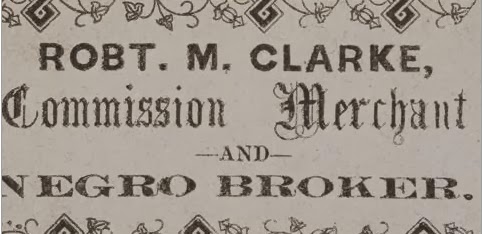
The Negro Broker Robt. M. Clarke's name appears on this pre-printed receipt

So the question arose, "Can more be learned about him?" Clearly to be a merchant and slave broker, this suggests that he might have been considered a strong business man and member of the community. So I searched for Robt. M. Clarke, and surprisingly I found such a name in a book entitled Pioneer Citizens, History of Atlanta 1833-1902.


In February of 1848 shortly after Atlanta began to organize the first city council, Robert M. Clarke's name appears when he assumed the position of city clerk. The position was held briefly by L.C. Simpson, but in February of that year, he resigned and the position was then filled by Robert M. Clarke.


Robert M. Clarke was also known in Atlanta because of a strong religious faith. In fact he became active in the first Sunday school of Atlanta, and was secretary and treasurer of the Atlanta Union Sabbath School.


Was this man of faith truly the same man who made a living in the trade of selling enslaved men, women and children? Was this human broker truly the same man who was a man of God and who established the first Sunday school in Atlanta?

Or could there have been other people in the city with the same name? 

I decided to conduct an 1860 Federal census search for Robert M. Clarke, but did not come up with anyone in Fulton County or Dekalb County Georgia, with that name. So I then decided to search for anyone called Clarke in Fulton County, and I saw the name of R. M. Clarke for Fulton County. I looked more closely and I was certain that I had located the trader Robert Clarke. The occupation was clear. Negro Trader.

Source Citation: Year: 1860; Census Place: Atlanta Ward 2, Fulton,Georgia; Roll: M653_122; Page: 748; Image: 52; Family History Library Film: 803122.


There were also no other Robert Clarkes, or R.M. Clareks in the Atlanta area. But as I was trying to find more online learn more about the document, I saw an auction house that had offered these same receipts for sale. They were were offered for sale in 2009

It appears that a large collection was possibly broken apart and each one sold separately, as I found one of the receipts sold in 2010 for $1000. It is hard to think that once again the sale of an item that reflected the slave trade made a profit for someone in the 21st century. I looked at the item from the 2010 sale it was for a slave not part of the original four receipts. This one was for a  young woman called Ann, being sold by the same dealer Robert Clarke, to the same purchaser, Joseph Silver.
Receipt for purchase of enslaved woman Ann by Joseph Silver & sold by Robert Clarke

I wondered what was happening in them middle of the Civil War that made Robert Clarke decide to sell so many slaves. 

-Was the turmoil of war making his business slower than before?  
-Was this simply business as usual? 
-Or was he selling a number of slaves in anticipation of things to come?

The transactions occurred in December 1862. Or was something else taking place that was prompting this sale of slaves? I noticed that even one of the sales occurred on Christmas Day. Perhaps the approach of January 1st was the motivation.

January 1st 1863 was significant, because that was the day that the Emancipation Proclamation was to have taken effect.  The document proclaimed freedom for all enslaved who lived in the ten states that were in rebellion. That would have included Georgia. Of course the proclamation did not mean that slave holders were going to comply. But I cannot help but ask whether these transactions were business as usual for Clarke, the Negro Trader, or was he seeing ahead and choosing to make his profit while he could and collect his funds before the eventual release of the enslaved from bondage?

I mentioned that I had to note that I was not familiar with pre-printed receipts for the sale of slaves. I have seen many bills of sale, and many ads announcing sales, but I was thrown off when I first saw Robert Clarke's receipts. But as I investigated the sale, I was surprised to come across additional pre-printed receipts as well! And the strangest thing is that these receipts also bore the name of the same purchaser--Joseph Silver.


Two additional receipts from Richmond Virginia, showing the purchase by Joseph Silver 
of two enslaved women Joane and Caroline, in February of 1861

Clearly Joseph Silver left an amazing paper trail of receipts from Richmond to Atlanta to wherever his estate may have been. He was a man who could easily spend a thousand or more when he felt he had to increase his supply of workers. I don't find him in Atlanta, and he was not a resident of Richmond. I wonder if by any chance he may have been the Joseph Silver of the Silverdale plantation in Mobile? I was surprised to see a large slave holder by that name, and even a site selling an image of the old Silver plantation in Mobile Alabama.

But before I began to study his history I had to stop myself and ask the question---- What is the story here? What is my focus?

-Is it about Robert M. Clarke the Negro trader? 
-Or was it about Joseph Silver a man who regularly purchased slaves? 
-Was it about the business which was so prolific that traders needed pre-printed receipts to keep track of their human inventory being traded?
- Or is there possibly another story?

I have chosen to end this piece with the other story. 

Though there are not facts known about them, they were the target, and apparently even into the 21st century, 150 years after their bondage officially ended, and more than a century after their death, they were still the commodities, on sale to the highest bidders. 

They were the forgotten victims that Atlanta's Sunday school founder could not see. 
They were workers who would toil endlessly for Joseph Silver, with no hope of finding family again. 
They were the men and women whom I can only hope, chose to survive.

 I want to remember them as people. I have no words to provide details about their lives. And I have no words to describe the feeling of shock and sadness when I look at those receipts. But we all need to look at them. And we need to see them and hear their names called aloud.

So, in their honor, I must call them by name, for they were more than commodities on a receipt. They were Lavenia, Simon, Dick, Irving, Ann, Joane and Caroline. 

Their dreams were deferred so long, but my hope is that they made it through the storm.


Wednesday, February 12, 2014

Little Rock Arkansas Freedman Marriages 1864-1866 (N-Z)


This is part 2 of a post from February 11th where I found some early marriages from Pulaski County of African Americans. These marriages were performed between 1864-1866. They were found in the Field Office of the Bureau of Refugees, Freedmen, and Abandoned Lands. Today's posts reflects the marriages sorted by Groom's surname with the letters N - Z.

(Surnames A - M can be found HERE. )

All images are found on the Internet Archive reflecting National Archives Publication M1901 Roll #14. This microfilm publication is part of the massive collection of data from the Freedman's Bureau, RG 105. 

For anyone who finds a marriage that interests them, I can email the full data about the Bride and Groom. For such information contact me HERE.

N


O

P

R

S

T

U

V

W

Y

Z
(No surnames with Z)


Tuesday, February 11, 2014

Little Rock, Arkansas Freedmen Marriages 1864-1866 (Surnames A - M)


One of the first acts of self determination when Freedom came to those formerly enslaved was the right to marry, a person of their own choice. Many of these men and women had considered themselves already husband and wife, but their personal relationship meant nothing when they lived in enslavement. If a slaveholder chose to sell one from one's spouse this was done with no consideration of the parties involved. So even before the end of the Civil War, as Union soldiers moved into those communities, appeals were made to those emampments where many found freedom, and one of the first duties was to employ the chaplains and to perform marriages.

The Bureau of Refugees, Freedmen and Abandoned Lands, often became the site where most of these marriage ceremonies were held. The records that remained recorded these marital union and these records are the very first records of African American marriages, even before the local courthouse welcomed black men and women. In the state of Arkansas, at the Little Rock Arkansas Freedman's Bureau, many such marriages were performed, and what follows is a list of the marriages performed. Some of the ceremonies were conducted a early as 1864, well before the war ended.

From a genealogical perspective, this data is priceless. While going through reel 18 of Arkansas Freedman's Bureau records of Pulaski County, I found several ledgers that reflected the marriages. Many of those whose marriages were recorded lived in Little Rock, but others lived in other communities such as Pine Bluff, Duvall's Bluff and even a few were recorded as residents of Ft. Smith, in the western part of the states.

This is the first half of the images of the marriages performed and recorded by the Little Rock Arkansas Field Office.
Source of documents:

National Archives Publication M1901 Roll 14, 
Little Rock Pulaski County, Register of Marriages, 1864-1866

A

B

C


D

E


F

G

H

I

J

K

L


M


M (continued)


These pages are presented merely to provide a preliminary glance at these valuable records. There is so much more data that is recorded, included ages of bride and groom, and interestingly the complexion of the parties getting married.  In addition to that, the complexion of the parents is also noted on these ledgers.


One will also note that some of the marriages recorded were those of men who were on active duty as soldiers in the US Colored Troops. 


In other cases, some of the parties that were marrying had long been married, and were in the latter years still having their marriages recorded, and several of the parties were in advanced  years.


Data on previous spouses was captured including those who had been separated. The most heart-breaking ones to see were those who were separated by the whim of the slaveholder, and simply sold away.


The list above represents the first half of the Little Rock marriages, recorded at the Field Office if Little Rock Arkansas, between 1864 and 1866. They are partial images of the marriage pages that were recorded. These are found digitized on the Internet Archive


Monday, January 20, 2014

He Extended the Hand of Friendship and I Accepted It

Meeting Colin Kelly in Arkansas in 2010
 
A man extended a hand of friendship to me, and I accepted it. 

In 2009, I received an email message from a man who lives near Tulsa Oklahoma. The message was short, and to the point. It said:

"I recently learned about you in an article in the Chronicles of Oklahoma about Jackson Crow. Nail Perry also mentioned in the article is my ancestor. I would appreciate any correspondence with you regarding the Perry family and would gladly share what I know of them." -Colin Kelley

I think after reading the message I simply said, "Wow--Nail Perry?" The name was familiar to me, because Nail Perry had testified on behalf of my gr.grandparents,Samuel and Sallie Walton when they appeared in front of the Dawes Commission. And Nail Perry was part of the Choctaw Family that had been the family where my ancestors were enslaved. Right away I replied to him, and he was gracious and kind and sharing. 

Well, In February 2010 I met this man. Was I nervous? Well yes a bit. But when I was on a trip to Arkansas, he and a cousin Dick Perry, both came to meet me. This was the first time I had been able to have such a conversation with a descendant of a slaveholder. They were both citizens of the Choctaw Nation. 

When he arrived at the home of a friend Tonia Holleman of Van Buren Arkansas, where I was staying there was a light rain. I had worried that the rain might cause him to change his mind about coming, but it did not. He drove from his home near Tulsa Oklahoma, and with him he brought some photos of his own ancestors and documents that might be of interest to me. 

We talked, we laughed and we shared. I taped part of that meeting, and I am still grateful that we had the chance to meet, and that this man truly came to the table with an outstretched hand of friendship with me. I accepted it, and truly appreciate the spirit of sharing and giving that I received. 

So,  on this day in which we remember the words and actions of Dr. King, I thought I would share my experience here in the video above. 


 ..........one day the sons of former slaves and 
the sons of former slave holders 
will be able to site down at the table of brotherhood."      

-Dr. Martin Luther King Jr. 1963-

Wednesday, January 15, 2014

"Till Justice Rolls Down Like Water..........."


Although today is not the holiday, today is his birthday.

I never met him or saw him, or heard him in person, but I was still impressed by him. And when I was a child, I was at a loss of words, I only knew he was a leader among leaders, and though I did not have the words to articulate what I saw and felt, but I was glad he was there.

I learned that he was a man of faith, word, courage, and action. He was also a son, a husband, a father, a brother, and to so many he was a leader. And as I grew, I continued to hear about him, and learned that he was making changes in the world. A movement had begun. I didn't fully understand it, and I never had the words to articulate what I was seeing, but I knew it was going on, he was part of it, and he was making a difference.

I had heard what he did in Montgomery, and I remember watching the March in 1963, on our black and white television, and I knew that changes were quickly coming. I heard my parents compare the changes that they had witnessed in their lifetime, and I also saw the transformation of a society to something different.

I was never sure how to articulate the changes that I saw--but they were there. The signs of "white" and "colored" began to disappear in my hometown, and little did I know that even in my tiny world as a child, the old order was fading.

Then the man of courage and wisdom was taken by an assassin's bullet, but yet, the movement could not be stopped. The movement was bigger than the man himself. I marveled for some time at how even his death could not stop the progress that had begun. I never had to words to articulate what had happened.

The world continued to change and still evolves. I am still baffled by many of those changes, but I finally found the right words. The words came from the same man. He was part of a movement that was destined to bring about change, because he was willing to fight "till justice Rolls down like water and righteousness like a mighty stream"

Happy Birthday, Dr. King!

Tuesday, January 14, 2014

Good Bye to Seventies Soulchild - Laura T. Lanier


Laura T. Lanier "Seventies Soulchild"

Some of us knew her only by her screen name--Seventies Soulchild.
Some of us did know her real name---and others only recognized her by her initials. But whatever she was called, we knew that she was one of the genealogy family. But today, we learned that without warning, she was gone. 

For years she graced the daily chats, on AfriGeneas, sharing information on the latest that she found on her Mississippi ancestors, or data on a new line, and all the while she was also reaching out to help others.

She was not out to build an empire or become a leader requiring followers--she merely reached out to share. She demanded no attention, demanded no support for her efforts--she gave freely, which made her friends in so many places. As she found new and useful data, she quickly shared it on her blog and would answer questions to all who inquired.

Many of us met her several years ago on AfriGeneas when she would post to the Forum and would join the daily lunch time chats. Her sense of humor and willingness to share, was always evident. She was not one, however, to accept mistreatment of herself nor of others. And if she experienced a negative, she removed herself from that environment, exited from it with dignity, even laughed about it with friends, and then, continued to give to those who asked. It would be difficult to find anyone who had a negative experience with her. It must be said that her passing has left a hole in many hearts. Her spirit was a good one, and she touched many leaving behind many friends who will truly miss her in the genealogy community.

Rest in peace Soulchild. As you now walk with the ancestors, know that those whom you touched have appreciated you, will miss you, and shall never discount what you gave to others. 

Good speed, dear soul.

Wednesday, January 8, 2014

An Ancestral Dinner The Book of Me Prompt #14

Collage representing ancestors


The Guests:

Lily Martin 

You died much too young when Tuberculosis swept the country in 1920. I look at your beautiful face and wonder what made you smile? What songs melted your heart? And what was your goal in life? I also want to know about you and your siblings, Uncle Leonard, Uncle Lem, and Aunt Viola.  Did Grandma Harriet tell you stories when you were a child and did you ever get to meet Amanda or Aunt Alice?

Council Martin
Ah, you are the silent mystery of that Martin line. You were the quiet neighbor who went courting the young lady Harriet next door whom you eventually married. What stories of the Martins did you pass to the family? Did Uncle Leonard's love of music come from you? And were you possibly a member one of the Mosaic Templars?

Sephus Bass
We almost did not find you. We heard you ran away to Texas, but thank goodness on a whim I decided to see if you were a soldier. You left so much in that pension file! You are my hero in so many ways--and your story of your escape from Nathan Bedford Forrest has amazed so many of us. And Uncle Sephus---would you believe it---I have found some of your descendants! Yes, your daughter Mary, had a daughter Josephine, and though they moved to Chicago---I later found the family living not too far away from me, in Washington DC. You would be so proud of them. One is an actor, and another one used to work for the President. Your legacy is far and wide, and we all embrace you for your courage, your sense of family, and your determination! It has defined us!

Braxton Bass
You are not forgotten. During the Civil War they saw something in you that promoted you to Sergeant. And you, like Uncle Sephus, escaped from N.B. Forrest. I am so sorry that you did not live very long, but I know that you had amazing skills as a blacksmith. And I know that your widow Fanny kept much of your own story alive as well. Because of you and Uncle Sephus and your nephews Henry and Emmanuel, a rich legacy remains.

Kitty Perry
Ah my matriarch from the Choctaw Perrys! I know you had a hard life, when they brought you from Mississippi, arriving with the Perry clan from Mississippi in 1831.  Did you ever speak about the time that the journey began? History says that the journey was made during the winter and I can imagine your heartbreak as you left those you loved and who loved you.

Did you stay with the Perrys after freedom? I guess there was not any place to go, as the old ones were long gone back in Mississippi, so Skullyville remained your home. And I suspect that you were one of those three ladies in the cabin when they came for your son, Jackson Crow. And I know that by that time, in your latter years, "Old Kit" as they sometimes called you, the heartbreak of watching the loss of your son, you eventually left this world shortly thereafter. I have looked for you in the census of 1885, and I found your daughter, but I did not see you, and know you were gone. I hope you and Jackson and Indiana, and Amanda and now Sallie and Davis are all together again, and watching over the rest of us.

Sallie Walton
Ahh the only one at this dinner whom I have actually met. I knew you and loved you, and though you left when I was a little girl, you were my heart and you are my heart still and even today I miss you. I only ask that you direct me to find some of the answers that lie buried in Skullyville, and other parts of LeFlore county Oklahoma. Just know that your imprint on my heart is still there.

Berry Young
Oh Berry---where did you go?

Amanda searched for you for so many years, and I have been looking among the soldiers for you as well. Is that your name on the Civil War monument? I know you had to leave Tippah County quickly, and could not return. I know you left right after the Yankees made their raid from Corinth. Did you join the army with the other men?

Or did you become a contraband like the others? I understand a measles outbreak took place in Corinth that year. Were you affected? I am glad that you had the courage to leave when the time came. Did father John make it back to you with warm clothes? And did son John find his way and his place? Your sacrifice did bring freedom and Amanda did manage to hold the family together after all. I wish I knew more and shall continue to search. And I know that some stories will possibly be told when I find your brother Henry Suggs. Your life made a difference and for that I am grateful.

Pleasant Barr
Ah dear sir--in spite of your own heartache, never seeing your son Bill Reed anymore, you found some solace in the last years of your life.

I can imagine how you felt looking back at your son Bill when that wagon pulled you away from Abbeyville, never to return. And being of mature age, you could not go back after freedom, but your eventual marriage to my Amanda soon after freedom helped to bring some stability to a family whose fabric had been ripped apart by war. You stepped in, and your sense of faith and your role in helping to establish St. Paul's Methodist Church in Ripley made a difference. And the church still stands today! You and Amanda and others became leaders in that small community of former slaves. And through faith you marched to a new life. Your son Elijah's story is the part still missing and but you can be glad sir, as your gr. gr. gr. grandson Melvin Collier and I both still search for Elijah's children, and are determined to find them.


St. Paul's United Methodist Church, Ripley Mississippi


Amanda Young Barr
What can be said, about the oldest ancestor I had continually heard of from childhood? My mother said many times how her grandma Harriet always spoke about "Mandy Young" of Ripley, Mississippi.

You know one day, my mom and I were at the library and she almost fainted when she picked up a book about Tippah County and saw the old slave master's name in it. She called me over, and was almost out of breath!! She heard her grandmother always talk about Tandy Young---and there his name was in a book, about Ripley Mississippi, mentioning his name! I most appreciate it that you never let the story of what happened to you, ever die. You told the story to your children and grandchildren, and they listened.

I found out that  you were the only one in all of Tippah county whose claim with the Southern Claims Commission, was approved! And you continued to work find out what happened to Berry. Because of your never ending search, I learned so much. And of course because you always told the stories, be glad that your granddaughter Frances is the one who told me about your memories of the "Night the Stars Fell". I see you now, not the slave in Mississippi, but the little girl in Tennessee awe stricken as the stars fell around her. I see your parents John and Martha, probably thinking about their own loved ones they were forced to leave behind in Virginia, when slave holders took them away. I know they were wondering if their own loved ones saw those stars falling too.

Thank you Amanda, for your steadfastness has taken me back the farthest in family history. There is still so much to learn, and know that the footprints you left behind are leading the way.


These are the guests at my ancestral dinner.


The Collage

The image at the top is a representation of the ancestors described in this piece. Some are true portraits and others are placed there symbolically. 

In the upper left corner Lily Martin appears above in an actual portrait of her made a year before she died. She is a maternal grandmother born in Mississippi who died in Arkansas. To her right is an image representing Council Martin. Born a slave in Tippah County, he died in Arkansas in the early 1900s. The next sketch represents Sephus Bass who was a Civil War soldier, and who later defended the family when attacked by night riders in Giles County Tennessee. He fled to Texas where he lived the remainder of his life. The next sketch of the Civil War soldier represents Braxton Bass, brother to Sephus. He was with the group that was captured by N.B. Forrest and who later escaped. The face of the elder lady, though unknown, represents a 4th gr. grandmother, Kitty Perry, enslaved by Choctaws, and taken to Indian Territory in 1831. Her granddaughter, was Sallie Walton,, whose actual portrait appears in the next image. Sallie, was also born a slave in the Choctaw nation, but was freed when a small child. Her life was spent mostly between Skullyville and western Arkansas where she is now buried. Berry Young was my gr. gr. grandfather. He was enlsaved by W. Tandy Young in Ripley Mississippi, and he left Ripley, when dozens of other slaves did . He left to join the Union army, but never returned, and his fate remains a mystery, but the image of the man leaving on the road with other self-emancipated slaves represents him. Pleasant Barr, was a man taken from his loved ones in South Carolina, who ended up in Mississippi. After the war, he found a new life, married my gr. gr. grandmother Amanda, and established a church that still stands today in Ripley Mississippi. The photo is an actual image of that historic church. The photo to the right of all of the others is a photo of a gr. gr. Aunt Frances Young Nelson. Her photo is there as she was a daughter to Amanda Young Barr, and some said she closely resembled her mother Amanda. So it is her face that was chosen to represent, Amanda. My Amanda was first married to Berry Kirk  Young, then to Pleasant Barr. Her search for her husband left a thick paper trail and through Amanda's telling the story of her life before and after freedom, I learned so much about this part of the family narrative. For Amanda, I am grateful that she told her story, and am honored that I have been so fortunate to have listened.